

There is a specific kind of frustration that arises when a development team receives a request that feels like a riddle. It is not the complexity of the code itself that causes the friction. It is the ambiguity of the request. In modern software delivery, the mechanism used to convey these requests is often called a story card. While the term “user story” is common, the format matters just as much as the content. Developers need clarity to build effectively. They need context to make technical decisions. They need boundaries to know when a task is finished.
This article explores what makes a story card functional for the people writing the code. We move beyond generic templates to discuss the structural elements that reduce friction and increase delivery speed. We will look at how to define work so that the engineering effort aligns with business value without unnecessary overhead.
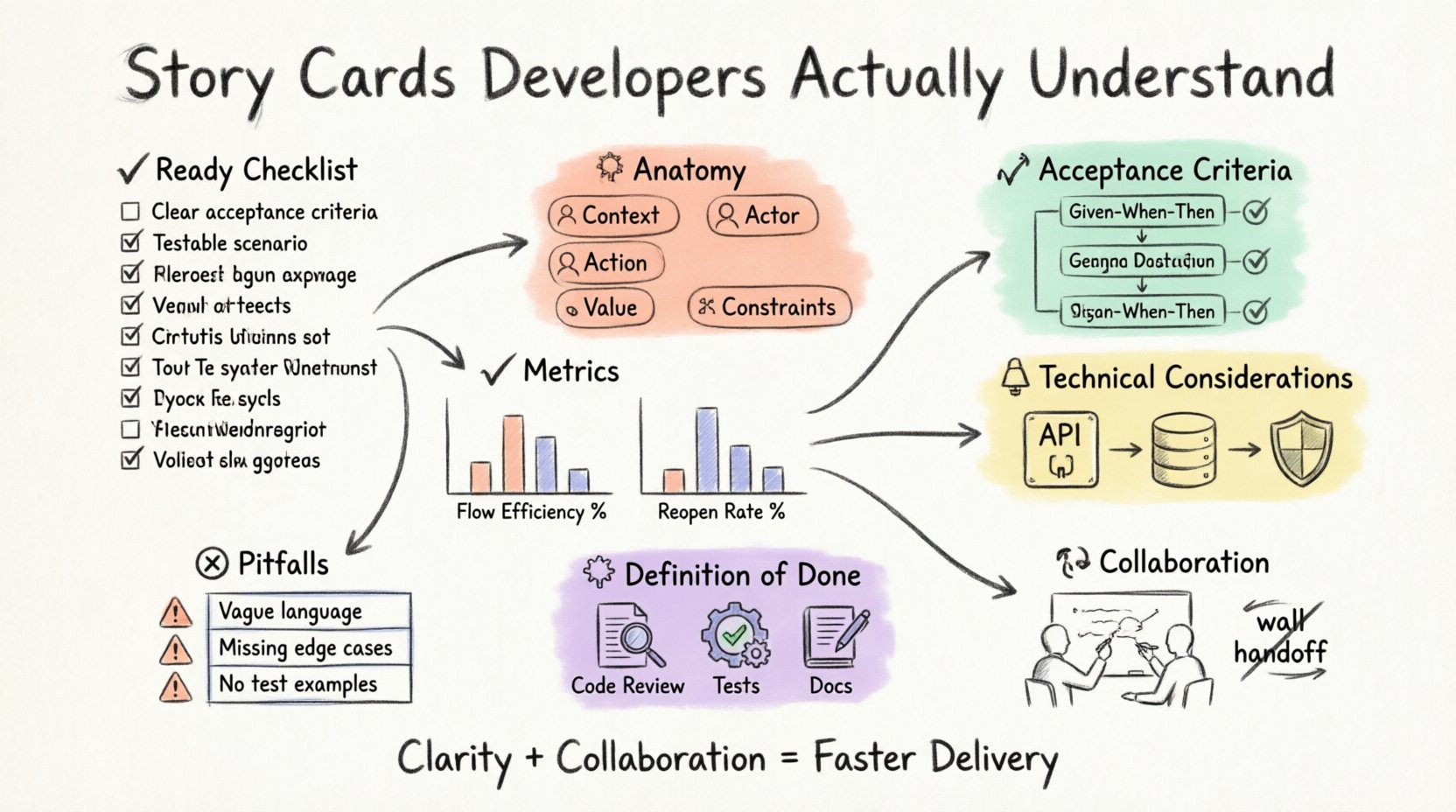
🧩 The Anatomy of a Functional Story Card
A story card is not just a task list. It is a contract between the product side and the engineering side. When this contract is vague, developers spend time guessing. When it is clear, they spend time building. A functional card contains specific components that answer the questions before they are asked.
Here are the core elements required for clarity:
- The Context: Why does this exist? What problem does it solve for the user?
- The Actor: Who is performing the action? Is it a guest, a verified user, or an administrator?
- The Action: What specific behavior is expected? This must be observable.
- The Value: What is the outcome if this works correctly?
- The Constraints: Are there technical limits, performance requirements, or compliance needs?
Without these elements, a card becomes a guessing game. Developers might implement a feature that works technically but fails to solve the intended problem. This leads to rework. Rework is the enemy of velocity.
📝 Acceptance Criteria: The Contract of Completion
Acceptance criteria are the most critical part of a story card for developers. They define the boundaries of the work. They are not a checklist for testers alone. They are instructions for the implementation. Good acceptance criteria are specific, testable, and unambiguous.
Consider the difference between a vague statement and a precise one. A vague statement says: “The user should be able to log in.” A precise statement says: “The user can enter email and password. If valid, they are redirected to the dashboard. If invalid, an error message appears below the form.”
Developers need to know the edge cases. What happens if the network fails? What happens if the input is empty? What happens if the password is too short? These details belong in the criteria section.
Key characteristics of effective acceptance criteria:
- Given-When-Then Format: This structure helps align business logic with technical logic.
- Positive and Negative Paths: Cover what works and what fails.
- Non-Functional Requirements: Mention load times or security protocols if relevant.
- Visual References: If the UI changes, link to a mockup or description.
When acceptance criteria are missing, developers create their own assumptions. Sometimes these assumptions are correct. Often, they are not. Disagreements arise during reviews, and time is lost on clarification.
🛠 Technical Considerations for Developers
Story cards often focus on the “what” and the “who.” They sometimes neglect the “how.” While developers do not need a full architecture document for every card, they do need to know the technical landscape. This prevents them from introducing debt or creating systems that break existing patterns.
Specific technical information that aids development includes:
- API Changes: Are we adding a new endpoint? Are we modifying an existing one?
- Data Structure: Does this require a new database table or a schema change?
- Dependencies: Does this feature rely on an external service?
- Security: Does this involve sensitive data or authentication changes?
- Accessibility: Are there specific screen reader or keyboard navigation requirements?
When these details are documented upfront, the developer can plan the implementation strategy. They can allocate time for database migrations. They can prepare unit tests for the new logic. They can estimate the effort more accurately.
🔄 Collaboration vs. Handoff
Traditional workflows often treat story cards as a handoff mechanism. The product team writes the card and throws it over the wall. The engineering team picks it up and builds it. This model creates silos. It creates a delay in feedback. It creates a disconnect between the intent and the execution.
Modern best practices suggest a collaborative approach. Developers should be involved in the refinement phase. This is the stage where the card is discussed before it is considered ready for work.
Benefits of early collaboration:
- Feasibility Checks: Developers can identify technical blockers early.
- Estimation Accuracy: Teams can size the work based on shared understanding.
- Shared Ownership: Everyone understands the goal, not just the implementer.
- Reduced Rework: Ambiguities are resolved before coding begins.
This does not mean developers need to write every word. It means they need to review the criteria and ask questions. If a requirement is unclear, the card should not be started. The cost of clarification during coding is ten times higher than clarification during planning.
📊 The Definition of Done
A story card is not complete when the code is written. It is complete when it meets the Definition of Done (DoD). The DoD is a shared agreement within the team about what quality looks like. It applies to every card, regardless of the feature.
Common elements of a Definition of Done include:
- Code Review: A peer has reviewed the changes.
- Tests Passed: Automated tests run successfully.
- Documentation Updated: Internal docs or external help guides are current.
- Performance Standards: The feature meets speed requirements.
- Deployment Ready: The code can be merged to the main branch.
Without a DoD, “done” becomes subjective. One developer might think code is done. Another might think testing is needed. This leads to inconsistent quality. It leads to bugs in production.
🚫 Common Pitfalls to Avoid
Even with good intentions, story cards can fail. Common mistakes include over-specification, under-specification, and lack of prioritization. Below is a table comparing common issues with their impact on development.
| Pitfall | Impact on Developer | Result |
|---|---|---|
| Micro-Management | Developers feel like order-takers. | Reduced creativity and morale. |
| Vague Goals | Unclear requirements lead to rework. | Missed deadlines and frustration. |
| Ignoring Technical Debt | Shortcuts are taken to meet dates. | System instability over time. |
| One-Way Communication | Questions go unanswered. | Delays in progress. |
| Missing Edge Cases | Unhandled errors cause crashes. | Production incidents. |
Avoiding these pitfalls requires discipline. It requires the product side to respect the engineering side. It requires the engineering side to communicate constraints clearly. It is a two-way street.
📈 Measuring Success
How do you know if your story cards are working? You look at the flow of work. You look at the quality of the output. You look at the sentiment of the team.
Metrics to consider:
- Flow Efficiency: How much time does a card spend waiting vs. being worked on?
- Reopen Rate: How often is a card reopened due to defects?
- Estimation Accuracy: Does the actual time match the estimated time?
- Blocker Frequency: How often do developers get stuck due to unclear requirements?
If the reopen rate is high, the acceptance criteria were likely insufficient. If the estimation accuracy is low, the scope was likely misunderstood. These metrics provide feedback on the quality of the story cards themselves.
🔍 Refinement: The Continuous Process
Story cards are not static. They evolve. As development begins, new information may emerge. This is normal. The process of refinement ensures the card remains accurate.
Refinement sessions should be regular. They should not be a surprise before a sprint. They should be a continuous activity. During these sessions, the team breaks down large stories into smaller, actionable items. Large stories are difficult to estimate and manage. Small stories provide faster feedback.
When a story is too big, it creates risk. If something goes wrong, the impact is large. If the story is small, the impact is contained. Breaking down work is a key skill for maintaining a healthy delivery pipeline.
💡 Technical Debt and Story Cards
Technical debt is often hidden. It accumulates when shortcuts are taken. Story cards can help manage debt by including tasks specifically for maintenance. Sometimes, a story card should not be a new feature. It should be a refactor.
Refactoring cards look different from feature cards. They focus on code structure, not user behavior. They might say: “Improve the load time of the search page.” They do not require a new UI element. They require code changes.
Ignoring technical debt leads to slow velocity over time. Features take longer to build. Bugs become harder to find. Including debt reduction in the regular flow of work prevents the system from becoming unmaintainable.
📝 Checklist for Ready Cards
Before a developer starts work, the card should pass a quick check. This ensures the team does not waste time on incomplete work. Use this checklist to verify readiness:
- ☐ Is the background context clear?
- ☐ Are the acceptance criteria testable?
- ☐ Are edge cases defined?
- ☐ Are design assets linked or attached?
- ☐ Are dependencies identified?
- ☐ Is the scope limited to a single outcome?
- ☐ Have security implications been considered?
- ☐ Is the priority clear?
If the answer to any of these is no, the card is not ready. It should be sent back for refinement. This gatekeeping protects the development time. It ensures that when coding starts, the path is clear.
🤝 The Role of Empathy
Writing a good story card requires empathy. It requires understanding the mind of the developer. It requires knowing what information they need to feel confident in their work.
Developers are problem solvers. They want to solve the right problem. They do not want to waste time on the wrong solution. When you write a card, you are setting them up to succeed. You are removing obstacles. You are providing the map so they can build the road.
This empathy extends to the team dynamics. It extends to the tools used. It extends to the language chosen. Clear language reduces cognitive load. When the text is easy to read, the mind is free to focus on the logic.
🏁 Final Thoughts
The quality of the code is often a reflection of the quality of the requirements. If the instructions are unclear, the result will be unclear. If the instructions are detailed and thoughtful, the result will be robust.
Story cards are the primary vehicle for this communication. They are not just administrative tasks. They are the foundation of collaboration. By investing time in writing them well, you invest in the speed and stability of the entire delivery process.
Focus on clarity. Focus on completeness. Focus on the developer experience. When you do this, you create an environment where engineering can thrive. You create a workflow that supports innovation rather than hindering it.