
Understanding the macroeconomic landscape is not optional for modern business strategy. It is a fundamental requirement for survival. When conducting a SWOT analysis, the Threats quadrant often feels the most volatile. While competitive moves and operational risks are visible, economic shifts can arrive like fog, obscuring visibility and altering the terrain overnight.
This guide explores how to identify economic trends that transform into business threats. We will examine specific indicators, analyze their direct impact on organizational stability, and provide a framework for integrating these findings into your strategic planning without relying on proprietary tools.
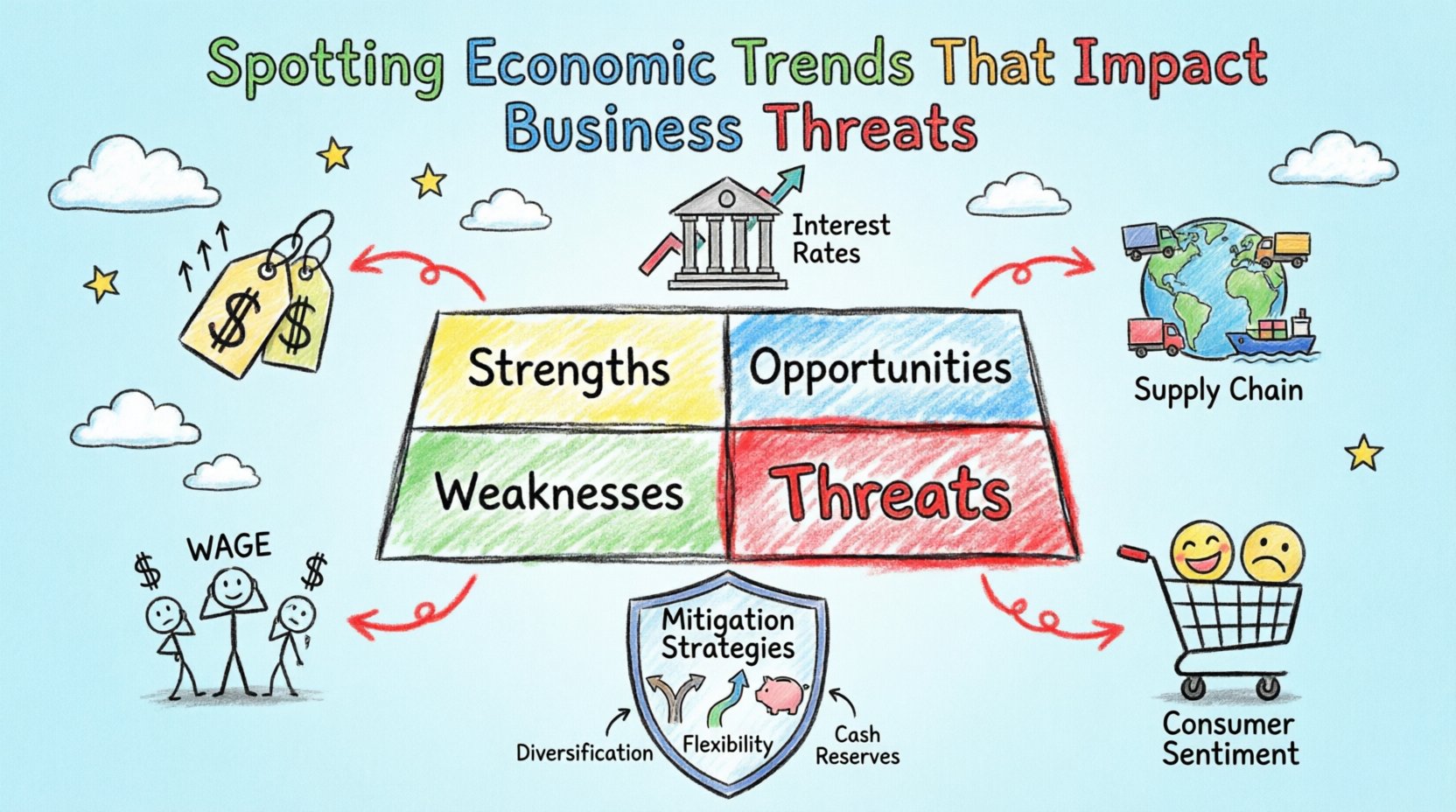
1. The Foundation: SWOT and the External Environment 🏗️
A SWOT analysis is a static snapshot of a dynamic situation. The Strengths and Weaknesses are internal. The Opportunities and Threats are external. Economic trends belong squarely in the external category. They are forces that exist outside the organization’s control but dictate the conditions under which the organization operates.
- Strengths: What does the business do better than others?
- Weaknesses: Where are the internal gaps?
- Opportunities: Favorable external conditions to exploit.
- Threats: External challenges that could jeopardize performance.
Economic trends often blur the line between Opportunity and Threat. High interest rates might be a threat for a capital-intensive expansion plan, yet an opportunity for a cash-rich lender. The key lies in your specific business model and risk tolerance.
2. Inflation and Cost Structures 💸
Inflation is the most pervasive economic indicator affecting daily operations. It represents the rate at which the general level of prices for goods and services is rising. For businesses, this is rarely a simple metric; it is a complex pressure point affecting margins, pricing power, and consumer behavior.
Direct Impacts on Threats
- Input Cost Volatility: Raw materials, energy, and logistics costs rise. If these costs cannot be passed to the customer, profit margins compress immediately.
- Pricing Power Limits: In a competitive market, raising prices to match inflation may lead to customer churn. This creates a threat to market share.
- Inventory Valuation: Holding inventory becomes riskier if prices drop after purchase, or if demand shifts due to purchasing power erosion.
- Wage Pressures: Employees demand higher wages to match the cost of living, increasing operational overhead.
When analyzing inflation in a SWOT context, consider the lag time. Contractual agreements may lock in costs for a period, providing a temporary shield, while spot market costs spike immediately. This discrepancy creates a specific window of financial threat.
3. Interest Rate Fluctuations and Capital Access 🏦
Central bank policies dictate interest rates. These rates serve as the cost of borrowing money. Changes in rates ripple through the entire economy, affecting everything from mortgage rates to corporate bond yields.
Key Threat Vectors
- Debt Servicing Costs: For businesses with variable-rate debt, rising rates increase monthly payments, straining cash flow.
- Reduced Valuation: Higher discount rates lower the present value of future cash flows, impacting company valuation and M&A potential.
- Capital Expenditure Delays: Projects that rely on financing may be shelved. This slows growth and allows competitors to capture market share.
- Consumer Durables Demand: High rates discourage large purchases like vehicles or real estate, threatening businesses in those sectors.
A business with low debt levels may view high rates as a neutral factor, whereas a highly leveraged entity faces an existential threat. The SWOT analysis must reflect the specific leverage profile of the organization.
4. Supply Chain Volatility and Global Trade 🌍
Globalization has created efficiency, but it has also introduced fragility. Geopolitical tensions, trade tariffs, and logistical bottlenecks are economic trends driven by policy and conflict.
Identifying the Risks
- Sourcing Concentration: Relying on a single region for critical components creates a single point of failure.
- Currency Exchange Rates: Fluctuations can make imports suddenly more expensive or exports less competitive.
- Regulatory Compliance: New trade policies may require costly adjustments to logistics or product specifications.
- Lead Time Extensions: Delays disrupt production schedules, leading to stockouts and delayed deliveries.
Monitoring trade policy changes is essential. A tariff imposed on a specific material can instantly turn a profitable product line into a threat to overall profitability.
5. Labor Market Dynamics and Workforce Costs 👥
The labor market is an economic ecosystem. Unemployment rates, participation rates, and wage growth data provide signals about the availability and cost of human capital.
Strategic Implications
- Talent Scarcity: Low unemployment rates mean harder recruitment. This threatens growth targets if roles remain vacant.
- Turnover Rates: High demand for workers increases turnover. Replacing talent incurs hidden costs in training and lost productivity.
- Automation Pressure: High labor costs may force a threat of disruption: competitors automate while you do not.
- Remote Work Policies: Economic shifts regarding remote work affect real estate costs and geographic hiring pools.
When labor becomes expensive, the threat is not just to the bottom line, but to the ability to execute strategy. A plan to expand operations may be rendered unfeasible if the necessary workforce cannot be secured.
6. Consumer Sentiment and Demand Shifts 🛒
Economic health is often measured by how people feel about it. Consumer confidence indices predict spending habits. If consumers feel insecure about the future, they save rather than spend.
Threat Indicators
- Discretionary Spending Decline: Non-essential products face the highest risk during downturns.
- Brand Loyalty Erosion: Consumers switch to cheaper alternatives when budgets tighten.
- Inventory Bloat: Overestimating demand leads to excess stock, requiring write-downs.
- Payment Delays: In B2B sectors, if your clients face cash flow issues, your receivables become a threat.
Understanding the elasticity of demand is crucial. Some goods are inelastic (necessary), while others are elastic (luxury). Economic trends impact elastic goods more severely.
7. Mapping Trends to SWOT Threats 🗺️
To integrate these concepts effectively, you must categorize economic data into actionable threat statements. The following table demonstrates how specific indicators translate into SWOT components.
| Economic Indicator | Business Impact | SWOT Threat Classification |
|---|---|---|
| Rising CPI (Consumer Price Index) | Increased cost of goods sold | Margin Compression |
| Interest Rate Hikes | Higher debt servicing costs | Liquidity Risk |
| Trade Tariffs | Import cost increases | Supply Chain Disruption |
| High Unemployment | Lower consumer spending power | Market Contraction |
| Strong Currency | Export competitiveness drops | Revenue Decline |
| Low Unemployment | Wage inflation | Operational Cost Increase |
8. Establishing a Monitoring Framework 📡
Identifying threats is only half the battle. You need a system to track them continuously. This does not require expensive software suites, but rather a disciplined process of data collection and review.
Core Components of Monitoring
- Government Reports: Review monthly releases from central banks and labor bureaus.
- Industry Newsletters: Subscribe to trade publications that analyze sector-specific economic data.
- Competitor Analysis: Watch how competitors adjust pricing or operations in response to economic shifts.
- Customer Feedback: Direct inquiries about budget constraints can reveal demand shifts before data appears.
- Financial Ratios: Track internal metrics like Days Sales Outstanding (DSO) to spot early signs of economic stress.
Set thresholds. For example, if raw material costs rise by 10% in a quarter, trigger a mandatory strategic review. This moves the analysis from reactive to proactive.
9. Common Pitfalls in Economic Forecasting ⚠️
Even with robust data, analysts make mistakes. Avoiding these errors ensures the accuracy of your threat assessment.
- Assuming Linearity: Economic trends are rarely straight lines. A V-shaped recovery differs vastly from a L-shaped stagnation. Avoid assuming past trends will continue indefinitely.
- Ignoring Lag Effects: Policy changes take time to filter through the economy. A rate hike today may impact hiring decisions in six months.
- Confirmation Bias: Focusing only on data that supports a desired outcome. Actively seek data that contradicts your assumptions.
- National vs. Local: National GDP growth does not guarantee local market health. Regional economic disparities are common.
- Overlooking Black Swans: Rare, unpredictable events can override all standard economic models. Maintain contingency plans for extreme scenarios.
10. Mitigation Strategies Without Tools 🛡️
Once threats are identified, how do you respond? The response must be structural and operational, not dependent on a specific platform.
- Diversification: Expand supplier bases to reduce reliance on single regions. Diversify customer segments to spread risk.
- Flexibility: Adopt variable cost structures where possible. Shift from fixed leases to flexible arrangements.
- Efficiency: Invest in process improvements that lower the cost base, providing a buffer against inflation.
- Reserves: Maintain cash reserves to weather periods of tight credit or low revenue.
- Communication: Keep stakeholders informed. Transparency builds trust during uncertain economic times.
11. Case Scenarios: Applying the Framework 📝
Let us apply this to two hypothetical scenarios to illustrate the application.
Scenario A: Manufacturing Sector
Context: A mid-sized manufacturer relies on imported steel.
Economic Trend: Rising interest rates and strong domestic currency.
Threat Analysis:
- Cost: Strong currency helps import costs, but high rates increase the cost of machinery financing.
- Demand: High rates may reduce construction activity, lowering demand for steel products.
- SWOT Action: Hedge currency exposure. Lock in fixed-rate financing for equipment. Reassess pricing models to account for slower demand.
Scenario B: Retail Sector
Context: A chain of consumer electronics stores.
Economic Trend: High inflation and stagnant wage growth.
Threat Analysis:
- Cost: Inventory costs rise due to supplier inflation.
- Customer: Disposable income shrinks. Electronics are often delayed purchases.
- SWOT Action: Shift focus to essential repairs or high-demand durable goods. Negotiate extended payment terms with suppliers to manage cash flow.
12. The Role of Leadership in Economic Analysis 🎓
Leadership cannot outsource economic vigilance. The executive team must understand the macro environment to make informed decisions.
- Educate the Board: Present economic risks alongside financial results during board meetings.
- Encourage Debate: Create a culture where challenging assumptions based on economic data is welcomed.
- Long-Term Vision: Ensure short-term economic noise does not derail long-term strategic goals.
When leadership treats economic trends as a core part of the business conversation, the organization becomes more resilient. The threat of the unknown is reduced when the known is actively managed.
13. Integrating into the Annual Review 🔄
Economic analysis should not be a one-time event. It must be woven into the annual planning cycle.
- Q1 Review: Assess the previous year’s economic assumptions. Did they hold true?
- Q2 Planning: Adjust budgets based on current inflation and interest rate forecasts.
- Q3 Monitoring: Check for emerging trends that were not present in Q1.
- Q4 Strategy: Refine the SWOT analysis for the upcoming fiscal year based on the full year’s data.
This cyclical approach ensures that the SWOT analysis remains a living document rather than a static artifact.
14. Future-Proofing the Analysis 🔮
Economic landscapes evolve. Climate change, digitalization, and demographic shifts are creating new economic variables.
- ESG Factors: Environmental regulations can impose new costs or open new markets.
- Digital Adoption: Automation can alter labor cost structures permanently.
- Demographics: Aging populations affect labor supply and consumer demand profiles.
Incorporating these long-term trends into your threat assessment ensures the business remains relevant in a changing world.
15. Final Summary of Best Practices ✅
- Monitor leading indicators like consumer confidence and PMI.
- Connect macro data to specific internal financial metrics.
- Update the SWOT analysis quarterly, not just annually.
- Focus on actionable threats, not just general economic warnings.
- Maintain cash reserves to handle volatility.
- Communicate risks clearly to all stakeholders.
Economic trends are inevitable. Business threats arising from them are manageable. By treating economic intelligence as a core competency, organizations can navigate uncertainty with precision. The goal is not to predict the future perfectly, but to prepare for multiple futures effectively.