

In the landscape of agile product development, epics represent significant bodies of work that deliver substantial value. However, treating an epic as a single unit of execution often leads to delays, unclear requirements, and missed opportunities for feedback. The practice of splitting large epics into smaller story cards is essential for maintaining velocity and ensuring continuous delivery. This guide explores the methodologies, principles, and practical steps required to break down complex initiatives into manageable, testable, and valuable units of work.
🧩 Understanding the Epic-Story Relationship
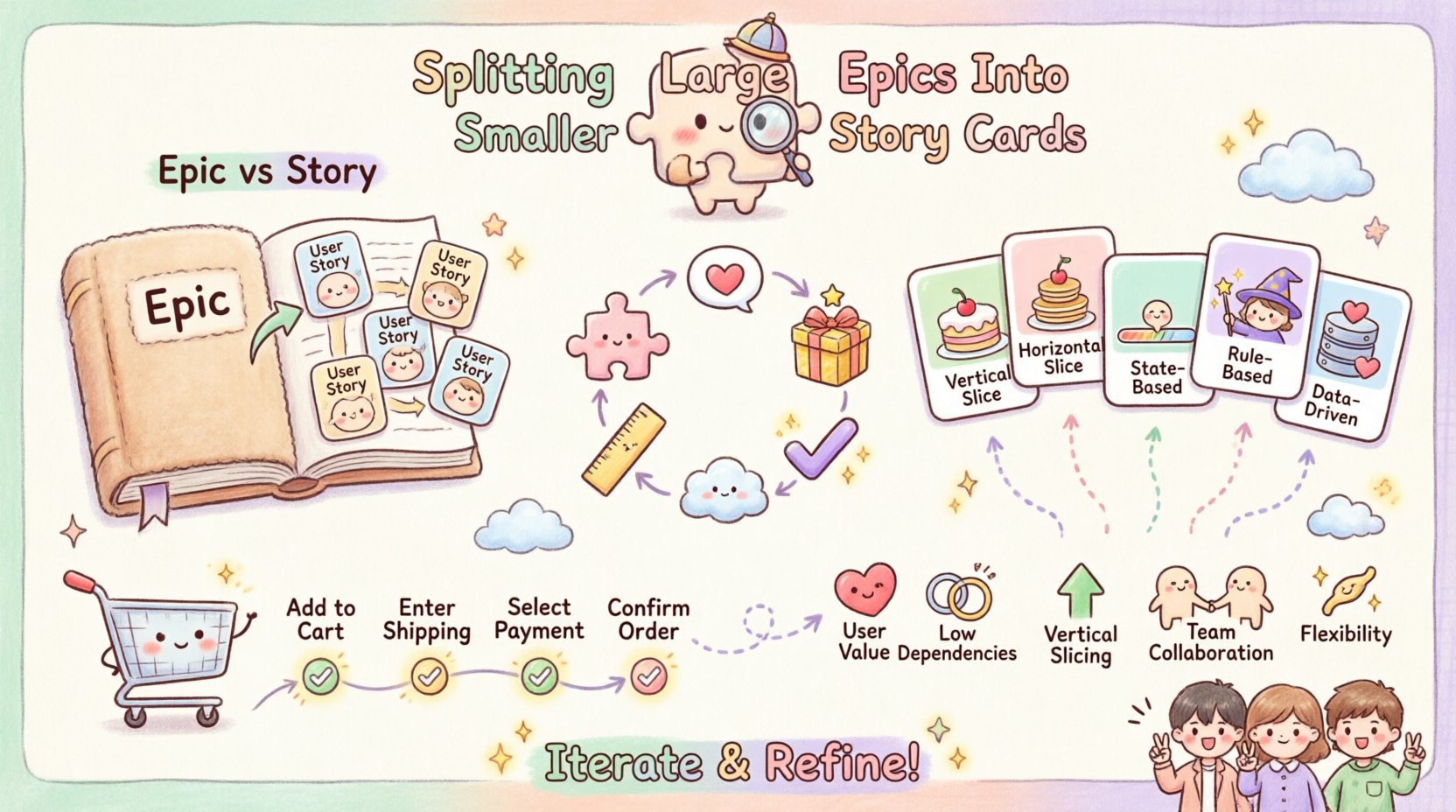
Before diving into the mechanics of splitting, it is crucial to define the hierarchy. An epic is typically a large feature or capability that is too big to be completed within a single sprint. It serves as a container for multiple user stories. A user story, conversely, is a small, independent unit of work that can be completed, tested, and delivered within a short timeframe.
Think of an epic as a book and the user stories as individual chapters. You cannot read the entire book in one sitting if it is too dense; you need to process it chapter by chapter. Similarly, a team cannot deliver an epic all at once without risking overwhelming complexity.
Why Size Matters
- Predictability: Smaller items allow for more accurate estimation. When work is too large, the uncertainty grows exponentially.
- Feedback Loops: Smaller stories can be released faster, enabling the team to gather user feedback sooner.
- Risk Reduction: Complex features often hide hidden dependencies. Breaking them down exposes these risks early in the cycle.
- Morale: Completing small, tangible tasks provides a sense of accomplishment and momentum for the team.
📐 Principles of Effective Splitting
Not every split is a good split. Arbitrary fragmentation can lead to overhead and context switching. To split effectively, teams should adhere to established criteria. The INVEST model is the industry standard for evaluating user stories.
The INVEST Criteria
Each story card should ideally meet these characteristics:
- Independent: The story should not rely on another story to be delivered, minimizing dependencies.
- Negotiable: The details are open for discussion, allowing flexibility in implementation.
- Valuable: The story must deliver value to the end user or the business immediately.
- Estimable: The team must be able to size the effort required to complete the work.
- Small: The work must be small enough to be completed within a single sprint.
- Testable: There must be clear acceptance criteria to verify the story is complete.
🛠 Techniques for Breaking Down Epics
There are several strategic approaches to splitting work. The right technique depends on the nature of the feature and the current priorities of the product. Below are the most effective methods.
1. Vertical Slicing (Value-Driven)
This is the preferred method for agile teams. Vertical slicing involves delivering a thin slice of functionality that works from the user interface down to the database. It provides end-to-end value, even if it is not the full feature.
- Example: Instead of building the entire checkout system (database, UI, payment gateway) at once, build the ability to add an item to the cart and view it.
- Benefit: Delivers immediate user value and validates the architecture early.
2. Horizontal Slicing (Layer-Based)
Horizontal splitting separates work by technical layer. For example, one story handles the database schema, another handles the API, and a third handles the front-end UI. While this helps with technical debt, it often delays value delivery.
- Example: Story A creates the table. Story B creates the API endpoint. Story C builds the form.
- Caution: Avoid this unless the team lacks the skills to deliver vertical slices or there is a specific technical milestone.
3. State-Based Splitting
Features often have different states. You can split work by the progression of an item through these states.
- Example: In a task management system, one story handles creating a task, another handles editing it, and a third handles archiving it.
4. Rule-Based Splitting
If a feature has complex business rules, split the work by the complexity of the rule.
- Example: A discount engine might have stories for standard discounts, percentage-based discounts, and bulk purchase discounts.
5. Data-Driven Splitting
When a feature relies on data volume, split the work based on data sets.
- Example: One story processes data from region A, another from region B.
📊 Comparison of Splitting Techniques
| Technique | Focus | Best Used When | Primary Benefit |
|---|---|---|---|
| Vertical Slicing | End-to-End Value | Standard Agile Delivery | Fast Feedback & Value |
| Horizontal Slicing | Technical Layers | Infrastructure Overhauls | Technical Clarity |
| State-Based | Lifecycle Phases | Workflow Management Systems | Clear Progression |
| Rule-Based | Business Logic | Complex Calculation Engines | Manageable Complexity |
📝 A Detailed Case Study: E-Commerce Checkout
To illustrate these concepts, consider an epic titled “Implement Secure Checkout Process.” This is too large to start development immediately. Here is how we might split it.
The Epic
Title: Implement Secure Checkout Process
Goal: Allow users to purchase items online securely.
Story 1: Guest Checkout (Vertical Slice)
- As a guest user,
- I want to enter shipping details without creating an account,
- So that I can purchase quickly without friction.
Acceptance Criteria: User can enter name, address, and card details. System processes payment. Confirmation email sent.
Story 2: Registered User Checkout
- As a registered user,
- I want to auto-fill my shipping and billing information,
- So that the process is faster for repeat purchases.
Acceptance Criteria: Logged-in user sees saved address. User can select from dropdown.
Story 3: Gift Options
- As a purchaser,
- I want to add a gift message and disable price printing,
- So that the recipient sees a pleasant surprise.
Story 4: Tax Calculation
- As a buyer,
- I want to see accurate tax based on location,
- So that I know the final cost before paying.
By splitting this way, the team can deliver Story 1 first. This validates the payment gateway integration and the core flow. Stories 2, 3, and 4 can follow in subsequent sprints, refining the experience based on real usage data from Story 1.
🤝 Collaboration During Splitting
Splitting work is not a solitary task performed by a product manager in isolation. It requires collaboration. The team that will do the work must understand the technical constraints and effort involved.
Refinement Sessions
Hold regular backlog refinement sessions. Use these meetings to discuss potential splits. Ask the developers:
- Where are the technical risks?
- Are there shared components that need to be built first?
- Can this be delivered in two chunks?
The Three Amigos
For each story, ensure a conversation between three roles: Product (What), Development (How), and QA (Verification). This trio ensures that the split story is testable and feasible.
⚠️ Common Pitfalls to Avoid
Even with the best intentions, teams can make mistakes when breaking down work. Awareness of these pitfalls helps maintain quality.
1. Over-Splitting
Creating stories that are too small leads to excessive overhead. If a story takes only 2 hours to complete, the team spends more time managing tickets than coding. Aim for stories that take 1 to 3 days of effort.
2. Ignoring Dependencies
Splitting one feature into two stories might create a hard dependency where Story B cannot start until Story A is deployed. Try to make stories independent or identify the dependency early.
3. Neglecting Acceptance Criteria
A story without clear acceptance criteria is not a story; it is a task. Ensure every split item has a definition of done.
4. Focusing Only on Features
Sometimes splitting reveals non-functional requirements. If a split story requires performance tuning, that is a valid story. Do not ignore technical debt or security requirements.
📏 Measuring the Quality of a Split
How do you know if your splitting strategy is working? Look at the following metrics during retrospectives.
- Sprint Completion Rate: Are teams finishing the stories they commit to? If not, the stories might be too big.
- Lead Time: Is the time from idea to deployment decreasing? Smaller stories usually flow faster.
- Change Frequency: Are you deploying changes more often? This indicates successful vertical slicing.
🔄 The Iterative Nature of Splitting
Splitting is not a one-time event. As the team learns more about the requirements or the technology, the plan may change. An epic that seemed clear at the start might reveal new complexities during the first sprint. This is normal. Be prepared to re-evaluate and split further if necessary. This adaptability is a core strength of agile methodologies.
🎯 Definition of Done for Split Stories
Every story card, regardless of size, must meet the Definition of Done. This ensures that partial completion does not accumulate technical debt.
- Code Review: Peer review completed.
- Testing: Unit tests and integration tests passing.
- Documentation: Updated in the knowledge base.
- Deployment: Deployed to the staging or production environment.
- Security: Security scan passed.
🧠 Summary of Best Practices
To maintain high velocity and quality, keep these principles in mind:
- Start with the user value: Always ask, “What does the user get from this specific slice?”
- Keep dependencies low: Independent stories flow better.
- Use vertical slicing: Deliver working software as early as possible.
- Involve the team: Developers and testers provide critical input on effort and risk.
- Stay flexible: Adjust the split based on new information.
🙋 Frequently Asked Questions
Q: How small is too small?
A story that takes less than half a day to complete may be too granular. It creates too much administrative overhead. Aim for stories that fit within a sprint but are substantial enough to warrant a full day of focused work.
Q: Can an epic be split into tasks instead of stories?
Yes, but tasks are usually technical steps required to complete a story. An epic should be split into stories first. Tasks are derived from the stories during sprint planning.
Q: What if the epic is dependent on an external vendor?
Split the work based on what you control. Create stories for the parts of the integration you can build, and use spikes or technical stories to investigate the vendor’s API. Do not block the entire epic on the vendor’s timeline if possible.
Q: Should we split by module or by user flow?
Split by user flow. Module-based splitting often leads to horizontal slicing, which delays value. User flow splitting ensures that every release provides a usable piece of functionality.
🌟 Final Thoughts
Splitting large epics into smaller story cards is a fundamental discipline in product delivery. It transforms overwhelming complexity into a series of achievable goals. By focusing on value, maintaining independence, and collaborating closely with the development team, organizations can ensure steady progress and high-quality outcomes. This approach does not just manage work; it manages risk and maximizes the return on investment for every line of code written. With the right techniques and a commitment to continuous refinement, teams can navigate even the most ambitious projects with confidence and clarity.