Service design is the intentional planning of how services are delivered to customers. It is not merely about aesthetics or individual touchpoints; it is about the entire ecosystem of interactions that define a relationship between a provider and a user. At the heart of this discipline lies the customer journey map. This visual artifact serves as a shared understanding of the experience, revealing friction points, emotional highs and lows, and opportunities for improvement.
Creating a robust journey map requires a shift in perspective. Instead of viewing a service through the lens of internal processes, teams must adopt the customer’s viewpoint. This guide explores the fundamentals of service design and the methodology for mapping the customer experience effectively.
Understanding Service Design 🛠️
Service design is a holistic approach. It considers every element of a service, from the physical environment to the digital interface, and from the initial contact to the post-service follow-up. It treats the service as a system where every component influences the others.
When we talk about service design, we are discussing:
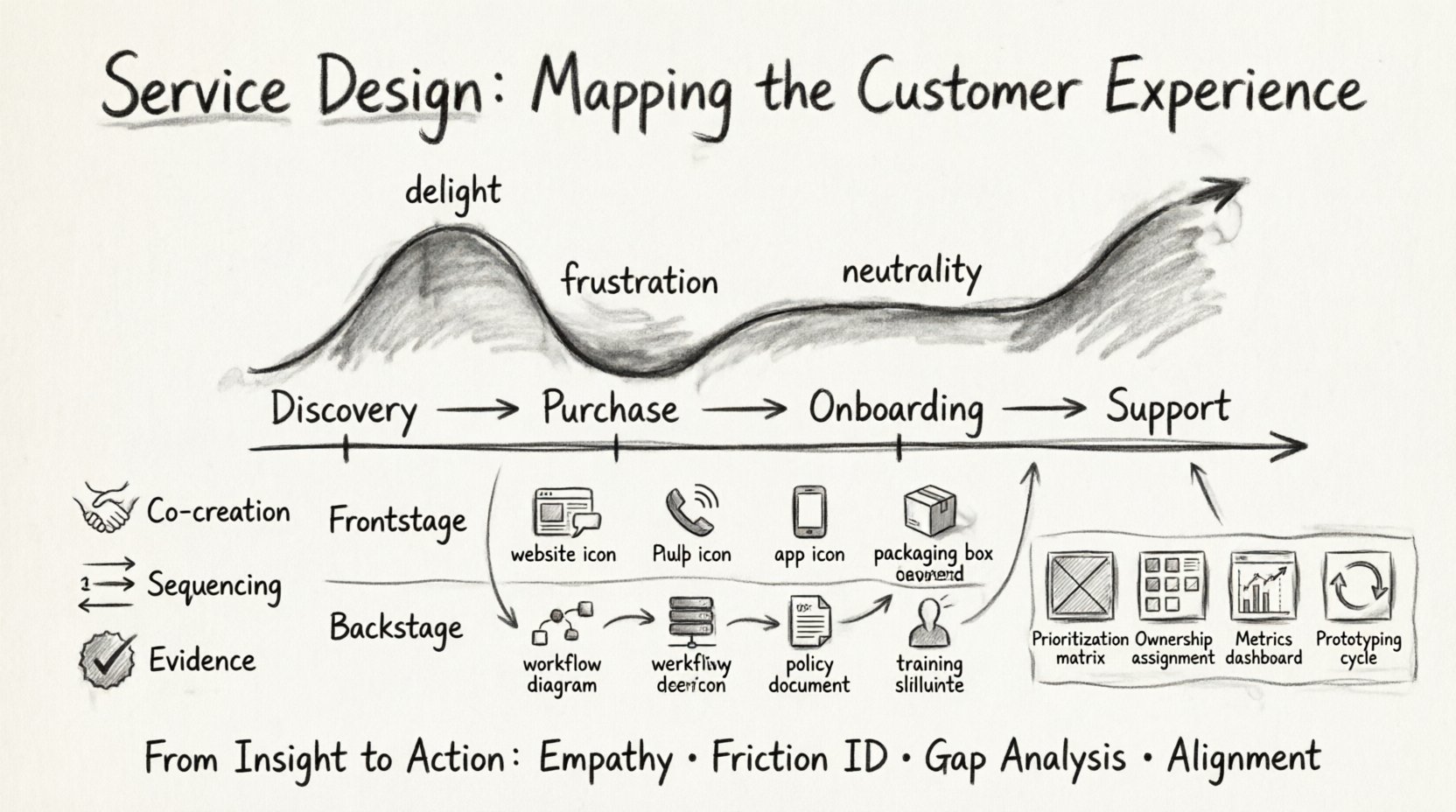
- Co-creation: Involving stakeholders, including customers, in the design process.
- Sequencing: Organizing actions and interactions in a logical order.
- Evidence: The physical or digital proof points that confirm the service has occurred.
- Frontstage: What the customer sees and experiences directly.
- Backstage: The internal processes and support required to deliver the frontstage experience.
Without a clear map of the journey, service design efforts often become disjointed. Different departments may optimize their specific silos without considering the impact on the overall flow. A journey map bridges these gaps.
The Purpose of Customer Journey Mapping 🧭
Why invest time in mapping the customer journey? The primary goal is alignment. A journey map acts as a single source of truth for the organization.
Key benefits include:
- Empathy Building: It forces teams to walk in the customer’s shoes, identifying emotional states that data alone cannot reveal.
- Friction Identification: It highlights moments where the process becomes confusing, slow, or frustrating.
- Gap Analysis: It reveals the difference between the ideal experience and the current reality.
- Stakeholder Alignment: It provides a visual reference that marketing, product, operations, and support teams can all discuss.
This is not a one-time exercise. As services evolve, the journey changes. The map must be a living document that reflects the current state of the service.
Core Components of a Journey Map 📋
A comprehensive map consists of specific layers. Each layer adds depth to the understanding of the interaction. The following table outlines the essential elements.
| Component | Description | Example |
|---|---|---|
| Phases | High-level stages of the journey. | Discovery, Purchase, Onboarding, Support. |
| Actions | Specific tasks the user performs. | Clicks “Sign Up”, Reads Terms, Contacts Support. |
| Touchpoints | Channels or interfaces used. | Website, Email, Phone Call, Mobile App. |
| Emotions | How the user feels at each step. | Excited, Confused, Frustrated, Satisfied. |
| Opportunities | Areas for improvement. | Reduce form fields, Add chatbot support. |
Each component must be grounded in research. Assumptions can lead to maps that do not reflect reality. User interviews, analytics, and observation are necessary to populate these fields accurately.
Preparing for the Mapping Session 🚶
Before drawing any lines or placing icons, preparation is critical. A successful mapping session relies on the right participants and the right data.
Key preparation steps include:
- Define the Scope: A journey can be massive. Narrow the focus to a specific service or scenario. For example, map the “First Purchase” journey rather than the “Lifetime Customer” journey.
- Identify the Persona: Who is experiencing this service? Different personas may have different journeys. Create a detailed profile representing the target user.
- Gather Data: Collect qualitative and quantitative data beforehand. Look at support tickets, survey results, and session recordings.
- Assemble the Team: Include cross-functional members. Marketing knows the messaging, operations knows the constraints, and support knows the complaints.
Without this groundwork, the session risks becoming a brainstorming workshop filled with opinions rather than insights. The map should reflect what is happening, not what everyone thinks is happening.
Mapping the Touchpoints 📱
Touchpoints are the moments of contact between the user and the service. They can be physical, digital, or interpersonal. Mapping them requires a chronological approach.
When listing touchpoints, consider:
- Direct Interactions: Face-to-face meetings, phone calls, or direct app usage.
- Indirect Interactions: Emails, notifications, or physical mail.
- Environmental Interactions: Signage, store layout, or packaging.
It is crucial to distinguish between channels and touchpoints. A channel is the medium (e.g., mobile app), while a touchpoint is the specific interaction within that medium (e.g., the “Forgot Password” flow).
A common error is focusing only on digital channels. If a service involves physical delivery, the packaging and unboxing experience are vital touchpoints. Ignoring these can lead to a disconnect between the digital promise and the physical reality.
Visualizing Emotions and Friction 😰
Data tells you what happened. Emotions tell you how it felt. Plotting an emotional curve on the journey map is one of the most powerful aspects of service design.
Use a line graph overlaid on the timeline. The X-axis represents the journey phases, and the Y-axis represents emotional sentiment (positive to negative).
When analyzing the curve, look for:
- Peaks: Moments of delight. These are opportunities to reinforce positive behavior.
- Troughs: Moments of frustration. These are priority areas for remediation.
- Plateaus: Moments of neutrality. These are often ignored but could be optimized for engagement.
Friction often manifests as a drop in the emotional curve. Common causes of friction include:
- Long wait times.
- Unclear instructions.
- System errors.
- Contradictory information.
- Lack of transparency regarding status.
Addressing these friction points directly improves the emotional trajectory of the journey. The goal is not to eliminate all negative emotion (some challenge can be engaging), but to prevent unnecessary suffering.
The Backstage of Service Delivery 🏗️
A journey map often stops at the frontstage. However, the backstage processes are what make the frontstage possible. Without understanding the backstage, you cannot fix the root cause of frontstage failures.
Backstage elements include:
- Internal Workflows: How employees process requests.
- Systems and Tools: The software used by staff to deliver the service.
- Policies: Rules that govern decision-making.
- Training: The knowledge and skills employees possess.
For example, a customer may be frustrated by a long hold time on the phone. The frontstage issue is the wait. The backstage issue might be understaffing, poor call routing logic, or a lack of training on self-service options. Fixing the phone script will not solve the wait time if the root cause is operational.
Integrating backstage processes into the map ensures that solutions are feasible and sustainable.
From Map to Action 🔄
A map is useless if it remains a document on a shelf. The value comes from translating insights into action items.
The process of turning the map into a plan involves:
- Prioritization: Not all issues can be fixed at once. Rank opportunities based on impact and effort.
- Ownership: Assign specific actions to specific teams or individuals.
- Metrics: Define how success will be measured. If the goal is to reduce frustration, define how that is tracked (e.g., CSAT scores, drop-off rates).
- Prototyping: Test changes before full implementation. Small experiments reduce risk.
Regular review cycles are necessary. A map created today may be obsolete in six months due to market changes or technology updates.
Common Misconceptions 🚫
Several myths surround service design and journey mapping. Dispelling these helps teams apply the methodology correctly.
- Myth: One Map Fits All. Different user segments have different journeys. A map for a new user will differ from one for a power user.
- Myth: It is a Static Document. The journey changes as the service evolves. The map must be updated regularly.
- Myth: It is Only for Digital Products. Physical services, healthcare, and logistics all benefit from journey mapping.
- Myth: It Replaces User Research. The map is a synthesis of research, not a substitute for it. You need data to build the map.
Integrating with Organizational Strategy 📊
For service design to have a lasting impact, it must align with the broader organizational strategy. The journey map should reflect the company’s value proposition.
Consider how the journey supports business goals:
- Retention: Does the map highlight opportunities to keep customers longer?
- Acquisition: Does it optimize the path to conversion?
- Cost Reduction: Does it identify areas where automation or self-service can lower operational costs?
When the journey map aligns with business objectives, it gains executive support. It moves from a tactical tool to a strategic asset.
Measuring Success After Implementation ✅
Once changes are made based on the map, validation is required. Did the intervention work? Did the emotional curve improve?
Key metrics to monitor include:
- Net Promoter Score (NPS): Measures overall loyalty.
- Customer Effort Score (CES): Measures how easy the journey was.
- Task Success Rate: Measures the ability to complete specific actions.
- Time to Complete: Measures efficiency.
Continuous monitoring ensures that the service remains responsive to user needs. It closes the loop between design, implementation, and measurement.
Final Thoughts on Service Design 🎯
Service design is a discipline of clarity. It brings order to complexity by visualizing the invisible connections between a user and a provider. Mapping the customer experience is not about creating a pretty diagram; it is about uncovering the truth of how people interact with your offerings.
By focusing on the fundamental components, preparing thoroughly, and prioritizing action over documentation, teams can create services that are not only functional but also meaningful. The journey map is a tool for empathy, a catalyst for change, and a foundation for growth.
Start small. Pick one critical journey. Involve the right people. Listen to the data. Iterate based on evidence. Over time, this process builds a culture of service excellence that resonates with customers and drives sustainable results.