

As organizations grow, the complexity of user research increases exponentially. What works for a small product team often breaks down when applied to a global enterprise. Scaling research operations is not merely about hiring more researchers; it is about constructing a resilient infrastructure that supports consistent, ethical, and actionable insights across hundreds of products and thousands of stakeholders. This guide outlines the structural, procedural, and cultural shifts required to mature your research function.
🏗️ Defining the Research Operations Framework
Research Operations (often abbreviated as REX) refers to the infrastructure and processes that enable a research team to function efficiently. In an enterprise context, this involves managing the lifecycle of research from recruitment to storage, while ensuring alignment with broader business goals. Without a defined framework, research becomes siloed, repetitive, and difficult to audit.
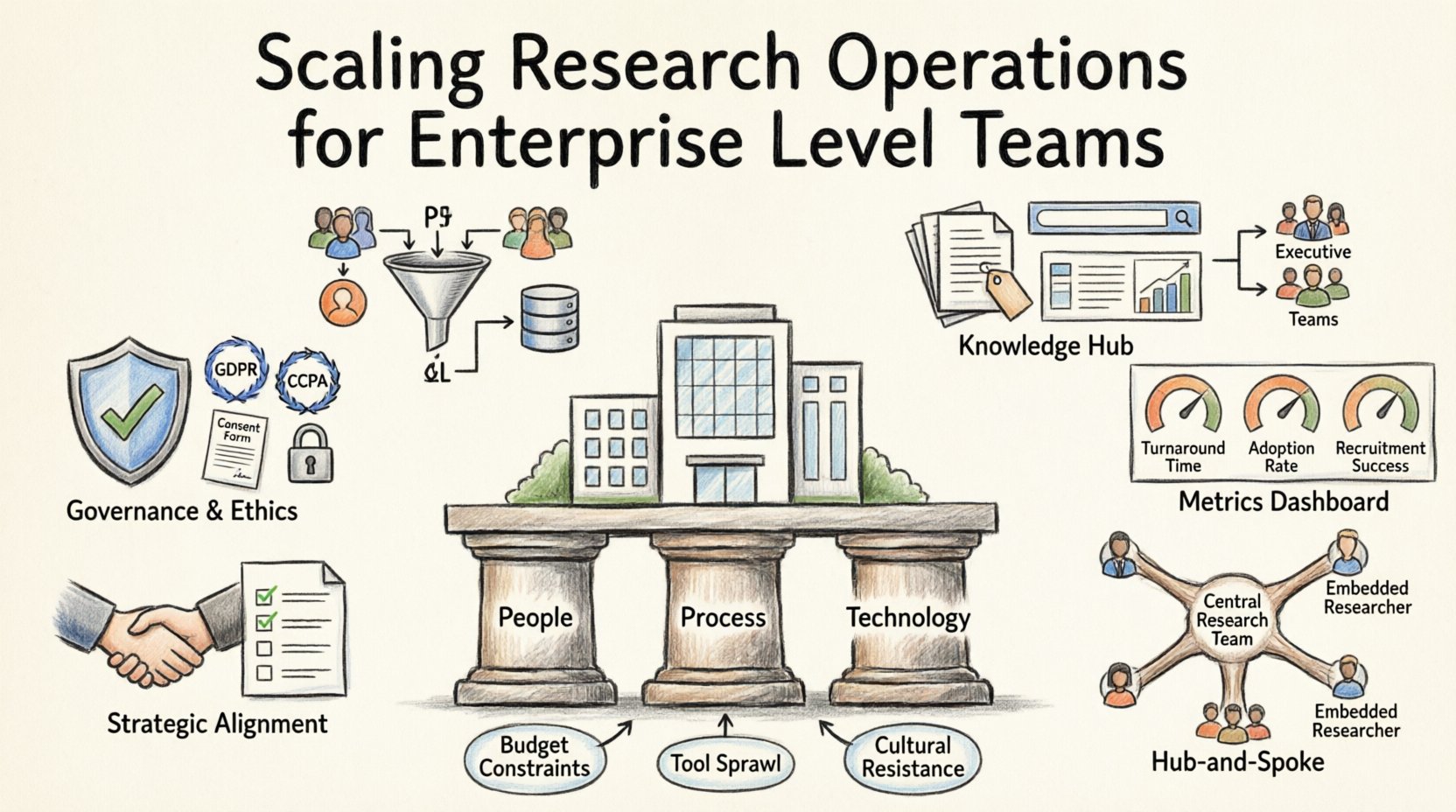
Building this framework requires attention to three core pillars:
- People: Roles, responsibilities, and skill development.
- Process: Standardized workflows for study design, execution, and synthesis.
- Technology: The systems used to manage participants, data, and findings.
When these pillars are aligned, the research team transitions from ad-hoc support to a strategic partner. The goal is predictability. Stakeholders should know what to expect regarding timelines, costs, and outputs.
🤝 Strategic Alignment & Stakeholder Management
In large organizations, research must compete for budget and attention. To scale effectively, research operations must demonstrate clear value to leadership. This involves moving away from reactive ticket-taking toward proactive strategic planning.
Establishing Governance Early
Before scaling recruitment or hiring more staff, you must define how research fits into the product development lifecycle. Governance ensures that research is not an afterthought but an integral component of decision-making.
- Define Entry Criteria: Establish clear guidelines for when a study is necessary versus when existing data suffices.
- Set Expectations: Create service level agreements (SLAs) regarding response times and study durations.
- Secure Buy-in: Engage with product and engineering leaders to understand their pain points and tailor the research roadmap accordingly.
Building a Community of Practice
Research does not exist in a vacuum. In an enterprise, many teams may conduct their own research. A Community of Practice helps standardize methods and share learnings.
- Host regular workshops on method selection and study design.
- Create templates for study plans and reports to ensure consistency.
- Encourage cross-functional collaboration to reduce duplication of effort.
🛡️ Governance, Compliance, and Ethics
Enterprise teams handle sensitive data and operate in regulated industries. As you scale, the risk of compliance violations increases. A robust governance framework protects the organization and the participants.
Data Privacy and Security
Ensuring data security is paramount. This involves adhering to regulations such as GDPR, CCPA, and HIPAA, depending on your region and industry.
- Data Minimization: Collect only the data necessary for the study.
- Encryption: Ensure all participant data is encrypted at rest and in transit.
- Access Control: Limit access to raw data to authorized personnel only.
- Retention Policies: Define how long data is kept and establish automated deletion processes.
Ethical Considerations
Ethics go beyond legal compliance. It is about treating participants with respect and transparency.
- Informed Consent: Ensure participants understand how their data will be used before they begin.
- Compensation: Provide fair and timely compensation for their time and expertise.
- Accessibility: Ensure research materials and methods are accessible to participants with disabilities.
| Compliance Area | Key Requirement | Operational Action |
|---|---|---|
| Data Privacy | GDPR / CCPA Compliance | Implement data masking and consent management protocols. |
| Security | Enterprise Security Standards | Conduct regular security audits of research tools and data storage. |
| Ethics | Institutional Review Board (IRB) | Submit studies for review if involving vulnerable populations. |
👥 Recruitment and Participant Management at Scale
Recruiting participants is often the biggest bottleneck in scaling research. As the number of studies increases, maintaining a diverse and accurate participant pool becomes challenging.
Built a Diverse Participant Pool
Diversity ensures that findings are representative of the entire user base. Relying on a single source of recruitment limits the validity of your insights.
- Segmentation: Define clear user segments based on demographics, behaviors, and needs.
- Sourcing Channels: Utilize multiple channels such as email lists, social media, and third-party networks.
- Screening: Use rigorous screening questionnaires to ensure participants match your target profile.
Managing the Participant Lifecycle
Participants are a resource that requires management. Treating them as partners rather than subjects improves retention and data quality.
- Communication: Send clear, timely updates regarding study schedules and outcomes.
- Incentives: Streamline the process of distributing rewards to maintain trust.
- Database Management: Keep participant records up to date, including preferences and availability.
When managing a large database, automation is key. While you should avoid specific software names, look for systems that allow for bulk communication and automated scheduling.
🧠 Synthesis, Storage, and Knowledge Distribution
Conducting studies is only half the battle. The insights generated must be synthesized, stored, and distributed effectively. In an enterprise, knowledge often gets lost in silos.
Centralized Knowledge Management
Creating a single source of truth for research findings prevents redundancy and ensures that insights are discoverable.
- Tagging System: Implement a consistent tagging system for easy searching and filtering.
- Searchability: Ensure that insights can be found by keywords, projects, or user segments.
- Version Control: Maintain records of how insights have evolved over time.
Standardizing Synthesis Methods
Different researchers may synthesize data differently. Standardization ensures that findings are comparable and reliable.
- Templates: Use standardized templates for affinity mapping and insight generation.
- Review Processes: Establish a peer review process for major reports before distribution.
- Visualizations: Use consistent visual styles for charts, maps, and quotes.
Disseminating Insights
Insights must reach the right people at the right time. Passive storage is not enough.
- Executive Summaries: Create high-level summaries for leadership that focus on strategic implications.
- Tactical Reports: Provide detailed findings for product teams to inform design decisions.
- Workshops: Host sessions to walk stakeholders through key findings and discuss next steps.
📊 Metrics, ROI, and Continuous Improvement
To justify the investment in research operations, you must measure its impact. Metrics help identify bottlenecks and demonstrate value to the business.
Key Performance Indicators (KPIs)
Focus on metrics that reflect both efficiency and impact.
- Turnaround Time: Measure the time from request to delivery of insights.
- Study Completion Rate: Track the percentage of planned studies that are successfully executed.
- Adoption Rate: Monitor how often research findings are cited in product decisions.
- Participant Retention: Track the percentage of participants who agree to future studies.
Continuous Improvement Loop
Research operations are never finished. Regular reviews help identify areas for optimization.
- Quarterly Reviews: Assess the performance of the research team and the operational framework.
- Stakeholder Feedback: Solicit feedback from product and engineering teams on research quality.
- Benchmarking: Compare your metrics against industry standards to identify gaps.
| Metric | Target | Why It Matters |
|---|---|---|
| Turnaround Time | < 4 Weeks | Ensures research keeps pace with agile development cycles. |
| Adoption Rate | > 70% | Indicates that insights are actionable and trusted. |
| Recruitment Success | > 90% | Reflects the health of the participant database. |
🏢 Organizational Structure for Growth
As the team grows, the structure must evolve to support specialization without losing cohesion.
Specialization vs. Generalization
In smaller teams, researchers are generalists. In larger teams, specialization allows for deeper expertise.
- Methodologists: Experts in specific research methods (e.g., usability, ethnography).
- Recruiters: Dedicated staff focused solely on participant management.
- Synthesis Leads: Staff responsible for managing knowledge repositories and training.
Hub and Spoke Model
This model is common in enterprise environments. A central research team supports multiple product groups.
- Central Team: Handles strategy, operations, and complex studies.
- Embedded Researchers: Located within product teams to provide immediate support.
- Consultants: External resources brought in for specialized needs.
🚧 Overcoming Common Scaling Challenges
Scaling research operations comes with predictable hurdles. Anticipating these challenges allows for proactive mitigation.
Challenge 1: Budget Constraints
Enterprise budgets are often tight. Justifying research spend requires clear linkage to business outcomes.
- Quantify the cost of building the wrong features versus the cost of research.
- Highlight risk reduction as a key value proposition.
- Share success stories where research prevented costly errors.
Challenge 2: Tool Sprawl
As teams grow, they often accumulate too many tools. This leads to fragmentation and inefficiency.
- Audit existing tools regularly to identify redundancies.
- Consolidate onto fewer, more robust platforms.
- Ensure tools integrate with existing workflows to reduce friction.
Challenge 3: Cultural Resistance
Not all stakeholders value research equally. Changing culture takes time.
- Invest in research literacy training across the organization.
- Showcase quick wins to build credibility.
- Make research accessible to non-researchers through self-service options.
🔍 Conclusion
Scaling research operations for enterprise teams is a complex undertaking that requires strategic planning, robust governance, and continuous improvement. By focusing on the pillars of people, process, and technology, organizations can build a research function that is efficient, ethical, and impactful. The journey is ongoing, but the investment yields a deeper understanding of users and a stronger product strategy.
Remember that the goal is not just to conduct more studies, but to enable better decisions. With a solid operational foundation, your research team can evolve from a service provider to a strategic asset.