
In the modern landscape of business interaction, the difference between a transactional exchange and a lasting relationship often comes down to one critical factor: empathy. Customer Journey Mapping is a strategic tool used to visualize the path a customer takes, but without an emotional layer, these maps remain cold diagrams of touchpoints. To truly understand the customer experience, organizations must integrate emotional intelligence into every stage of the journey.
This guide explores how empathy transforms the practice of journey mapping. We will examine why understanding feelings is as vital as understanding actions, how to gather the necessary data, and the structural changes required to sustain a human-centric approach.
Defining Empathy vs. Sympathy in Business 🤝
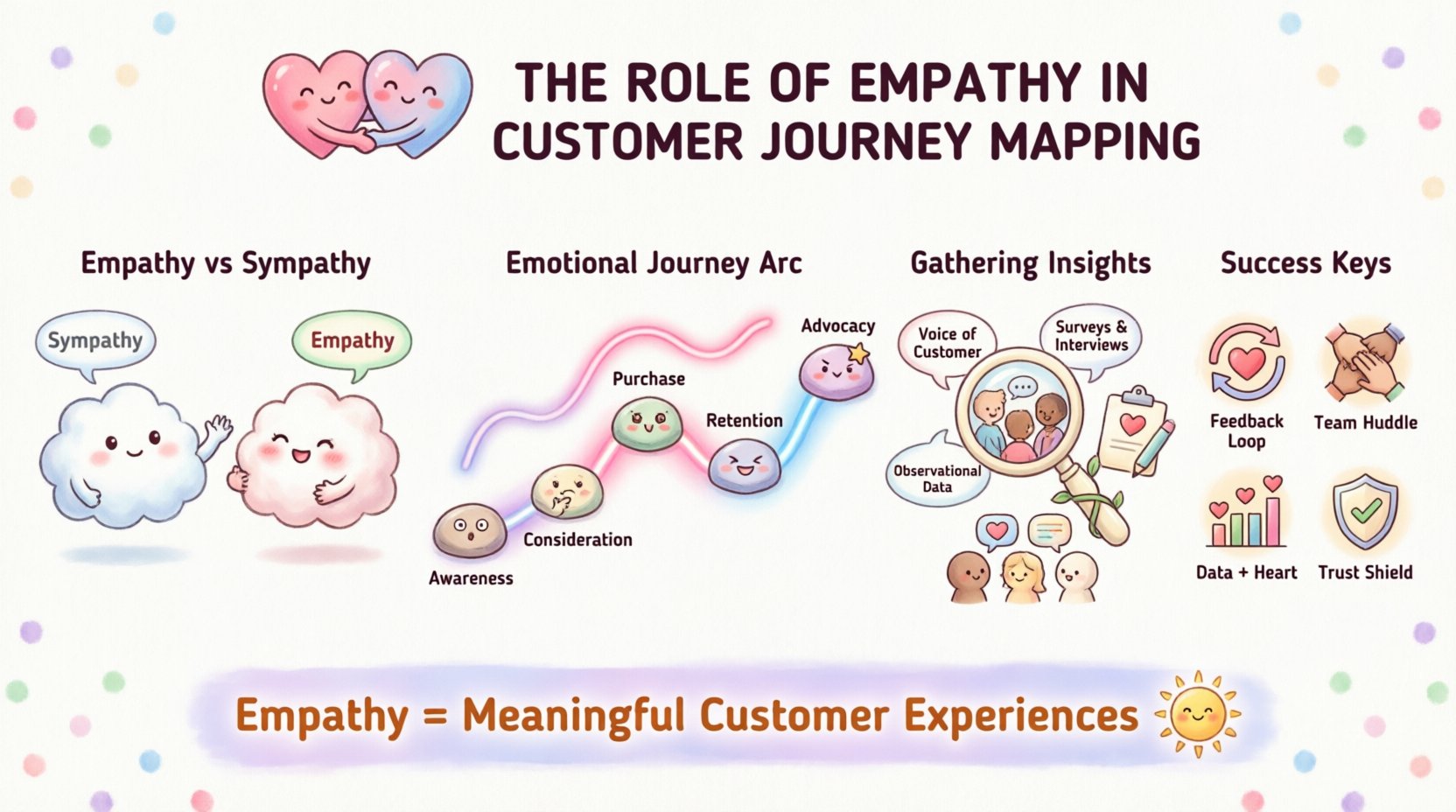
Before integrating empathy into mapping, it is essential to distinguish it from sympathy. Sympathy is acknowledging someone’s hardship from a distance. It involves feeling for the person. Empathy, however, involves feeling with the person. It is the ability to step into another’s shoes and see the world through their eyes without judgment.
In the context of Customer Experience (CX), this distinction is crucial:
- Sympathy: “We understand you are frustrated with the delay.” (Detached)
- Empathy: “We know this delay disrupts your day and causes stress for your family. Here is exactly how we are fixing it.” (Connected)
When building a journey map, sympathy leads to generic responses. Empathy leads to tailored solutions that address the root cause of the emotion, not just the symptom. This shift requires a cultural change within the organization, moving from a focus on efficiency to a focus on human connection.
The Intersection of Empathy and Journey Mapping 🗺️
A standard journey map tracks the user’s actions: they visit the site, they add to cart, they checkout. An empathetic journey map tracks the internal state accompanying those actions. It asks the question: How does the user feel at this specific moment?
Consider the following elements that must be added to a traditional map:
- Emotional Arc: The rise and fall of satisfaction throughout the process.
- Pain Points: Moments of friction that trigger negative emotions like anxiety or confusion.
- Moments of Delight: Unexpected interactions that generate joy or relief.
- Context: The environment in which the interaction occurs (e.g., rushing to work, relaxing at home).
By layering these emotional indicators over the functional steps, organizations can identify where the user experience breaks down psychologically, not just technically.
Mapping the Emotional Arc Across Stages 📈
To implement this effectively, we must analyze the emotional state required at each stage of the customer lifecycle. Different stages demand different emotional supports. The table below outlines the typical emotional requirements per stage.
| Stage | Primary Emotion | Empathy Focus |
|---|---|---|
| Awareness | Curiosity / Skepticism | Clarity and transparency |
| Consideration | Confusion / Comparison | Guidance and reassurance |
| Purchase | Excitement / Anxiety | Simplicity and security |
| Retention | Satisfaction / Boredom | Consistency and engagement |
| Advocacy | Pride / Trust | Recognition and community |
For instance, during the Purchase stage, anxiety is often the dominant emotion due to financial risk. An empathetic map identifies this and suggests interventions, such as clear return policies or live chat support, to alleviate that specific fear.
Methods for Gathering Empathetic Insights 🔍
You cannot assume you know how a customer feels; you must ask and observe. Quantitative data tells you what happened, but qualitative data tells you why. To build an accurate empathetic map, rely on the following methods.
- Deep-Dive Interviews: Conduct one-on-one conversations where the focus is on feelings. Ask “How did that make you feel?” rather than “What did you click?”.
- Contextual Inquiry: Observe customers using the product in their natural environment. Note body language, sighs, and pauses.
- Feedback Loops: Implement open-ended survey questions that allow for narrative responses.
- Support Ticket Analysis: Review past interactions to identify recurring emotional triggers in customer complaints.
- Shadowing: Have team members sit in on customer calls or sessions to witness the interaction firsthand.
It is important to gather this data from a diverse range of customers. Relying on a single segment can lead to biased empathy that excludes minority groups or niche users.
Integrating Feedback Loops into the Process 🔄
Empathy is not a one-time project; it is a continuous practice. Once the initial map is created, it must evolve. Customer needs change, and so do their emotional states. To keep the map relevant, integrate feedback mechanisms that run parallel to the journey.
Key integration strategies include:
- Real-Time Sentiment Analysis: Use text analysis on live chats to detect frustration levels immediately.
- Post-Interaction Surveys: Send short surveys immediately after key touchpoints to capture fresh emotional data.
- Internal Debriefs: Hold regular meetings where staff share stories of customer struggles. This builds a culture of empathy internally.
- User Testing Sessions: Regularly watch users attempt to complete tasks to identify new friction points.
By making feedback a routine part of the workflow, the organization ensures that the journey map remains a living document rather than a static poster.
Organizational Barriers to Empathy 🧱
Even with the best intentions, internal structures can block empathetic mapping. Teams often operate in silos, where the marketing team does not speak to the support team. This fragmentation leads to disjointed experiences where the customer feels like they are dealing with different companies.
Common barriers include:
- KPI Misalignment: If support is measured solely on speed, they may rush customers who need more time to process information.
- Lack of Direct Contact: Decision-makers who never speak to customers often design based on assumptions rather than reality.
- Resource Constraints: Empathy requires time. If teams are understaffed, there is no time for deep listening or thoughtful design.
- Defensive Culture: When employees fear punishment for mistakes, they hide problems rather than reporting them for empathy-driven fixes.
Overcoming these barriers requires leadership commitment. Leaders must prioritize human connection alongside efficiency metrics.
Measuring the Impact of Empathy 📊
How do you know if empathy is working? Traditional metrics like conversion rates are important, but they do not capture the emotional value. To measure the success of an empathetic strategy, look at the following indicators.
- Customer Effort Score (CES): Measures how easy it was for the customer to achieve their goal. Lower effort usually correlates with higher empathy.
- Net Promoter Score (NPS): While broad, a rise in promoters often signals that customers feel valued.
- Retention Rates: Empathetic customers are less likely to leave, even if competitors offer lower prices.
- Qualitative Feedback Volume: An increase in positive, detailed feedback suggests customers feel heard.
- Resolution Time vs. Resolution Quality: Sometimes taking more time to solve a problem results in higher satisfaction than a quick fix.
Tracking these metrics allows the organization to validate that their empathetic investments are yielding tangible business results.
Common Pitfalls to Avoid 🚫
While striving for empathy, organizations can inadvertently create negative experiences. Fake empathy is often more damaging than no empathy at all. Customers can sense when an apology is scripted rather than genuine.
Pitfalls to watch out for include:
- Over-Promising: Empathy does not mean agreeing to impossible requests. It means understanding the constraint and explaining it clearly.
- Ignoring Data: Relying on gut feeling instead of customer insights leads to assumptions that may be wrong.
- One-Size-Fits-All: Treating all customers the same ignores individual needs and contexts.
- Performance Empathy: Acting nice only for the sake of the transaction. This erodes trust when the relationship becomes difficult.
Genuine empathy requires consistency. It must be present in the happy moments and the difficult ones.
The Future of Human-Centric Design 🌱
As technology advances, the line between digital and physical blurs. Artificial intelligence and automation will handle more tasks, making the human element even more valuable. In a world of bots, the ability to connect emotionally becomes a primary differentiator.
The future of journey mapping lies in:
- Hyper-Personalization: Using data to anticipate needs before they are voiced.
- Proactive Support: Reaching out to customers when a problem is detected before they know it exists.
- Integrated Channels: Ensuring the emotional context travels with the customer as they switch between phone, email, and chat.
Organizations that master the balance between technological efficiency and emotional intelligence will lead the market. Those that treat customers as data points will struggle to retain loyalty.
Conclusion on Empathy in Mapping 🏁
Building a journey map without empathy is like building a house without a foundation. It may stand for a while, but it will not withstand the pressure of real-world challenges. By prioritizing the emotional needs of the customer, businesses create experiences that are not just functional, but meaningful.
This approach requires patience, research, and a willingness to listen. It demands that teams step back from their own assumptions and truly understand the user. When done correctly, empathy becomes the backbone of a sustainable, successful customer experience strategy.