Design is rarely a solitary endeavor. In modern product development, the work of a designer intersects with engineering, product management, marketing, and research. While this collaboration is essential for creating robust solutions, it introduces inevitable friction. Disagreements over feasibility, timeline, user needs, or visual fidelity are common. When left unaddressed, these conflicts can erode trust, delay shipping, and compromise the final user experience. However, when managed with intention and structure, conflict becomes a catalyst for better outcomes.
This guide explores the mechanics of conflict within cross-functional teams. It provides actionable strategies to navigate disagreements without compromising relationships or product quality. We will examine the root causes, establish communication frameworks, and discuss how to build a culture where dissent is viewed as a resource rather than a roadblock.
Understanding the Anatomy of Friction 🧩
Conflict is not inherently negative. It is a signal that different perspectives are colliding. In a design context, these collisions often stem from differing priorities and constraints. To resolve issues, one must first understand where they originate.
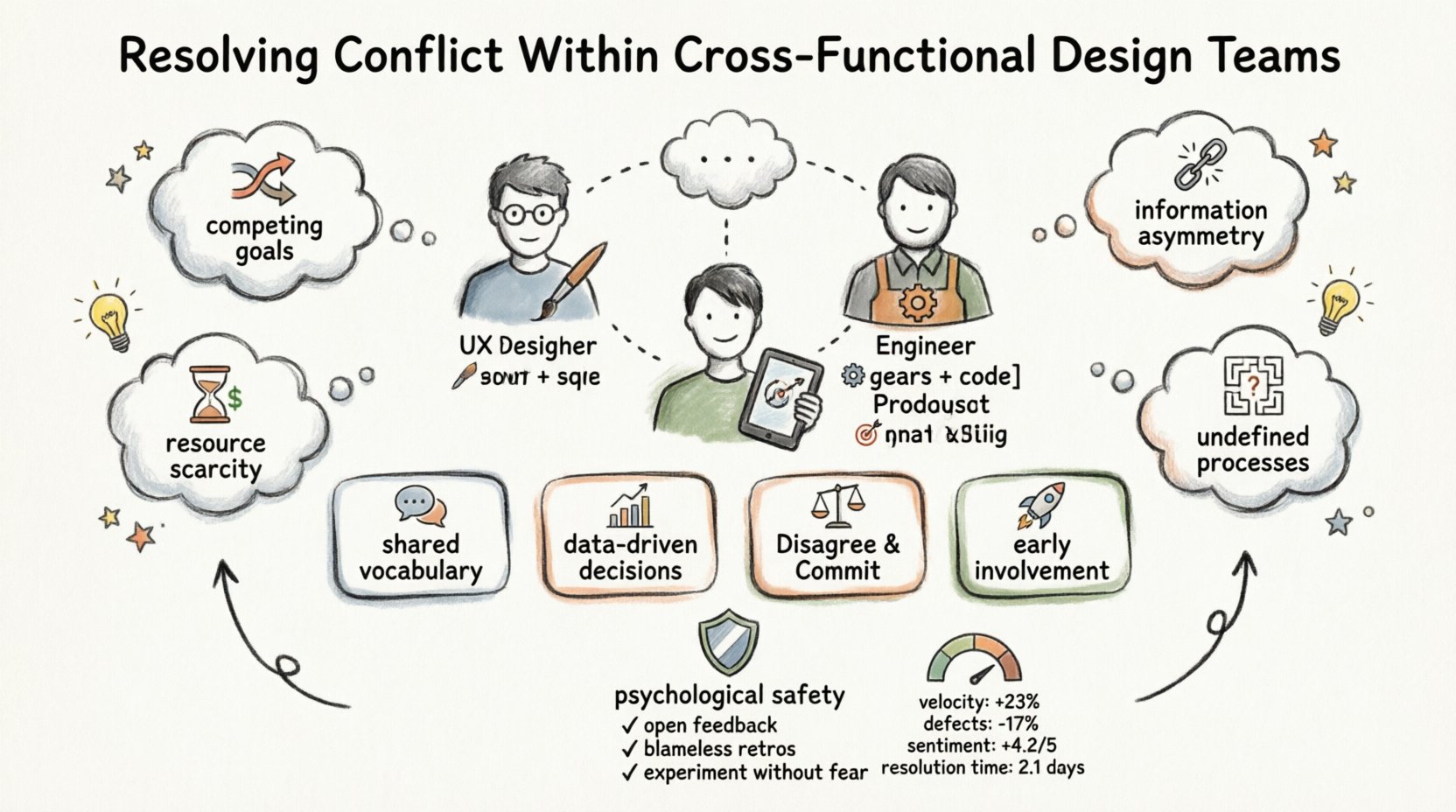
- Competing Goals: Designers prioritize user flow and accessibility. Engineers prioritize performance and technical debt. Product Managers prioritize speed to market and business metrics. When these goals appear mutually exclusive, friction arises.
- Information Asymmetry: Often, one team possesses knowledge the other lacks. Engineers may not understand the nuance of a user journey. Designers may not understand the cost of a specific animation. This gap leads to assumptions and frustration.
- Resource Scarcity: Time and budget are finite. Deciding where to allocate effort forces trade-offs that inevitably upset someone.
- Undefined Processes: Without clear handoff protocols or decision-making hierarchies, ambiguity breeds conflict. Who has the final say on a UI change?
Perspective Mapping: The Three Pillars 🧭
Before entering a discussion, it is helpful to visualize the stakes for each role. The table below outlines common pain points and motivations for key functions within a product team.
| Role | Primary Focus | Common Friction Point | Desired Outcome |
|---|---|---|---|
| UX/UI Designer | Usability, Accessibility, Aesthetics | Features are cut for speed; technical debt ignored | High fidelity implementation that respects user needs |
| Engineer | Stability, Performance, Scalability | Designs are unfeasible; frequent scope changes | Clean codebase with realistic deadlines |
| Product Manager | ROI, Market Fit, Timeline | Scope creep; delayed delivery; unclear priorities | Product shipped on time that solves the business problem |
Recognizing these distinct drivers allows the team to move from “me vs. you” to “us vs. the problem.” When a designer argues for a feature, they are advocating for the user. When an engineer argues against it, they are advocating for the system’s health. Both are valid.
Strategies for Resolution 🤝
Once the root cause is identified, specific tactics can be applied to resolve the tension. These methods focus on dialogue, data, and process.
1. Establish a Shared Vocabulary 🗣️
Jargon creates barriers. Engineers speak in API endpoints and latency; designers speak in pixels and motion. To bridge this, teams should agree on a shared lexicon.
- Define what “done” means for a feature. Does it mean the design is coded, or does it mean it has been tested and deployed?
- Standardize how design systems are referenced. Ensure everyone understands the difference between a component library and a custom implementation.
- Use plain language in documentation. Avoid abstract descriptions of interactions. Use concrete examples.
2. Data-Driven Decision Making 📊
Subjective opinions lead to endless loops. “I think this looks better” is not a valid argument in a conflict. Shift the conversation to evidence.
- User Research: If two design directions exist, run a quick usability test. Let the users decide which path works better.
- Analytics: Look at historical data. Did a similar feature increase conversion? Did it increase support tickets?
- Technical Constraints: Ask the engineering lead to quantify the risk. Is this a two-day task or a two-week refactor? Make the cost visible.
3. The “Disagree and Commit” Protocol ⚖️
Not every disagreement requires consensus. In some cases, a decision must be made to keep momentum. The team should agree on a mechanism for this before conflict arises.
- Designate the Decider: For a specific sprint or feature, who has the final vote? Usually, this is the Product Manager, but it can rotate.
- Document the Rationale: If a decision is made that contradicts a team member’s advice, document why. This reduces second-guessing later.
- Post-Mortem Analysis: After the decision, review the outcome. Was it right? If not, adjust the process for next time.
4. Early Involvement 🚀
Conflict often stems from late feedback. If engineers are brought in only after designs are finalized, they may find significant blockers. If designers are brought in only after code is written, they may find the layout broken.
- Design Sprints: Hold collaborative sessions where all roles sketch solutions together.
- Technical Design Reviews: Treat design specs like code. Review them for feasibility before they are handed off.
- Pairing: Encourage designers and engineers to pair on complex components. This builds empathy and shared understanding of the constraints.
Communication Frameworks for Difficult Conversations 📢
How you say something is often as important as what you say. Structured communication prevents emotions from derailing the technical discussion.
The Situation-Behavior-Impact Model
When providing feedback on a conflict, avoid generalizations. Use a structured approach to keep the conversation objective.
- Situation: Describe the specific context. “In yesterday’s review meeting…”
- Behavior: Describe the observable action. “…the design proposal was rejected without explanation…”
- Impact: Describe the effect. “…this left the team unsure of how to proceed and slowed our progress…”
Active Listening Techniques
Often, conflict escalates because people feel unheard. Practice active listening to de-escalate.
- Paraphrasing: Repeat back what the other person said to confirm understanding. “So, you are concerned that this animation will impact load times on mobile devices?”
- Validating: Acknowledge their expertise. “I understand why that constraint matters given our current infrastructure.”
- Asking Questions: Instead of stating facts, ask. “What would a solution look like that meets both the visual goal and the performance constraint?”
Building Psychological Safety 🛡️
Conflict thrives in environments where people fear repercussions. Psychological safety is the belief that one will not be punished or humiliated for speaking up with ideas, questions, concerns, or mistakes. This is critical for design teams.
Indicators of Psychological Safety
- Team members admit when they are wrong without fear of blame.
- Disagreements are focused on the work, not the person.
- Novel ideas are welcomed, even if they seem risky.
- Feedback is solicited proactively, not just during reviews.
Leadership’s Role
Leaders must model vulnerability. When a leader admits a mistake, it gives permission for the rest of the team to do the same. Leaders should also intervene when conflict becomes personal. If a discussion shifts to “you always” or “you never,” the leader must pause and reset the conversation to the objective.
Case Scenarios: Navigating Specific Conflicts ⚙️
Here are common scenarios and how to approach them based on the strategies above.
Scenario A: The Unimplementable Design
The Conflict: A designer creates a complex interaction that engineers say is too costly or impossible within the timeline.
The Resolution: Do not simply cut the feature. Instead, explore the “why.” What is the user goal of that interaction? Is it to delight, or to inform? If it is to inform, can a simpler icon achieve the same result? If it is to delight, can it be deferred to a later phase? Prioritize the core value over the implementation detail.
Scenario B: The Shifting Requirement
The Conflict: Product changes the requirements mid-sprint, causing the design team to redo work and the engineering team to worry about scope.
The Resolution: Implement a “Change Control” process. If requirements change, a formal assessment of the impact on timeline and quality is required. The team should discuss the trade-off explicitly. “We can add this new feature, but we must remove that one to stay on schedule.” This makes the cost of change visible to everyone.
Scenario C: Accessibility vs. Aesthetics
The Conflict: A design looks visually striking but fails contrast ratios or screen reader compatibility.
The Resolution: Accessibility is not a feature; it is a requirement. Frame this not as a creative compromise but as a legal and ethical standard. Use automated testing tools to demonstrate the gaps. If the aesthetic is still desired, collaborate on a solution that meets the standard without losing the brand identity. Often, color adjustments or font sizing can solve this.
Measuring Success Post-Conflict 📈
After a conflict is resolved, how do you know the process is working? You need metrics that reflect team health, not just output.
- Velocity Stability: Are teams shipping at a consistent rate, or are they fluctuating wildly due to rework?
- Defect Rates: Are bugs related to design intent decreasing? This indicates better alignment.
- Team Sentiment: Regular anonymous surveys can track how team members feel about collaboration. Look for trends in questions about trust and communication.
- Time to Resolution: How long does it take to resolve a disagreement? If it takes days, the process is broken.
Continuous Improvement Loops 🔄
Conflict resolution is not a one-time fix. It requires ongoing maintenance. Teams should hold retrospectives not just to discuss what went wrong, but how they discussed what went wrong.
- Review the Process: Did the decision-making framework work? If not, tweak it.
- Share Learnings: If a conflict was resolved well, document it. Make it a case study for the wider organization.
- Training: Invest in workshops on negotiation, empathy, and technical communication for all roles.
By treating conflict as a natural part of the creative process, teams can transform friction into fuel. The goal is not to eliminate disagreement, but to ensure that every disagreement leads to a clearer understanding of the product and a stronger team dynamic.
Final Thoughts on Team Dynamics 💡
High-performing design teams are not those that never argue. They are the ones that argue effectively. They have established norms that allow for robust debate without personal attacks. They value diverse perspectives and use data to ground their discussions.
As you move forward, remember that your role is to facilitate clarity. Whether you are a designer, engineer, or manager, your contribution to a healthy conflict culture is vital. Focus on the shared mission of building a great product. When that north star is clear, the path through disagreement becomes much easier to navigate.
Start small. Pick one friction point in your current workflow. Apply one of the strategies above. Measure the result. Iterate. The path to a harmonious cross-functional team is a continuous journey, not a destination.