
Growth is a powerful force, but it changes the fundamental mechanics of how a business operates. When you are in the early stages, a strategic plan that worked yesterday might work tomorrow. However, as you scale rapidly, the environment shifts beneath your feet. The assumptions you made at 50 employees often crumble at 500. This is why refreshing your SWOT analysis during rapid scaling is not optional; it is a critical survival mechanism.
A SWOT analysis is a foundational tool for understanding your Strategic position. It stands for Strengths, Weaknesses, Opportunities, and Threats. In a static environment, this document is a snapshot. In a scaling environment, it must be a video feed. If you do not update it, you risk making decisions based on outdated data, leading to operational bottlenecks and missed market signals. This guide provides a detailed approach to keeping your strategic framework relevant.
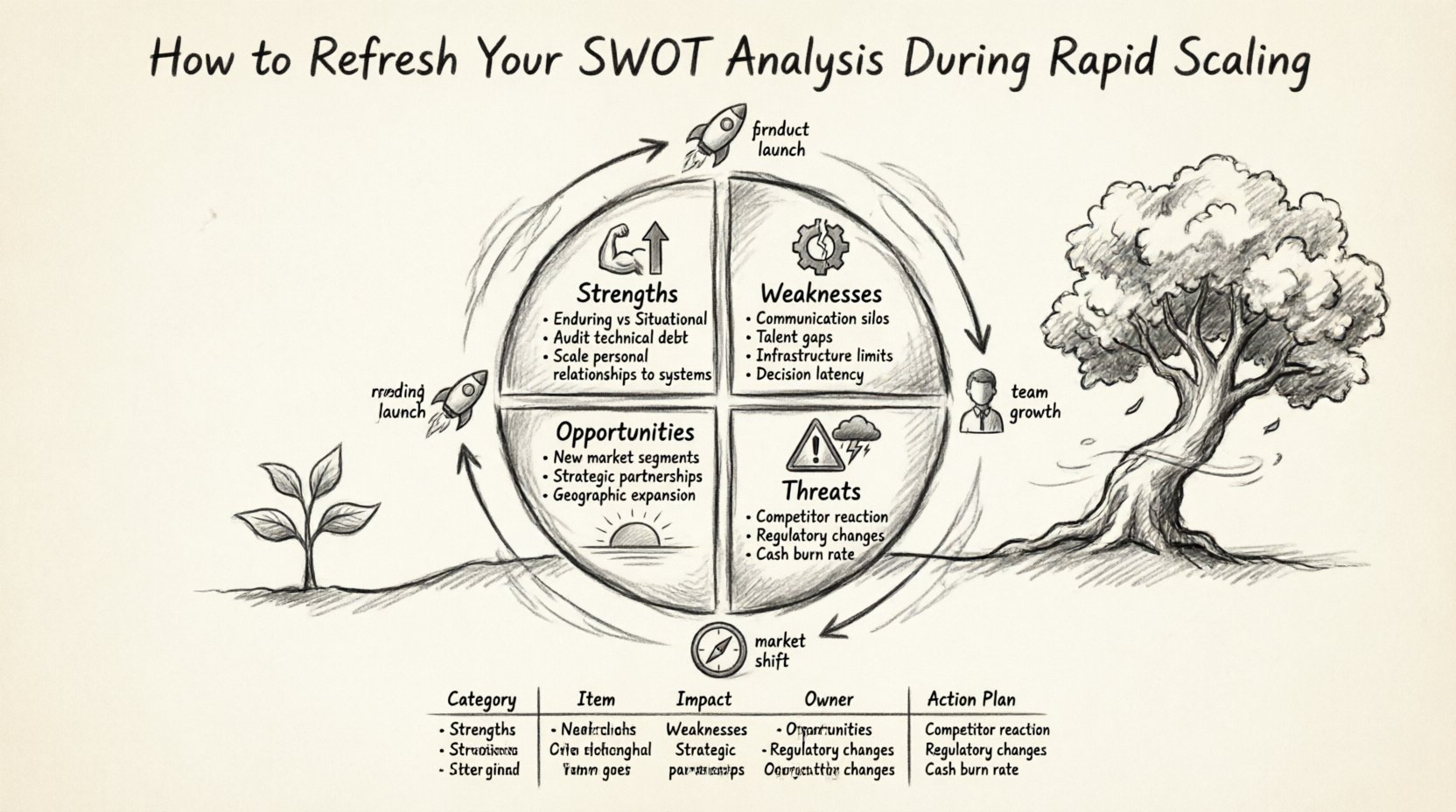
Why Static Plans Fail During Growth 📉
Many organizations treat their strategic documents as annual rituals. They create a SWOT analysis in January and file it away until the next fiscal year. This approach works when growth is steady and predictable. It does not work when you are experiencing hypergrowth. Rapid scaling introduces variables that render previous assumptions obsolete almost overnight.
- Resource Allocation Changes: Budgets and headcount shift quickly. A strength in cash flow at one stage becomes a weakness in capital allocation at another.
- Market Velocity: Competitors react faster. A threat that was minor six months ago might now be a primary revenue killer.
- Operational Complexity: Processes that were simple manual checks become critical failure points when volume increases tenfold.
- Cultural Dilution: The “strength” of a tight-knit team can turn into a “weakness” if communication silos form as the organization expands.
To maintain authority in your market, you must acknowledge that your internal reality is fluid. A static SWOT analysis creates a false sense of security. It suggests stability where there is actually volatility. By refreshing this analysis, you align your strategic vision with current operational realities.
Determining the Right Timing for Updates 🕒
Frequency is a key component of effective strategic planning. You do not need to refresh your SWOT analysis every day, but waiting a full year is too long during a period of rapid expansion. The trigger points for a refresh are often tied to specific business milestones rather than calendar dates.
Key Triggers for Refreshing Your Analysis
- Significant Funding Rounds: When capital enters the business, the expectations and risks change. You must re-evaluate what you can afford to lose versus what you must protect.
- Product Milestones: Launching a new flagship product changes your market positioning and resource requirements.
- Team Expansion Thresholds: Moving from a department of 20 to a department of 50 requires a different management structure. This impacts internal weaknesses.
- Market Shifts: If a competitor enters your space or a regulatory change occurs, your external analysis (Opportunities and Threats) is immediately outdated.
Aim for a quarterly review cycle during high-growth phases. This ensures that your strategy remains agile. Quarterly reviews allow you to catch drift before it becomes a crisis. They provide a rhythm for the organization to pause, assess, and recalibrate without losing momentum.
Reassessing Strengths in a New Context 💪
Strengths are assets you possess that give you a competitive advantage. However, a strength is context-dependent. What was a strength during the startup phase may become a liability during the scaling phase.
Evaluating Core Competencies
Start by auditing your current capabilities. Ask specific questions about your core offerings.
- Technical Debt: Did your initial speed of development become a strength that now hinders maintenance? Code written for speed might not scale for volume.
- Brand Perception: Was being “the small, agile alternative” a strength? As you grow, customers may expect enterprise-grade reliability. Your agility must evolve into scalability.
- Key Personnel: Are you relying on one founder for sales? That works for 10 clients. It fails for 1,000. Your strength in personal relationships must transition into a strength in systems.
- Process Efficiency: Manual processes are often strengths in the early days because they require low overhead. They become weaknesses when you cannot replicate them.
When refreshing your analysis, categorize strengths into two buckets: enduring and situational. Enduring strengths are those that hold value regardless of size. Situational strengths are temporary advantages that may vanish as you grow. Focus your strategy on solidifying the enduring ones and converting the situational ones into structural assets.
Identifying Hidden Weaknesses in Processes ⚙️
Weaknesses are internal limitations that hinder performance. In a scaling environment, weaknesses are often hidden until they cause a major incident. The friction of growth exposes cracks in the foundation.
Common Scaling Weaknesses
- Communication Silos: Departments stop talking to each other. Marketing does not know Sales is promising features Engineering has not built yet.
- Talent Gaps: You have hired for volume, but not for depth. You have managers, but not leaders who can mentor new teams.
- Infrastructure Limits: Your customer support system might handle 50 tickets a day but crashes at 500. Your software licensing might not support concurrent users.
- Cash Flow Management: Revenue grows, but cash does not. Accounts receivable takes too long, causing liquidity issues.
- Decision Latency: Decisions that used to be made in 10 minutes now require five meetings and a committee. Speed is lost.
Be brutally honest during this refresh. Do not hide weaknesses to protect morale. Acknowledging a weakness is the first step to fixing it. Use the data you have from customer complaints, employee feedback, and operational metrics to identify these gaps.
Seizing New Opportunities on the Horizon 🌟
Opportunities are external factors you can exploit to grow further. Scaling opens doors that were previously closed. You now have the budget, the brand recognition, and the reach to explore new avenues.
Where to Look for Growth
- New Market Segments: Your product might have accidentally appealed to a different industry. Analyze your customer data to find these patterns.
- Strategic Partnerships: Larger companies may now be willing to partner with you. This can provide distribution channels you could not access before.
- Product Extensions: You have a loyal user base. What complementary services can you offer them? Upselling becomes easier when trust is established.
- Geographic Expansion: Scaling often implies readiness for new regions. Regulatory compliance and local market knowledge become the focus.
- Talent Acquisition: You can now attract top-tier talent that previously worked for competitors. Your employer brand is stronger.
Opportunities are not just about making more money. They are about building a more resilient business. Diversify your opportunities so that if one channel dries up, others can sustain the organization. Do not put all your eggs in the basket of the current product line.
Recognizing Emerging Threats to Stability ⚠️
Threats are external obstacles that could cause trouble. As you grow, you become a larger target. Competitors notice you. Regulators watch you. Customers expect more.
Threats to Monitor Closely
- Competitor Reaction: Larger competitors may copy your features or undercut your pricing. They have more resources to fight back.
- Regulatory Changes: As you grow, you may fall under different compliance laws. Data privacy and labor laws often tighten with company size.
- Cash Burn Rate: If growth slows, but burn rate remains high, the threat is immediate insolvency. This is the most common killer of scaling startups.
- Talent Poaching: Competitors will try to hire your best people. Losing key staff during a critical growth phase can stall momentum.
- Reputation Risk: One bad press cycle can undo years of brand building. Public scrutiny increases as you become more visible.
Threat management requires proactive mitigation, not just reaction. For every threat identified, you need a contingency plan. If the threat materializes, you must know your response steps. This reduces panic and preserves decision-making quality under pressure.
A Framework for Strategic Alignment 📋
To make this refresh actionable, you need a structured approach. Simply listing items is not enough. You must prioritize them and assign ownership. Use the following table to organize your findings during the refresh session.
| Category | Item | Impact (High/Med/Low) | Owner | Action Plan |
|---|---|---|---|---|
| Strength | Example: Proprietary Algorithm | High | CTO | Document and leverage in sales pitch |
| Weakness | Example: Slow Support Response | High | Head of Ops | Hire 3 new agents, implement automation |
| Opportunity | Example: Enterprise Tier | Medium | VP Sales | Develop pricing model by Q3 |
| Threat | Example: Competitor Price Drop | High | Marketing Director | Review value proposition, adjust messaging |
This table forces specificity. It prevents vague statements like “improve culture.” It demands an owner and a concrete action. When you review your SWOT, map every item to a specific task in your project management system. This bridges the gap between strategy and execution.
Gathering Insights Across the Organization 👥
A SWOT analysis cannot be done in a vacuum by the executive team alone. To get an accurate picture, you need input from the front lines. Employees who interact with customers daily see the weaknesses and opportunities that leadership misses.
Stakeholder Engagement Strategies
- Department Head Interviews: Sit down with heads of Sales, Engineering, Support, and HR. Ask them what is working and what is breaking.
- Cross-Functional Workshops: Bring people from different departments together. This breaks down silos and reveals interdependencies.
- Customer Feedback Loops: Review support tickets, NPS scores, and churn reasons. These are direct indicators of external threats and internal weaknesses.
- Anonymous Surveys: Allow employees to voice concerns without fear. This often uncovers cultural weaknesses that are not spoken about openly.
When you gather this data, look for patterns. If three departments mention “slow approvals” as a bottleneck, that is a systemic weakness, not an isolated complaint. Synthesize the feedback into the SWOT matrix. Ensure that the final document reflects the consensus of the organization, not just the view of the top.
Common Mistakes to Avoid in Planning ⛔
Even with the best intentions, teams make errors when refreshing their strategic analysis. These mistakes can invalidate the entire exercise. Be vigilant against these common pitfalls.
- Confusing Internal with External: Weaknesses and Strengths are internal. Opportunities and Threats are external. Do not mix them up. This confusion leads to poor strategy.
- Listing Problems as Weaknesses: A problem is a temporary issue. A weakness is a fundamental limitation. “We missed a deadline” is a problem. “We lack project management tools” is a weakness.
- Being Too Vague: “Improve customer service” is not a strategy. “Reduce ticket response time to 2 hours by hiring two staff members” is a strategy.
- Ignoring the Data: Do not let opinions override metrics. If the data says a product is failing, do not list it as a strength because you want it to succeed.
- Failing to Share Results: If only leadership sees the SWOT, the rest of the team cannot align with it. Share the key findings with the wider organization.
Clarity is more important than complexity. A simple, accurate SWOT analysis is better than a complex, inaccurate one. Focus on the factors that will actually drive your business forward in the next 12 months.
Keeping the Strategy Alive Post-Refresh 🔄
Writing the document is only half the work. The real value comes from integrating the findings into your daily operations. A SWOT analysis that sits in a folder is useless. It must influence decision-making.
- Link to OKRs: Ensure your Objectives and Key Results are directly derived from the SWOT findings. If you identified a weakness in speed, your OKRs should focus on efficiency.
- Regular Check-ins: Review the SWOT in monthly leadership meetings. Ask: “Has this threat materialized? Has this opportunity been taken?”
- Resource Adjustment: If the analysis shows a new opportunity, move budget and people there. If it shows a threat, cut costs in other areas to build a defense.
- Communication Cadence: Remind teams why they are doing what they are doing. Connect their daily tasks to the strategic strengths you are protecting.
Agility is the goal. When the market changes, your SWOT changes. When your internal capabilities change, your SWOT changes. Treat this analysis as a living document that evolves with your business. This ensures that you are always moving with purpose, even in the chaos of rapid growth.
Final Thoughts on Strategic Maturity
Moving from a startup mindset to a scaled enterprise mindset requires discipline. The tools you used to get here may not work for where you are going. Refreshing your SWOT analysis is the process of aligning your tools with your destination. It forces you to confront the reality of your organization.
Do not wait for a crisis to update your strategy. Proactive planning prevents reactive panic. By regularly auditing your Strengths, Weaknesses, Opportunities, and Threats, you build a business that is resilient. You build a company that can withstand the pressure of growth. This is the foundation of sustainable success.
Start your next refresh today. Gather your team. Look at the data. Be honest. And move forward with a clear map of where you stand and where you need to go.