

Operating a business alone requires a unique set of skills and a distinct strategic approach. The solopreneur model offers freedom, but it also concentrates risk and responsibility on a single individual. To navigate this landscape effectively, structured planning is essential. The SWOT analysis remains a cornerstone of strategic planning, but standard corporate templates often fail to capture the nuance of solo operations. This guide details proven SWOT analysis frameworks specifically designed for independent business owners. These methods help clarify internal capabilities and external market realities without the bureaucracy of large organizations.
🔍 Understanding the Core of SWOT
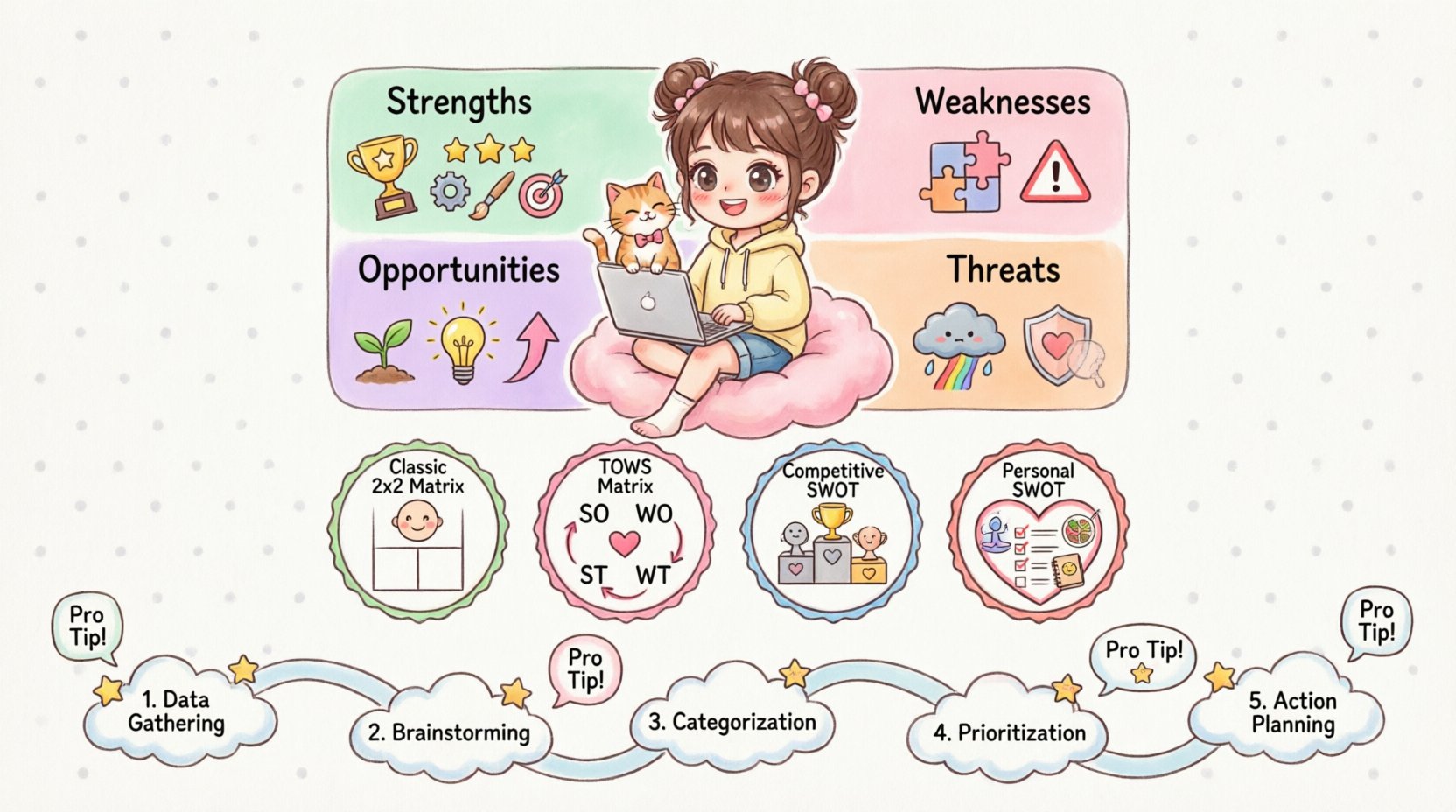
SWOT stands for Strengths, Weaknesses, Opportunities, and Threats. It is a matrix used to evaluate the strategic position of an organization or individual. For a solopreneur, this tool transforms abstract business goals into actionable data points. It forces a pause on daily execution to assess the broader context. The framework divides factors into two categories: internal and external.
- Internal Factors: These are elements within your control. They include your skills, financial reserves, workflow efficiency, and personal brand reputation.
- External Factors: These exist outside your control. They encompass market trends, competitor actions, economic shifts, and regulatory changes.
When applied correctly, this analysis prevents burnout by highlighting where effort yields the highest return. It also mitigates risk by identifying potential pitfalls before they become crises. The process is not a one-time event but a recurring practice that evolves as the business matures.
💡 Why Solopreneurs Need Structured Planning
In a traditional company, strategy is often distributed among departments. A marketing team handles outreach, while finance manages cash flow. In a solopreneurship, you are the entire department. Without a clear framework, it is easy to become reactive. You might chase every new trend or spend hours on administrative tasks that do not drive revenue.
Using a dedicated SWOT framework provides several distinct advantages:
- Focus: It identifies the few activities that actually move the needle.
- Resource Allocation: It helps decide where to invest time and money.
- Risk Management: It surfaces threats that a solo operator might overlook.
- Clarity: It separates personal feelings from business realities.
Many solopreneurs struggle with isolation. A structured analysis creates an objective mirror. It allows you to see the business as a customer or investor would, rather than as the founder. This detachment is crucial for making difficult decisions regarding pricing, product pivots, or service expansions.
🛠 Framework 1: The Classic 2×2 Matrix
The Classic 2×2 Matrix is the foundational approach. It divides the workspace into four quadrants. Each quadrant represents one of the four letters in SWOT. This visual layout is intuitive and requires no specialized tools. It is best used for initial discovery or broad annual planning.
🟢 Strengths (Internal)
These are your competitive advantages. In a solo context, strengths are often personal attributes. They might include:
- Specialized technical skills or certifications.
- Deep industry knowledge accumulated over years.
- Low overhead costs compared to agencies.
- Agility in decision-making.
- A strong personal network or referral base.
🔴 Weaknesses (Internal)
Weaknesses are areas where you lack resources or capability. Acknowledging these is not negative; it is strategic. Common weaknesses for solopreneurs include:
- Limited capacity to scale output quickly.
- Burnout risk due to wearing too many hats.
- Lack of cash reserves for downturns.
- Difficulty with specific tasks (e.g., accounting, sales).
- Dependency on a single income stream.
🟢 Opportunities (External)
Opportunities are favorable conditions in the market. These are external factors you can leverage. Examples include:
- Growing demand for remote services.
- Emerging technologies that simplify your workflow.
- Competitors leaving the market.
- Changes in consumer behavior favoring independent creators.
🔴 Threats (External)
Threats are external challenges that could harm the business. These require mitigation strategies. Typical threats include:
- Market saturation from low-cost alternatives.
- Economic recessions reducing client budgets.
- Platform algorithm changes affecting visibility.
- Regulatory changes impacting compliance.
⚡ Framework 2: The TOWS Matrix
While the Classic Matrix identifies factors, the TOWS Matrix connects them to create strategy. TOWS is an acronym that rearranges the order to emphasize action. The goal is to cross-reference internal and external factors to generate specific strategies. This is the most actionable framework for a solopreneur ready to execute.
The TOWS Matrix creates four types of strategic combinations:
- SO Strategies (Maxi-Maxi): Use Strengths to maximize Opportunities.
- WO Strategies (Mini-Maxi): Overcome Weaknesses by taking advantage of Opportunities.
- ST Strategies (Maxi-Mini): Use Strengths to minimize Threats.
- WT Strategies (Mini-Mini): Minimize Weaknesses and avoid Threats.
For example, a strength might be your ability to work remotely (S). An opportunity might be a global market for your services (O). The SO strategy is to actively market to international clients. A weakness might be slow delivery times (W). An opportunity might be automation tools (O). The WO strategy is to invest time in learning automation to speed up delivery. This matrix turns abstract lists into a roadmap.
🏆 Framework 3: Competitive SWOT
When operating alone, it is easy to lose sight of the competition. The Competitive SWOT framework shifts the focus outward. It compares your position directly against key competitors or alternative solutions. This is vital for positioning your price and value proposition accurately.
📊 Comparison Table
| Factor | Your Business | Competitor A | Competitor B |
|---|---|---|---|
| Price Point | Mid-range | High-end | Low-cost |
| Service Speed | Fast | Slow | Medium |
| Personalization | High | Low | Medium |
| Expertise | Specialized | General | General |
By filling out this grid, you can identify gaps in the market. If competitors are all high-cost, a mid-range option becomes a clear opportunity. If they are all slow, speed becomes a primary strength to advertise. This framework prevents you from building a business that simply replicates what already exists.
👤 Framework 4: Personal SWOT
A solopreneur business is inextricably linked to the founder. If the founder burns out, the business fails. The Personal SWOT analysis focuses on the individual behind the brand. It ensures that the business model supports the human being running it.
- Strengths: Energy levels, work style, mental resilience, health habits.
- Weaknesses: Procrastination triggers, stress tolerance, skill gaps in management.
- Opportunities: Hiring virtual assistants, delegating tasks, networking for support.
- Threats: Isolation, financial instability, lack of boundaries.
This framework helps you design a business that fits your life, rather than forcing your life to fit the business. It encourages setting boundaries and prioritizing sustainability over aggressive growth.
📝 Step-by-Step Implementation Guide
Implementing these frameworks requires discipline. Here is a reliable process to follow for consistent results.
1. Data Gathering
Before brainstorming, collect data. Review your financial records from the last year. Analyze your calendar to see where time is actually spent. Survey your clients to understand what they value most. Do not rely on assumptions. Use hard numbers and direct feedback.
2. Brainstorming Session
Schedule a dedicated time, at least two hours, with no interruptions. Use a large whiteboard or a physical notebook. Write down every point that comes to mind. Do not judge ideas yet. Quantity is more important than quality at this stage.
3. Categorization
Move each item into the correct quadrant. Be honest. A lack of marketing knowledge is a weakness, not a neutral fact. A new industry trend is an opportunity, even if you are not ready to exploit it yet.
4. Prioritization
Not all points are equal. Rank the top three items in each category. Focus on the ones that have the highest impact on your revenue or stability. Eliminate items that are minor distractions.
5. Action Planning
Convert the top priorities into tasks. Assign deadlines and owners. If you are using the TOWS framework, link the tasks to specific strategies. Review this list monthly.
⚠️ Common Mistakes to Avoid
Even with a framework, errors occur. Solopreneurs often fall into specific traps that reduce the value of the analysis.
- Being Too Vague: “Good marketing” is not a strength. “High conversion rate on email campaigns” is. Specificity drives action.
- Ignoring Weaknesses: It is tempting to focus only on strengths. However, unaddressed weaknesses can cause failure. Be ruthless in identifying gaps.
- Static Planning: A SWOT analysis done once a year is often outdated by month six. The market changes fast. Update the data quarterly.
- Confusing Internal and External: Do not list a competitor’s weakness as your strength. Your strength must be something you possess.
- Lack of Follow-Through: A document with no action plan is useless. Every insight must lead to a task.
🔄 Integrating SWOT into Monthly Reviews
To keep the analysis relevant, integrate it into your regular review cycle. Do not wait for a crisis to check your strategic position. Set aside the first hour of every month for a mini-SWOT review.
Ask these questions during the monthly review:
- Did a new threat emerge this month?
- Did we capitalize on an opportunity we identified?
- Has a weakness become more pronounced?
- Are our strengths still relevant?
This habit keeps the business agile. It prevents the need for major strategic pivots later. It turns strategic planning into a routine operational task. By treating the SWOT as a living document, you ensure the business remains aligned with reality.
📈 Scaling with Strategic Insight
As the business grows, the SWOT analysis evolves. A solo operation has different needs than a small team. The frameworks provided here remain valid, but the granularity changes. You may need to analyze the strengths of contractors rather than just yourself. You may need to assess threats related to hiring rather than just cash flow.
The core principle remains: align internal capabilities with external possibilities. Whether you are one person or a hundred, the logic of SWOT provides a clear path forward. It removes guesswork and replaces it with structured reasoning.
🛡 Final Thoughts on Strategic Clarity
Building a business alone is a complex challenge. It requires constant vigilance and clear thinking. The frameworks outlined in this guide offer a structured way to manage that complexity. They provide a method to turn uncertainty into strategy. By regularly applying these tools, you build a resilient business capable of withstanding market shifts.
Start with the Classic 2×2 Matrix to get oriented. Move to TOWS to generate action. Use the Competitive and Personal frameworks to refine your positioning and sustainability. Keep the process honest and specific. Avoid the temptation to make the analysis look good; make it work. The value lies in the execution of the insights, not the creation of the document.
With these tools, you can navigate the solo entrepreneur journey with confidence. You have the framework. The next step is to begin the work.