In the dynamic landscape of business strategy, identifying where to invest resources is often more critical than identifying what to invest in. Many organizations possess a vast array of potential market opportunities, yet they struggle to determine which ones align with their internal capabilities. This process is not merely about chasing trends; it is about strategic alignment. When a company aligns its market pursuits with its fundamental competencies, the likelihood of sustainable success increases significantly. This guide explores the methodology of prioritizing market opportunities based on core strengths, utilizing the framework of SWOT analysis to drive decision-making.
Understanding Core Strengths 🏗️
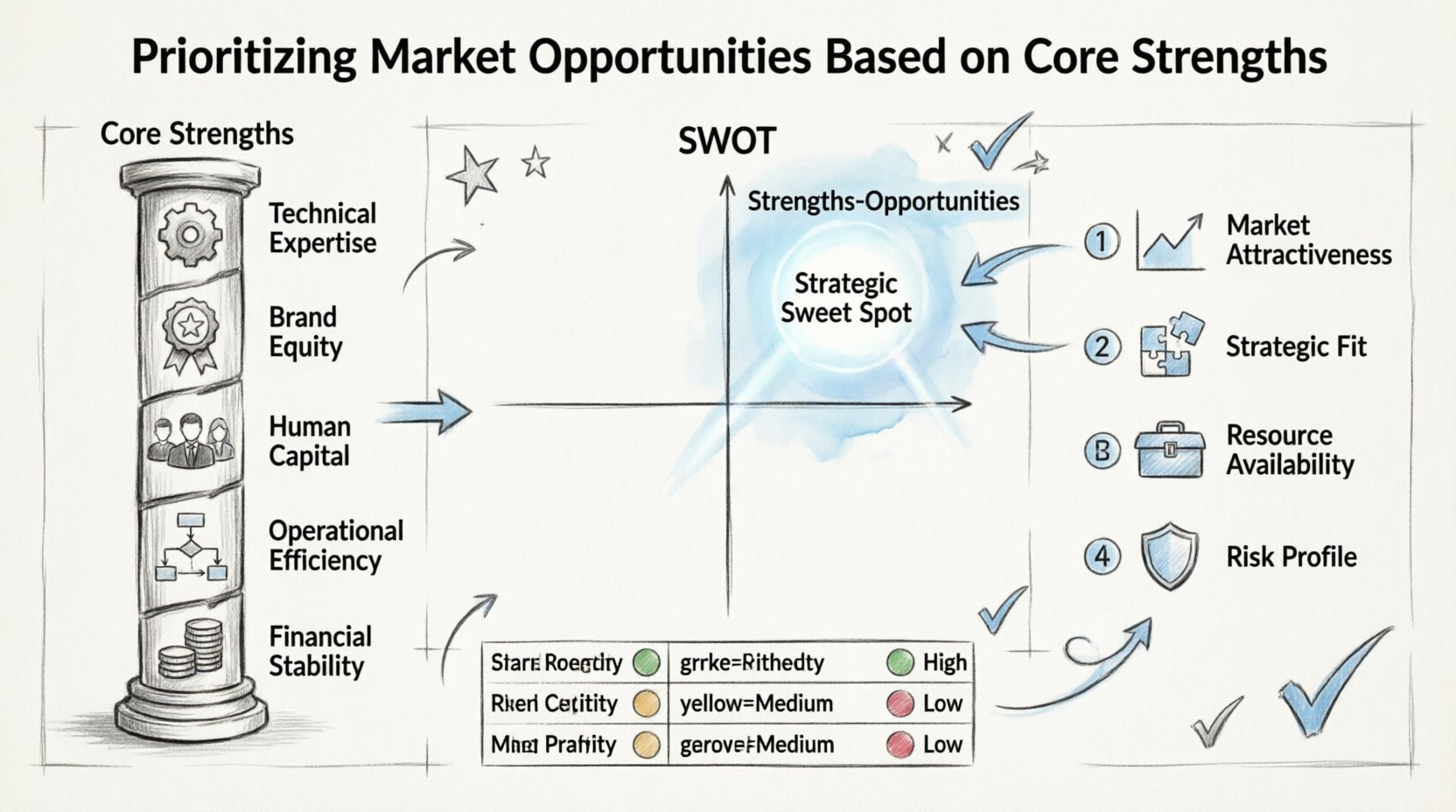
Before evaluating external opportunities, an organization must have a clear, unambiguous definition of its own internal assets. Core strengths are the unique capabilities, resources, or advantages that give an entity a competitive edge. These are not simply good practices; they are deeply embedded competencies that are difficult for competitors to replicate quickly.
- Technical Expertise: Proprietary technology, specialized engineering knowledge, or unique manufacturing processes.
- Brand Equity: Trust, reputation, and customer loyalty built over years of consistent delivery.
- Human Capital: A talented workforce, specialized management teams, or a unique corporate culture.
- Operational Efficiency: Supply chain mastery, cost leadership, or rapid deployment capabilities.
- Financial Stability: Strong cash flow, access to capital, or low debt ratios.
Identifying these elements requires introspection. It involves looking at past successes and analyzing the underlying factors that contributed to them. Often, teams confuse what they do well with what they enjoy doing. A core strength must be validated by market performance and tangible results. If a capability does not translate into value for the customer or efficiency for the business, it may be a nice-to-have, but it is not a strategic asset.
The Role of SWOT Analysis in Strategic Alignment 📊
SWOT analysis is a foundational tool for strategic planning. It stands for Strengths, Weaknesses, Opportunities, and Threats. While often used generically, its power lies in the intersection of internal and external factors. Specifically, the matrix helps map Strengths (S) against Opportunities (O) to identify the most viable paths forward.
The S-O Matrix
The most critical quadrant in this analysis is the Strength-Opportunity matrix. This quadrant represents the sweet spot where internal capability meets external demand. When a market opportunity exists that directly leverages a core strength, the barrier to entry for competitors is higher, and the execution risk is lower.
- Strengths (Internal): What are you good at?
- Opportunities (External): What does the market need?
- Strategic Fit: Where do these two intersect?
Conversely, pursuing opportunities that do not match core strengths often leads to resource dilution. It requires building new capabilities from scratch, which is costly and time-consuming. While diversification is a valid strategy, it carries higher risk. Prioritization focuses on the low-hanging fruit that aligns with existing competencies.
A Framework for Prioritization 🧩
To move from analysis to action, a structured framework is necessary. Random selection or intuition alone is insufficient for high-stakes decisions. The following framework allows teams to score and rank opportunities objectively.
1. Market Attractiveness
Does the market offer sufficient volume and growth potential? A small niche might be attractive, but is it large enough to impact the bottom line? Factors include market size, growth rate, and profitability margins.
2. Strategic Fit
How well does the opportunity utilize existing strengths? This is the most critical filter. If an opportunity requires capabilities the organization lacks, the score should reflect that deficit unless a plan to acquire them exists.
3. Resource Availability
Do you have the capital, time, and personnel to execute? Even a high-fit opportunity must be dropped if the organization is already at capacity. Resource constraints often dictate the order of operations.
4. Risk Profile
What could go wrong? Assess regulatory risks, competitive responses, and technological obsolescence. A high-reward opportunity with catastrophic downside risk may be unsuitable for a conservative organization.
Comparative Scoring Table 📋
To visualize this prioritization, organizations often use a weighted scoring matrix. Below is an example of how different market opportunities might be evaluated against core strengths.
| Opportunity | Market Size (1-10) | Strength Alignment (1-10) | Resource Need (1-10) | Feasibility Score |
|---|---|---|---|---|
| Product A Expansion | 8 | 9 | 4 | High Priority |
| Service B Launch | 6 | 5 | 7 | Medium Priority |
| Market C Entry | 9 | 3 | 9 | Low Priority |
| Product D Pivot | 5 | 8 | 3 | High Priority |
In this table, Product A Expansion scores high on market size and strength alignment while requiring fewer new resources. It is the clear winner. Market C Entry offers a large market but lacks alignment with core strengths, suggesting a high risk of failure or excessive cost to enter. This scoring system removes emotion from the decision-making process and highlights data-driven insights.
Resource Allocation and Opportunity Cost 💰
Every decision to pursue one opportunity is a decision not to pursue another. This is the concept of opportunity cost. When prioritizing based on core strengths, you are essentially betting on what you know you can do well. However, resources are finite.
- Capital: Investment in R&D, marketing, or infrastructure.
- Talent: Assigning top performers to new ventures vs. maintaining existing operations.
- Time: The window of opportunity in the market may close if execution is delayed.
When an opportunity scores high on alignment but requires significant resource reallocation, leadership must decide if the potential return justifies the disruption. Sometimes, it is better to maintain steady operations than to overextend into a new market that drains the core business. Protecting the cash flow of the existing business is often more important than chasing a theoretical gain.
Risk Assessment and Mitigation ⚠️
Even with strong alignment, risks exist. Market conditions change, competitors react, and internal dynamics shift. A robust prioritization process includes a risk assessment phase.
Common Risks
- Execution Risk: The team fails to deliver the product or service as promised.
- Market Risk: Customer demand is lower than anticipated.
- Competitive Risk: A larger player enters the space and dominates.
- Integration Risk: The new venture conflicts with existing business units.
Mitigation Strategies
For each high-priority opportunity, a mitigation plan should be drafted. If execution risk is high, consider a pilot program. If market risk is high, conduct thorough customer validation before full launch. If competitive risk is high, focus on differentiation rather than price wars. These steps ensure that the pursuit of opportunities is managed rather than reckless.
Validation Before Commitment 🔍
Before committing significant resources, validate the opportunity. This involves testing assumptions with real data. Small-scale experiments can reveal flaws in the strategy that large-scale planning might miss.
- Customer Interviews: Speak directly to potential users to understand their pain points.
- Prototype Testing: Build a minimum viable version to gauge interest.
- Financial Modeling: Create conservative and aggressive scenarios to understand break-even points.
- Competitor Analysis: Study how similar offerings have performed in the past.
This validation phase acts as a gatekeeper. It prevents the organization from sinking money into projects that look good on paper but fail in practice. It aligns the internal confidence with external reality.
Execution and Monitoring 🚀
Once an opportunity is prioritized and validated, execution begins. This phase requires clear goals and key performance indicators (KPIs). The initial SWOT analysis should not be forgotten; it serves as a reference point to ensure the project remains aligned with core strengths.
- Define Milestones: Set clear dates for deliverables.
- Assign Ownership: Designate specific individuals responsible for outcomes.
- Regular Reviews: Schedule periodic meetings to review progress against the plan.
- Adaptability: Be willing to pivot if the market data suggests the initial strategy is flawed.
Monitoring is not just about tracking numbers; it is about tracking alignment. If a project starts to drift away from the core strengths that justified its selection, it may need to be re-evaluated. The initial strength-based prioritization is only valid if the execution remains true to those strengths.
Continuous Improvement and Feedback Loops 🔄
Strategic planning is not a one-time event. It is a continuous cycle. After an initiative concludes, a post-mortem analysis should be conducted. What worked? What did not? Did the core strengths hold up under pressure? This feedback informs the next round of prioritization.
Over time, core strengths may evolve. A capability that was once a strength might become a commodity. New strengths may emerge. The organization must remain agile in its self-assessment. Regularly revisiting the definition of what makes the organization unique ensures that future opportunity prioritization remains relevant.
Integrating Weaknesses and Threats 🛡️
While the focus is on strengths, ignoring weaknesses and threats can be fatal. A comprehensive approach considers how strengths mitigate weaknesses and threats.
- Strength vs. Threat: How does your strength protect you from a market threat?
- Weakness vs. Opportunity: How can you mitigate a weakness to capture an opportunity?
For instance, if a weakness is limited distribution channels, but an opportunity exists in direct-to-consumer sales, the organization must decide if it has the strength to build that channel. If not, the opportunity might be deprioritized until the weakness is addressed. This holistic view prevents blind spots in the strategy.
Final Thoughts on Strategic Focus 🧭
Focusing on opportunities that match core strengths is a discipline. It requires the courage to say no to attractive but misaligned options. It demands a deep understanding of the internal machinery that drives success. By using SWOT analysis as a guide, organizations can navigate complexity with clarity.
The goal is not to do everything, but to do the right things. Prioritization ensures that energy is concentrated where it yields the highest return. This approach builds a sustainable trajectory for growth, rooted in reality rather than speculation. As the market evolves, so too must the assessment of strengths and opportunities, ensuring the organization remains resilient and responsive.