In the dynamic landscape of product development, the backlog is often the single most critical asset a team possesses. It represents the collective intent of the organization, the needs of the customer, and the technical roadmap for the future. However, a backlog that is too long, too vague, or poorly ordered becomes a liability rather than an asset. The challenge lies not in adding items to the list, but in deciding what to build next.
Prioritizing backlog items using story value is the mechanism that transforms a chaotic list of requests into a strategic plan for delivery. It forces teams to move beyond “who shouted the loudest” and toward a data-driven, value-centric approach. This article explores the nuances of assigning value to user stories, the techniques available to measure that value, and the operational habits required to maintain a healthy, high-value backlog.
Understanding the Concept of Story Value 🧠
Before diving into methods, we must define what “value” actually means in this context. In software development, value is often conflated with revenue. While revenue is a component, it is not the only one. Story value is a composite metric that reflects the benefit a specific user story delivers to the product, the business, the user, and the engineering team.
When we prioritize by story value, we are essentially answering the question: “If we only have resources to build one thing next, which one generates the most positive impact?”
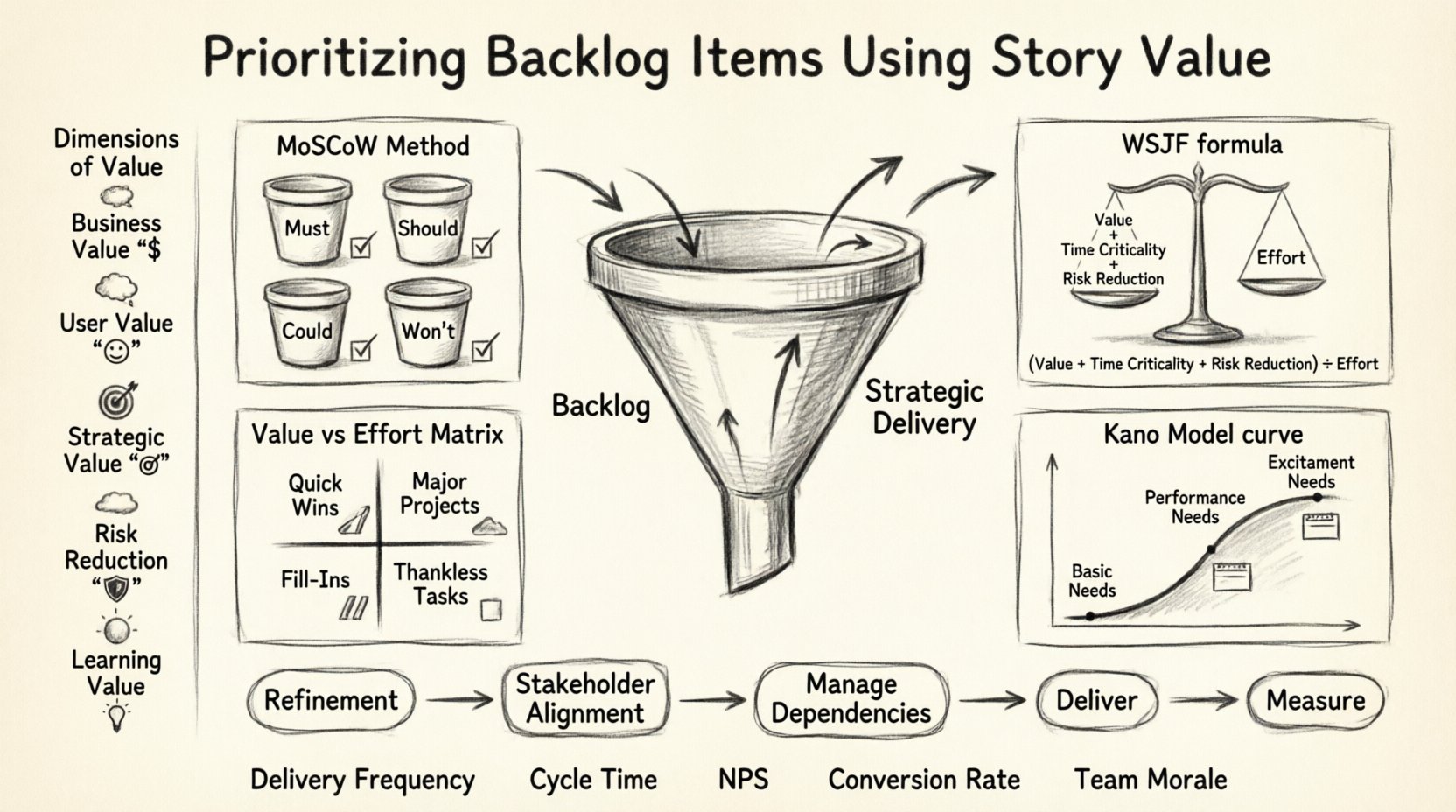
Dimensions of Value
Value is multidimensional. A single story might not score highly on financial return but could be critical for other reasons. Effective prioritization considers these dimensions:
- Business Value: Direct impact on revenue, cost reduction, or market share.
- User Value: Improvement in user experience, accessibility, or satisfaction.
- Strategic Value: Alignment with long-term company goals or regulatory compliance.
- Risk Reduction: Technical debt removal, security hardening, or architecture validation.
- Learning Value: Gaining data or feedback that informs future decisions.
Ignoring any of these dimensions can lead to short-term gains that cause long-term pain. For example, a feature that generates immediate revenue but violates a compliance requirement is not high value; it is a liability.
Why Prioritization Often Fails ⚠️
Many teams struggle with backlog management. They collect requirements but fail to order them effectively. Understanding common pitfalls helps in avoiding them.
- Vocal Minority: Prioritizing based on the most aggressive stakeholder rather than the highest value.
- Recency Bias: Focusing on the newest ideas while ignoring foundational work that has been pending.
- Lack of Clarity: Attempting to prioritize stories that are not well-defined or understood.
- Ignoring Dependencies: Placing a high-value feature at the top of the backlog when it is blocked by a low-priority technical task.
- Static View: Treating the backlog as a fixed document rather than a living artifact that changes with market conditions.
To succeed, the team must adopt a mindset where value is quantified, debated, and revisited regularly. It requires discipline to say “no” to good ideas so that great ideas can be built.
Techniques for Estimating Story Value 📊
There is no single magic formula for value. Different contexts require different models. Below are the most effective frameworks for prioritizing backlog items using story value.
1. The MoSCoW Method 🛠️
MoSCoW is a classic prioritization technique used to reach a shared understanding of the importance of requirements. It categorizes items into four buckets:
- Must Have: Non-negotiable. The product cannot be released without these. Examples: Security fixes, core checkout flow.
- Should Have: Important but not vital for the immediate release. These cause significant inconvenience if missing.
- Could Have: Desirable features that provide extra value but are not expected. Examples: Nice-to-have UI animations.
- Won’t Have: Items agreed to be left out for the current timeframe. This is crucial for setting expectations.
While MoSCoW is simple, it does not inherently weigh the degree of value. Two “Must Haves” might have vastly different impacts on the business. Therefore, it is often best used in conjunction with other scoring methods.
2. Weighted Shortest Job First (WSJF) ⚖️
WSJF is derived from the Theory of Constraints and is designed to maximize the economic benefit of delivery. It calculates a score by dividing the total value by the time required to deliver the story.
The formula looks like this:
WSJF Score = (Job Value + Time Criticality + Risk Reduction) / Job Size (Effort)
Key components include:
- Job Value: A composite score of user benefit, business value, and strategic alignment.
- Time Criticality: How urgent is it to do this now? Does the value decay over time?
- Risk Reduction: Does this reduce technical or business risk?
- Job Size: The relative effort required (often estimated in story points).
The advantage of WSJF is that it explicitly factors in the cost of delay. A feature that is highly valuable but only slightly less urgent than another might be deprioritized if it takes twice as long to build. It optimizes for throughput.
3. Value vs. Effort Matrix 📉
This is perhaps the most visual and accessible tool for teams. It plots items on a two-dimensional graph.
- X-Axis: Effort (Time, Cost, Complexity).
- Y-Axis: Value (Revenue, Satisfaction, Impact).
This creates four quadrants:
- Quick Wins (High Value, Low Effort): Prioritize these immediately. They provide momentum and low risk.
- Major Projects (High Value, High Effort): These are strategic initiatives. Break them down into smaller stories to deliver value incrementally.
- Fill-Ins (Low Value, Low Effort): Do these when you have spare capacity or to maintain morale.
- Thankless Tasks (Low Value, High Effort): Avoid these. They consume resources without delivering return.
Using a table helps visualize these distinctions clearly.
| Quadrant | Characteristics | Action |
|---|---|---|
| Quick Wins | High Value, Low Effort | Execute First |
| Major Projects | High Value, High Effort | Plan & Schedule |
| Fill-Ins | Low Value, Low Effort | Fill Gaps |
| Thankless Tasks | Low Value, High Effort | Reject or Refactor |
4. The Kano Model 📈
The Kano Model classifies customer preferences into five categories. It helps distinguish between features that delight users and those that are merely expected.
- Basic Needs: If these are missing, users are dissatisfied. If present, they don’t necessarily increase satisfaction (e.g., a car having brakes).
- Performance Needs: Satisfaction increases linearly with the level of performance (e.g., battery life on a phone).
- Excitement Needs: Unexpected features that create high satisfaction (e.g., a surprise free upgrade).
Prioritization using Kano involves ensuring Basic Needs are met before moving to Performance or Excitement features. Investing in Excitement features when Basic Needs are unmet is a waste of resources.
The Process of Backlog Ordering 🔄
Applying a technique is only half the battle. The process of how the team interacts with the backlog determines the quality of the output. Prioritization is not a one-time event; it is a continuous practice.
1. Discovery and Refinement
Before a story can be prioritized, it must be understood. A vague story cannot have an accurate value assigned to it. During refinement sessions:
- Define the acceptance criteria clearly.
- Identify the specific user or stakeholder who benefits.
- Estimate the relative size or effort.
- Document the hypothesis of value (e.g., “We believe that changing the checkout button will increase conversion by 5%.”)
If a story cannot be refined to this level, it should not be at the top of the priority list.
2. Stakeholder Alignment
Value is subjective. The engineering team might see technical debt as high value, while the marketing team sees a new feature as high value. Alignment is key.
- Regular Syncs: Hold bi-weekly or monthly sessions where product owners and stakeholders review the top of the backlog.
- Transparency: Show the team the rationale behind decisions. When people understand the “why,” they are more likely to support the decision.
- Feedback Loops: Allow stakeholders to question the value assessment. If a stakeholder argues a “low value” item is actually critical, re-evaluate the scoring.
3. Managing Dependencies
Sometimes a high-value item is blocked by a low-value item. This is a common friction point.
- Re-evaluate the Blocker: Is the blocker actually required? Can we decouple the stories?
- Swap Priorities: If the blocker is a prerequisite for value delivery, it may need to be moved up, even if its intrinsic value is low.
- Parallel Work: Can the team work on the high-value item in a way that avoids the dependency for now?
Common Pitfalls in Valuation 🚧
Even with a framework, teams fall into traps. Being aware of these traps helps maintain objectivity.
- Confusing Effort with Value: A complex task is not necessarily high value. A simple UI tweak might drive significant engagement.
- Ignoring Opportunity Cost: Every story chosen is a story rejected. The cost of not building the “other” thing must be factored in.
- Over-Engineering Estimation: Spending hours debating the exact value of a story that will be built in two weeks. Keep the estimation proportional to the uncertainty.
- Fixed Priorities: Assuming the order is set in stone. Market conditions change. A “Must Have” today might be irrelevant next quarter.
Measuring the Success of Prioritization 📏
How do we know the prioritization strategy is working? We need metrics that reflect value delivery, not just output.
- Delivery Frequency: Are we shipping value faster? Improved prioritization often leads to higher throughput.
- Cycle Time: The time from start to finish for a story. High-value items should ideally move faster if dependencies are managed well.
- Customer Satisfaction: Net Promoter Score (NPS) or user feedback on released features.
- Business Metrics: Conversion rates, retention rates, or revenue attributed to specific features.
- Team Morale: Teams feel more motivated when they see their work delivering tangible results rather than getting lost in a backlog.
If the team is delivering features that the stakeholders claim are “not important,” the prioritization process is broken. If the team is constantly interrupted by “urgent” requests, the process is not resilient enough.
The Role of the Product Owner in Value 🎓
In many frameworks, the Product Owner (PO) holds the responsibility for the backlog. Their role is to maximize the value of the product resulting from the work of the Development Team.
To do this effectively, the PO must:
- Be Available: Be accessible to the team for clarification.
- Be Decisive: Make the call when data is insufficient. Indecision is a cost.
- Communicate Vision: Ensure the team understands the “North Star” so they can make micro-decisions aligned with value.
- Protect the Team: Shield the team from external noise that does not align with the current value focus.
However, the PO should not work in a silo. The Development Team provides the technical perspective on feasibility and effort, which is crucial for the Value/Effort calculation. Collaboration yields the most accurate valuation.
Navigating Change and Uncertainty 🌪️
One of the biggest challenges in prioritization is the volatility of requirements. A feature planned for high value might become obsolete due to a competitor’s launch or a shift in regulation.
To navigate this:
- Shorten Iterations: If you deliver every two weeks, you can re-evaluate priorities more frequently than if you deliver every quarter.
- Keep the Top 20% Sharp: Focus refinement efforts on the top 20% of the backlog. The rest can remain slightly fuzzy until they move up.
- Document Assumptions: When a story is prioritized, document the assumptions behind its value. If those assumptions prove false, the story can be easily deprioritized.
Flexibility is not a weakness; it is a requirement for modern product development. The backlog is a hypothesis about what the market wants. The delivery is the experiment to prove it.
Conclusion on Continuous Value Delivery ✅
Prioritizing backlog items using story value is an exercise in judgment, communication, and discipline. It requires moving away from gut feeling and toward structured decision-making. By utilizing techniques like WSJF, Value/Effort matrices, and the Kano Model, teams can ensure they are working on the right things.
The goal is not just to finish the backlog, but to deliver the right outcomes. When value is the primary lens, resources are allocated to the most impactful work, risk is managed proactively, and the team remains aligned with the strategic vision of the organization. This approach builds a culture of accountability and results, where every story has a clear purpose and a measurable impact.
Start by auditing your current backlog. Identify the top five items. Ask the team to score them using one of the methods above. Reorder based on the score. Deliver. Measure. Repeat. This cycle is the engine of sustainable product growth.