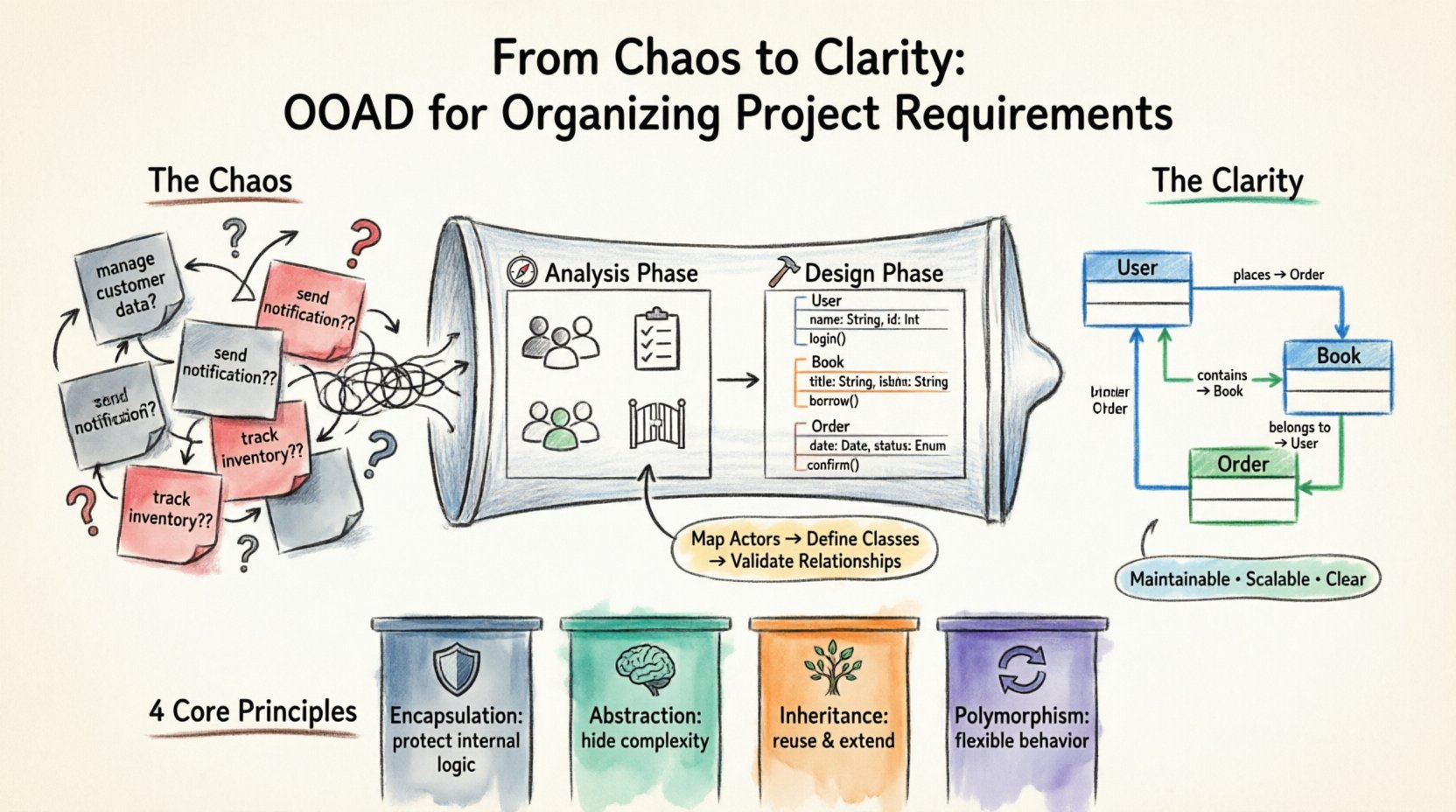
Software projects often begin with a flurry of activity. Stakeholders share ideas, business analysts document needs, and developers prepare to build. However, the input rarely arrives in a neat, structured format. Instead, requirements often arrive as scattered notes, conflicting priorities, and vague descriptions. This state of disorder is common. When the initial input lacks structure, the resulting system becomes fragile, difficult to maintain, and prone to failure. The path from this initial chaos to a stable, clear system lies in a disciplined approach to modeling. Object-Oriented Analysis and Design (OOAD) provides that path. It transforms abstract needs into concrete structures that mirror the real-world problems they solve. This guide explores how applying OOAD principles brings order to complex requirements without relying on specific tools.
Understanding the Challenge: Messy Requirements 📋
Before diving into the solution, it is necessary to acknowledge the nature of the problem. Requirements gathering is inherently messy. Business stakeholders speak in terms of outcomes and value, while technical teams think in terms of logic and data. This gap creates friction. A request to “manage customer data” might mean different things to a salesperson and a database administrator. One thinks of a contact list; the other thinks of schema normalization. When these conflicting views are not reconciled early, technical debt accumulates immediately.
Messy requirements typically exhibit specific characteristics:
- Redundancy: The same concept appears in multiple places with slight variations.
- Ambiguity: Terms are used without clear definitions.
- Hidden Dependencies: One requirement relies on another that has not been explicitly stated.
- Scope Creep: New needs emerge that contradict or expand the original scope without formal tracking.
Without a structured method to address these issues, the development team risks building a system that works for today but breaks tomorrow. OOAD addresses this by forcing the team to identify entities, their attributes, and their behaviors explicitly. It acts as a filter, separating essential business rules from incidental details.
What is Object-Oriented Analysis and Design? 🏗️
Object-Oriented Analysis and Design is a methodology for modeling systems based on the concept of objects. Unlike procedural approaches that focus on functions and actions, OOAD focuses on the nouns and verbs of the business domain. It models the system as a collection of interacting entities. Each entity represents a real-world concept, such as an order, a user, or a product.
The process consists of two distinct but overlapping phases:
- Analysis: Understanding the problem domain without worrying about implementation details. This phase identifies what the system must do.
- Design: Deciding how the system will do it. This phase defines the structure of the code and data.
By separating these phases, teams avoid the common pitfall of mixing business logic with technical constraints too early. The analysis phase ensures the requirements are sound. The design phase ensures the solution is efficient. Together, they create a blueprint that guides the entire project lifecycle.
The Analysis Phase: Mapping Business Logic 🧭
The analysis phase is where the chaos of requirements begins to settle. The primary goal is to identify the key actors and their interactions. This is often achieved through use cases. A use case describes a specific goal an actor wants to achieve within the system. It does not describe the steps the system takes, but rather the value delivered.
Consider a scenario involving a digital library. The requirements might state “Users can borrow books.” In a functional approach, this might become a function named BorrowBook. In an object-oriented approach, the focus shifts to the User and the Book. The interaction between them becomes the focus.
Identifying Actors and Use Cases
To organize messy requirements, start by listing all potential actors. These are the roles interacting with the system, such as administrators, customers, or automated services. Next, map the goals for each actor. This creates a high-level view of the system’s purpose.
- Actors: Define who initiates the action.
- Goals: Define what the actor wants to accomplish.
- Preconditions: Define what must be true before the action starts.
- Postconditions: Define the state of the system after the action completes.
This structure forces stakeholders to think about the context of their requests. It reveals hidden dependencies. For example, a requirement to “send a notification” might depend on the precondition that “the user has a valid email address.” Identifying this early prevents logic errors later.
The Design Phase: Structuring the Solution 🔨
Once the analysis is complete, the design phase begins. This is where the abstract concepts from the analysis are translated into concrete structures. The core unit of design is the class. A class defines the data (attributes) and behavior (methods) associated with a specific concept.
In the library example, a Book class might have attributes like title, author, and status. The status attribute might track whether the book is available or checked out. This data structure directly reflects the requirements identified in the analysis phase.
Mapping Requirements to Classes
To ensure clarity, every requirement should trace back to a specific class or relationship. This traceability is crucial for maintaining order. If a new requirement arises, you can determine exactly which part of the design it affects.
The following table illustrates how to map requirements to design elements:
| Requirement | Related Entity | Attribute | Behavior |
|---|---|---|---|
| Users must authenticate to access the system | User | password_hash, session_token | login(), logout() |
| The system must calculate discounts | Order | discount_rate, total_amount | calculate_discount(), apply_tax() |
| Admins can view all user logs | Admin, LogEntry | timestamp, action_type | fetch_logs(), filter_logs() |
This mapping ensures that the design remains grounded in business needs. It prevents the team from adding technical features that do not serve a purpose. It also highlights gaps where requirements are missing. If a behavior is listed without a corresponding entity, the team knows to investigate further.
Core Principles: The Foundation of Clarity 🧱
Object-Oriented Design relies on four fundamental principles. These principles act as guidelines for organizing code and requirements. They help ensure that the system remains flexible and understandable over time.
1. Encapsulation 🛡️
Encapsulation involves bundling data and methods together while restricting direct access to some of an object’s components. In the context of requirements, this means protecting internal logic from external interference. For example, a BankAccount object should not allow a user to directly change the balance. Instead, the user must request a deposit or withdrawal. This enforces business rules automatically.
When organizing messy requirements, encapsulation helps isolate complexity. If a rule changes, you only need to update the specific class, not the entire system. This reduces the risk of unintended side effects.
2. Abstraction 🧠
Abstraction focuses on hiding complex implementation details and showing only the essential features of an object. It allows developers to work with high-level concepts without getting bogged down in low-level mechanics. In requirements analysis, abstraction helps manage complexity by grouping similar items.
For instance, instead of defining every specific type of vehicle (car, truck, motorcycle), you might define a general Vehicle concept. Specific types inherit from this general concept. This simplifies the requirement model and reduces redundancy.
3. Inheritance 🌿
Inheritance allows a new class to adopt the properties and behaviors of an existing class. This is useful when dealing with categories of requirements that share common traits. It promotes code reuse and consistency.
If multiple user types require similar authentication processes, you can define a base AuthUser class. Specific types like StandardUser and AdminUser can inherit from it. This ensures that security logic is consistent across all user types without repeating the code.
4. Polymorphism 🔄
Polymorphism allows objects to be treated as instances of their parent class rather than their actual class. This means different objects can respond to the same message in different ways. In requirements, this translates to flexibility. A processPayment method might behave differently depending on whether the payment is made via credit card or bank transfer.
This principle allows the system to handle new requirements without modifying existing code. When a new payment method is introduced, you simply add a new class that implements the payment interface.
Handling Complexity: Dealing with Ambiguity 🤔
Even with OOAD, ambiguity can persist. Requirements often evolve, and new information emerges during development. The key is to have a process for managing this evolution without breaking the existing structure.
One effective strategy is to prioritize requirements into layers. The core business logic forms the foundation. Secondary features sit on top. This ensures that the most critical requirements are stable. If a secondary feature changes, it should not impact the core.
Another strategy is to use interfaces. An interface defines a contract for behavior without implementing it. This allows different parts of the system to communicate without knowing the internal details of each other. It creates a boundary that protects the system from change.
Refactoring as a Requirement
It is important to view refactoring not as a technical task, but as a requirement management activity. As understanding of the domain deepens, the structure of the system must evolve. If the current design no longer matches the requirements, it must be changed. This is not a failure; it is a sign that the analysis phase was incomplete.
Teams should allocate time specifically for structural improvement. Ignoring structural decay leads to a system that is impossible to modify. Regular reviews of the class diagram against the requirement document help identify areas that need attention.
Communication Benefits of OOAD 🗣️
One of the most valuable aspects of OOAD is its ability to facilitate communication. The diagrams and models used in this process serve as a common language between business stakeholders and technical teams.
When stakeholders review a class diagram, they can see if the concepts match their mental model of the business. If they see a Customer class that stores address, they can immediately confirm if this aligns with their understanding. If it does not, the discrepancy is caught early.
This shared understanding reduces the likelihood of costly mistakes. It also speeds up the onboarding process for new team members. A well-structured design document explains the system better than hours of verbal explanation.
Visualizing Relationships
Relationships between entities are often the most confusing part of messy requirements. OOAD clarifies these through specific notations:
- Association: A link between two classes.
- Aggregation: A whole-part relationship where parts can exist independently.
- Composition: A strong whole-part relationship where parts cannot exist without the whole.
- Inheritance: An “is-a” relationship.
Using these notations correctly forces the team to think about the nature of the relationships. It prevents loose coupling where components depend on each other too tightly. It ensures that the system can scale as requirements grow.
Common Pitfalls to Avoid ⚠️
While OOAD is powerful, it is not a magic solution. There are common mistakes that can undermine its benefits. Awareness of these pitfalls helps maintain the clarity of the project.
Over-Engineering
It is easy to create complex structures that are not needed. Creating multiple layers of abstraction for a simple requirement adds unnecessary overhead. The design should be as simple as possible, but no simpler. Every class and relationship should have a clear justification based on a requirement.
Premature Abstraction
Designing for future needs before they exist is a common error. This leads to generic classes that do not fit current requirements well. Instead, focus on solving the problem at hand. Allow the design to evolve as requirements become clearer.
Neglecting the Business Domain
Sometimes teams focus so much on technical structure that they lose sight of the business value. The model must reflect the business, not just the technology. If a class represents a technical concept rather than a business concept, it creates a disconnect. Always validate the model against the stakeholder’s domain.
Maintaining Clarity Over Time 🔄
The work does not end once the design is complete. Maintaining clarity requires ongoing discipline. The system will change, and the design must change with it. Regular audits of the architecture ensure that the model remains accurate.
Teams should encourage documentation that stays in sync with the code. When a class is modified, the documentation should be updated. This creates a living record of the system’s evolution. It prevents the drift between what the code does and what the requirements say it should do.
Collaboration is key. Design decisions should be made collectively. This ensures that everyone understands the structure and the reasoning behind it. It distributes knowledge and prevents bottlenecks where only one person understands the system.
Conclusion on Structure 📝
Organizing messy project requirements is a critical task that determines the success of a software project. Object-Oriented Analysis and Design offers a robust framework for achieving this. By focusing on entities, behaviors, and relationships, teams can transform ambiguity into structure. The principles of encapsulation, abstraction, inheritance, and polymorphism provide the tools needed to build systems that are maintainable and scalable.
Success in this area does not come from tools alone. It comes from a disciplined mindset. It requires a commitment to understanding the problem deeply before building the solution. When requirements are clear, the path to implementation becomes straightforward. When requirements are messy, OOAD provides the method to untangle them. Applying these concepts consistently leads to systems that stand the test of time and change.
Start with the analysis. Map the actors. Define the classes. Validate the relationships. Follow this process, and the chaos will give way to clarity. The result is a system that works as intended and adapts as needed. This is the true value of a well-organized approach to software development.