
Entering the field of software development involves more than just learning syntax. It requires a deep understanding of how to structure systems, manage complexity, and communicate logic effectively. Object-Oriented Analysis and Design (OOAD) serves as a cornerstone methodology for building robust, maintainable software solutions. For professionals aiming to advance from junior roles to architectural leadership, mastering these concepts is essential.
This guide addresses the most frequent inquiries regarding OOAD, focusing on its practical application in career progression. We will explore the core principles, distinguish between analysis and design phases, and examine how these skills translate into professional value. Whether you are preparing for an interview or refining your daily workflow, understanding these mechanics provides a solid foundation for long-term success.
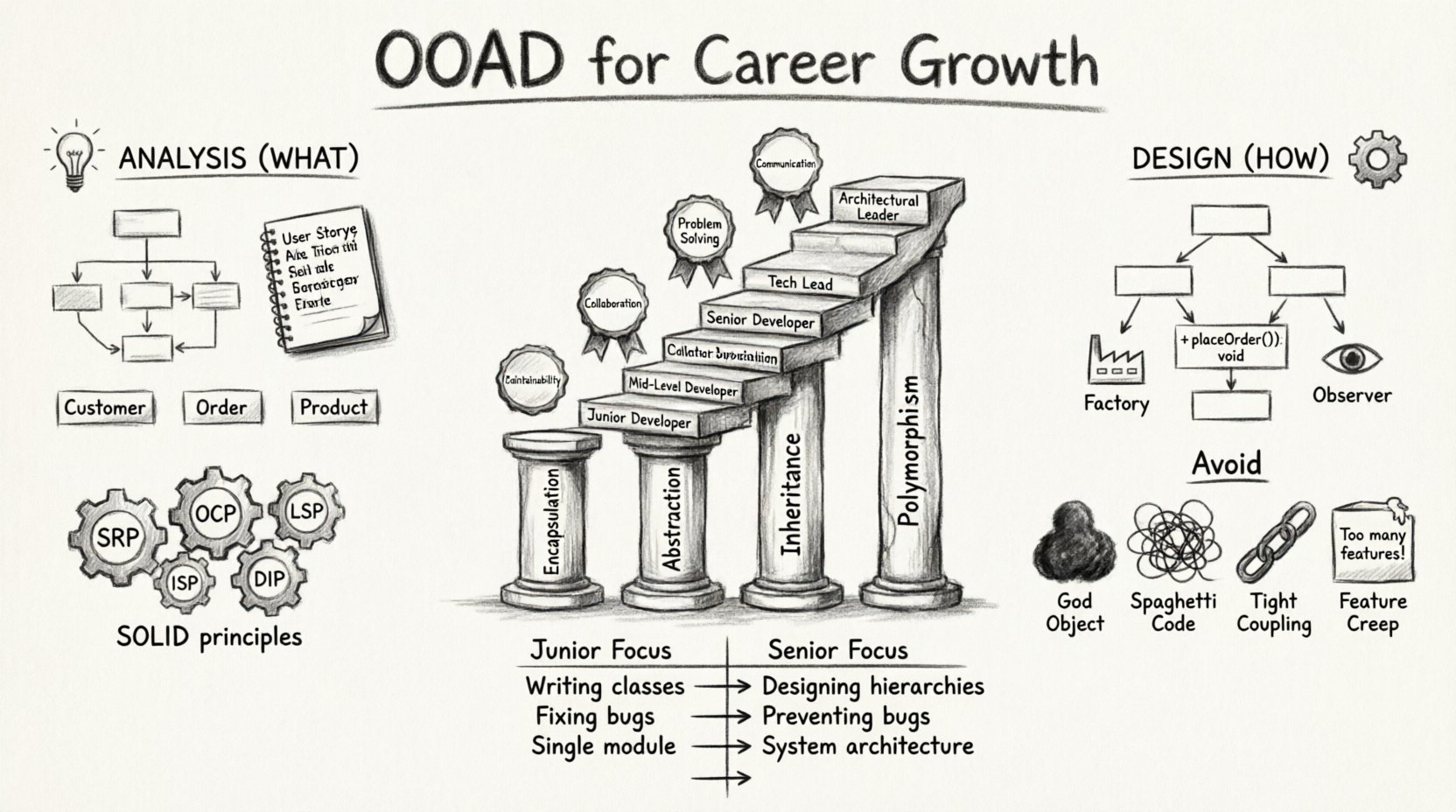
Understanding the Foundation: What is OOAD? 🧱
Object-Oriented Analysis and Design is a structured approach to software development. It focuses on identifying objects, their properties, behaviors, and relationships within a system. Unlike procedural programming, which organizes code around functions and logic flow, OOAD centers on data structures that encapsulate both state and behavior.
When you engage in OOAD, you are essentially modeling the real-world entities relevant to your problem domain. This modeling process helps in creating a blueprint that is easier to understand, modify, and extend over time. It shifts the focus from how the program works to what the program represents.
- Analysis Phase: Focuses on understanding the problem domain without worrying about technical implementation details.
- Design Phase: Translates the analysis model into a technical solution, defining classes, interfaces, and architecture.
Why OOAD Drives Career Trajectory 📈
Proficiency in OOAD is a strong signal of technical maturity. Employers value engineers who can design systems that scale. As you progress in your career, the complexity of the problems you solve increases. Simple scripts do not require complex design patterns, but enterprise-level systems do.
Here is how OOAD directly impacts career growth:
- Maintainability: Clean object structures reduce the time required to fix bugs or add new features later.
- Collaboration: Well-defined interfaces allow multiple developers to work on different parts of a system without stepping on each other’s toes.
- Problem Solving: It encourages breaking down large problems into manageable, reusable components.
- Communication: OOAD provides a shared vocabulary (like inheritance, polymorphism) that streamlines discussions with peers and stakeholders.
Top Questions & Detailed Answers ❓
To clarify common uncertainties, we have compiled the most critical questions regarding OOAD and its application in the workplace.
1. What is the primary difference between Analysis and Design? 🤔
This is a fundamental distinction. Analysis is about the what. It involves gathering requirements, identifying user needs, and defining the scope of the system. It answers questions like: “What does the user need to do?” and “What data is involved?”.
Design is about the how. Once the analysis model is established, design takes that information and maps it to technical constructs. It answers questions like: “What classes will represent this data?” and “How will these classes interact?”.
Skipping analysis often leads to design flaws. If you build a house without a blueprint, the structure may collapse. Similarly, coding without analysis often results in a fragile system.
2. How do the four pillars of Object-Oriented Programming apply here? 🏛️
While often discussed in the context of coding, these pillars are critical during the design phase. They guide how you structure your classes and relationships.
- Encapsulation: Bundling data and methods together while restricting direct access to some components. This protects data integrity.
- Abstraction: Hiding complex implementation details and showing only the necessary features. This reduces cognitive load for users of the system.
- Inheritance: Allowing a class to derive properties and behaviors from another class. This promotes code reuse.
- Polymorphism: Allowing objects to be treated as instances of their parent class. This enables flexible and interchangeable behavior.
Understanding these concepts allows you to create flexible systems that adapt to change without requiring a complete rewrite.
3. Is OOAD still relevant in modern development? 💻
Yes. While functional programming and microservices architectures have gained popularity, the underlying principles of OOAD remain vital. Even in functional paradigms, the concept of data modeling and separation of concerns aligns with OOAD principles. Many modern frameworks utilize OOAD concepts internally, such as dependency injection and interface segregation.
Ignoring these principles can lead to “spaghetti code,” where logic is scattered and hard to trace. OOAD provides a disciplined way to organize code, regardless of the specific syntax used.
Core Principles Comparison 📊
To better visualize how OOAD principles guide development decisions, refer to the table below.
| Principle | Definition | Benefit to Career |
|---|---|---|
| Single Responsibility | A class should have one reason to change. | Reduces complexity and testing time. |
| Open/Closed | Open for extension, closed for modification. | Allows new features without breaking existing ones. |
| Liskov Substitution | Subtypes must be substitutable for base types. | Ensures reliability when swapping implementations. |
| Interface Segregation | Clients should not be forced to depend on methods they do not use. | Keeps interfaces clean and focused. |
| Dependency Inversion | Depend on abstractions, not concretions. | Decouples high-level logic from low-level details. |
Distinguishing Analysis from Design in Practice 🛠️
Many professionals struggle to separate these phases. In an agile environment, they often overlap, but the mental model remains distinct.
During Analysis:
- Create Use Case diagrams.
- Define user stories.
- Identify domain entities (e.g., Customer, Order, Product).
- Map out data flow without code.
During Design:
- Define class diagrams.
- Specify method signatures.
- Choose design patterns (e.g., Factory, Observer).
- Plan database schema.
Keeping these phases distinct ensures that business requirements drive technical decisions, rather than technical limitations dictating business functionality.
Soft Skills in Technical Design 🤝
Technical skills alone do not guarantee career growth. The ability to communicate design decisions is equally important. OOAD provides a framework for this communication.
- Documentation: Writing clear design documents helps onboard new team members quickly.
- Code Reviews: Understanding OOAD allows you to give constructive feedback on peers’ code structure.
- Stakeholder Management: Explaining technical constraints in terms of business value (e.g., “This design choice speeds up future reporting”) builds trust.
Common Design Anti-Patterns ⚠️
Avoiding mistakes is often as important as knowing best practices. Here are common pitfalls that hinder career progression and system health.
- God Object: A class that knows too much and does too much. This makes testing and modification difficult.
- Spaghetti Code: Unstructured code with complex, tangled control flow. It is hard to debug.
- Tight Coupling: When classes depend heavily on the internal details of other classes. This makes the system rigid.
- Feature Creep: Adding too many features during the analysis phase without proper prioritization.
Recognizing these patterns early allows you to refactor proactively rather than reactively.
Preparing for Senior Roles 🎓
As you move from junior to senior levels, the expectation shifts from writing code to designing systems. OOAD becomes the primary tool for this transition.
Senior engineers are expected to:
- Make high-level architectural decisions.
- Mentor junior developers on design principles.
- Predict future scalability issues.
- Balance technical debt with feature delivery.
The following table outlines the shift in focus between career stages.
| Responsibility | Junior Focus | Senior Focus |
|---|---|---|
| Code Structure | Writing functional classes. | Designing class hierarchies. |
| Problem Solving | Fixing bugs in existing code. | Preventing bugs through design. |
| Scope | Single feature or module. | Entire system architecture. |
| Communication | Reporting status. | Negotiating requirements. |
Staying Current in a Changing Landscape 🔄
Technology evolves rapidly. New languages and frameworks emerge constantly. However, the fundamental principles of OOAD remain stable. To stay competitive:
- Read Design Patterns: Books like “Design Patterns: Elements of Reusable Object-Oriented Software” provide timeless examples.
- Refactor Regularly: Practice improving existing codebases without changing external behavior.
- Study Legacy Systems: Analyze older codebases to understand how design decisions impact longevity.
- Engage with Communities: Discuss design trade-offs on technical forums to see diverse perspectives.
Investing time in these areas ensures that your skills remain relevant regardless of which specific tools become popular.
Final Thoughts on Professional Development 💡
Career growth in software engineering is a marathon, not a sprint. Object-Oriented Analysis and Design provides the discipline required to navigate complex challenges. By focusing on clear structures, maintainable code, and effective communication, you position yourself as a valuable asset to any organization.
Remember that tools change, but the need for organized, logical systems remains constant. Continuously refining your ability to analyze problems and design solutions will serve you throughout your entire career. Focus on the principles, not just the syntax, and you will build a foundation that supports long-term success.