In the landscape of modern software development, two distinct philosophies often clash: the rapid iteration of Agile methodologies and the structured rigor of Object-Oriented Analysis and Design (OOAD). Teams frequently face a dilemma where speed threatens architectural integrity, while excessive design slows down delivery. This guide explores how to harmonize these forces, ensuring that software remains maintainable without sacrificing the responsiveness that Agile promises.
When building complex systems, the temptation to dive straight into coding is strong. However, skipping the analysis phase often leads to a tangled web of dependencies. Conversely, over-designing can result in a waterfall of documentation that never sees the light of day. The key lies in understanding where OOAD fits within the iterative lifecycle.
Foundations of Object-Oriented Analysis and Design 🧱
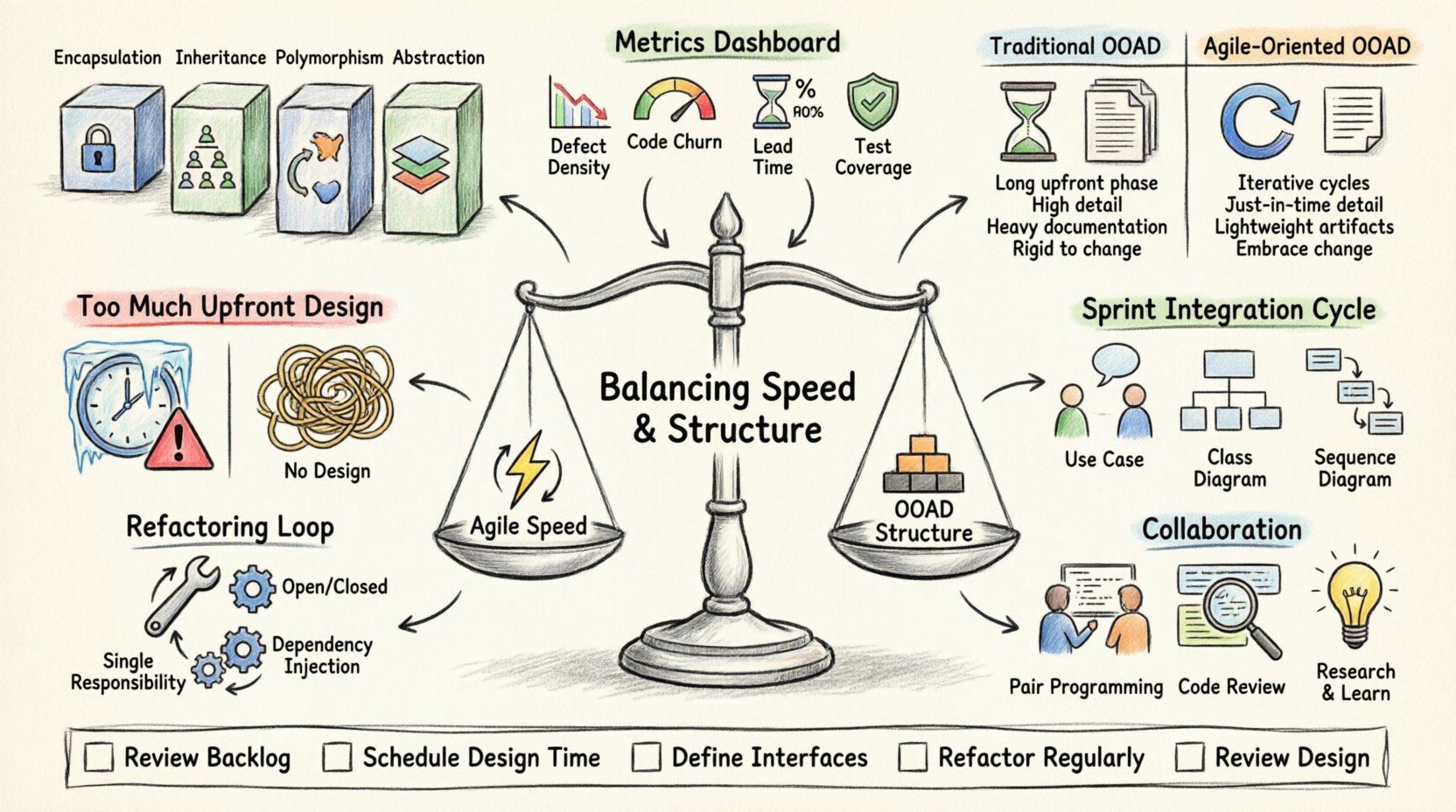
Object-Oriented Analysis and Design focuses on modeling real-world problems using objects that encapsulate data and behavior. This approach prioritizes concepts like encapsulation, inheritance, and polymorphism to create flexible systems. In a traditional setting, this involves extensive upfront planning. In an Agile environment, the principles remain the same, but the timing and granularity shift.
- Encapsulation: Hiding internal states and requiring all interaction to occur through an object’s methods.
- Inheritance: Creating new classes based on existing ones to share behavior.
- Polymorphism: Allowing objects to be treated as instances of their parent class rather than their actual class.
- Abstraction: Hiding complex reality while exposing only the necessary parts.
These pillars provide the structure needed to manage complexity. Without them, codebases degrade quickly into spaghetti code, making future changes risky and expensive.
Agile Principles vs. Traditional Design 📜
Agile frameworks emphasize individuals and interactions over processes and tools. They value working software over comprehensive documentation. At first glance, this seems to contradict the heavy documentation often associated with OOAD. However, this is a misconception. Agile does not reject design; it rejects unnecessary design.
Traditional design often attempts to predict every future requirement. Agile design accepts uncertainty. The goal is to create a structure that is robust enough to handle current needs but flexible enough to adapt to future changes.
| Aspect | Traditional OOAD | Agile-Oriented OOAD |
|---|---|---|
| Timing | Upfront, before coding | Just-in-time, during iterations |
| Detail Level | High fidelity, comprehensive | Low fidelity, evolving |
| Documentation | Extensive manuals | Code comments, diagrams, wikis |
| Change Handling | Formal change requests | Iterative refinement |
The Danger of Too Much Upfront Design 🚫
Attempting to design the entire system before writing a single line of code is a common pitfall. It assumes that requirements are static. In reality, user needs evolve. A detailed class diagram created three months ago may be obsolete by the time the first feature is released.
Excessive design leads to:
- Analysis Paralysis: Teams spend weeks planning instead of delivering value.
- False Confidence: A perfect design does not guarantee perfect implementation.
- Rigidity: Heavy models are difficult to update when requirements shift.
In an Agile context, design should be emergent. The architecture emerges from the code as features are built, guided by technical constraints rather than hypothetical scenarios.
The Danger of No Design 🌪️
On the opposite end of the spectrum lies the belief that any design is bad design. Some teams argue that code is self-documenting and that design happens during refactoring. While refactoring is vital, having zero design intent leads to structural debt.
Without OOAD principles, teams risk:
- High Coupling: Changes in one module break unrelated modules.
- Low Cohesion: Classes perform unrelated tasks, making them hard to maintain.
- Code Duplication: Without clear abstractions, similar logic is repeated across the codebase.
- Onboarding Friction: New developers struggle to understand the system flow.
Object-oriented thinking provides a mental model that helps developers understand how different parts of the system interact. It is not about drawing diagrams; it is about organizing logic.
Integrating OOAD Artifacts into Sprints 📊
How do you bring structure into a two-week sprint cycle? The answer lies in lightweight artifacts that serve a specific purpose without becoming a burden.
Use Case Diagrams for Context
Before coding a feature, the team should define the actors and actions. A simple Use Case diagram helps clarify what the system must do. It does not need to be detailed; it just needs to map the flow.
- Identify the Actor: Who is using the system?
- Identify the Goal: What are they trying to achieve?
- Identify the System Boundary: What is inside and outside the scope?
Class Diagrams for Core Logic
For complex domains, a Class Diagram is useful. However, in Agile, these are often created just-in-time. When a new feature requires a specific domain model, sketch the relationships between objects. Focus on:
- Responsibilities: What does this object know and do?
- Relationships: Does it own another object? Does it reference it?
- Interfaces: What services does it offer to others?
Sequence Diagrams for Interaction
When multiple objects interact to complete a task, a Sequence Diagram clarifies the order of messages. This is particularly helpful for API integrations or complex state transitions.
Refactoring as a Continuous Process 🔧
Refactoring is the engine that keeps OOAD relevant in Agile. It is the process of restructuring existing code without changing its external behavior. In a traditional model, refactoring is a separate phase. In Agile, it is integrated into every sprint.
During a sprint, developers should:
- Apply the Single Responsibility Principle: Ensure a class has one reason to change.
- Check Open/Closed Principle: Make classes open for extension but closed for modification.
- Reduce Dependency: Inject dependencies rather than creating them internally.
This continuous improvement prevents the accumulation of technical debt. If a class becomes too large, split it. If a method does too much, break it down. This is the practical application of OOAD principles in a fast-paced environment.
Collaboration and Knowledge Sharing 🤝
Design is not a solitary activity. In Agile teams, design discussions happen during ceremonies like Sprint Planning and Backlog Refinement.
Pair Programming: Two developers working on the same code allows for immediate design feedback. One person drives, the other navigates the architecture. This is a powerful way to enforce OOAD standards.
Code Reviews: Reviews should not just check for bugs. They should check for design smells. Is the naming consistent? Is the logic encapsulated properly? Are the dependencies clear?
Technical Spikes: When uncertainty is high, dedicate a short period to research. This is where OOAD modeling shines. Sketch out potential solutions to see which offers the best structure before committing to implementation.
Common Pitfalls and How to Avoid Them ⚠️
Even with good intentions, teams often stumble. Recognizing these pitfalls early saves time and effort.
| Pitfall | Consequence | Mitigation Strategy |
|---|---|---|
| Over-Engineering | Wasted time building for hypothetical needs | YAGNI (You Ain’t Gonna Need It) |
| Under-Designing | System becomes unmaintainable quickly | Plan for the next two iterations only |
| Ignoring Domain Logic | Business rules get lost in technical code | Use Domain-Driven Design principles |
| Static State Abuse | Hard to test, hard to predict | Prefer dependency injection over static calls |
Metrics for Success 📈
How do you know if your balance is working? Look at metrics that reflect health, not just speed.
- Defect Density: Are bugs decreasing as features are added?
- Code Churn: Are the same files being modified repeatedly? High churn indicates poor design.
- Lead Time: How long does it take to move a feature from code to production? Stable lead times suggest a healthy architecture.
- Test Coverage: Good design is testable. High coverage indicates good separation of concerns.
The Role of Documentation in Agile 📝
Agile values working software over documentation, but it does not mean documentation is useless. The type of documentation changes.
- Living Documentation: Code comments and README files that are updated with every change.
- Visual Aids: Diagrams that are kept on a whiteboard or digital board, updated as needed.
- API Contracts: Clear definitions of how services interact.
Documentation should serve the developer, not the auditor. If a diagram is not used, delete it. If a comment is misleading, fix it. The goal is clarity.
Future Trends in Design and Development 🚀
The landscape is shifting. Microservices and cloud-native architectures require a different approach to OOAD. Objects are no longer just in-memory structures; they are often distributed services.
However, the core principles remain. Encapsulation is now about API boundaries. Inheritance is often replaced by composition. The need for structure is greater than ever due to system complexity.
Teams that master the balance between OOAD and Agile will be better equipped to handle this complexity. They will build systems that are both fast to deliver and long-lasting to maintain.
Practical Steps for Implementation 🛠️
Ready to start? Here is a checklist for your next sprint.
- Review the Backlog: Identify features that require significant architectural changes.
- Schedule Design Time: Allocate time in the sprint for sketching class structures.
- Define Interfaces: Agree on how components will talk to each other before implementation.
- Refactor Regularly: Dedicate 10-20% of sprint capacity to improving code structure.
- Review Design: Include architectural review in your definition of done.
By following these steps, you integrate design thinking into the daily flow. It becomes a habit, not a hurdle.
Final Thoughts on Balance ⚖️
The relationship between Object-Oriented Analysis and Design and Agile teams is not adversarial. It is symbiotic. Agile provides the speed and feedback loop; OOAD provides the structure and stability. When used together, they create a development environment where quality and velocity coexist.
Success is not about choosing one over the other. It is about applying the right amount of design at the right time. It is about knowing when to sketch a diagram and when to write code. It is about respecting the complexity of the problem while respecting the constraints of the timeline.
As you move forward, keep your eyes on the long-term health of the codebase. A fast car that breaks down every mile is useless. A slow car that never breaks down is also less than ideal. The goal is a vehicle that goes fast and stays on the road. This is the essence of balancing speed and structure in software engineering.