
Building robust software systems requires more than just writing code. It demands a structured approach to understanding problems and constructing solutions. Object-Oriented Analysis and Design (OOAD) provides this foundation. This methodology focuses on modeling systems as collections of interacting objects. By following a disciplined process, teams can create scalable, maintainable, and flexible applications. This guide explores the end-to-end lifecycle of OOAD, from gathering initial requirements to the final deployment phase.
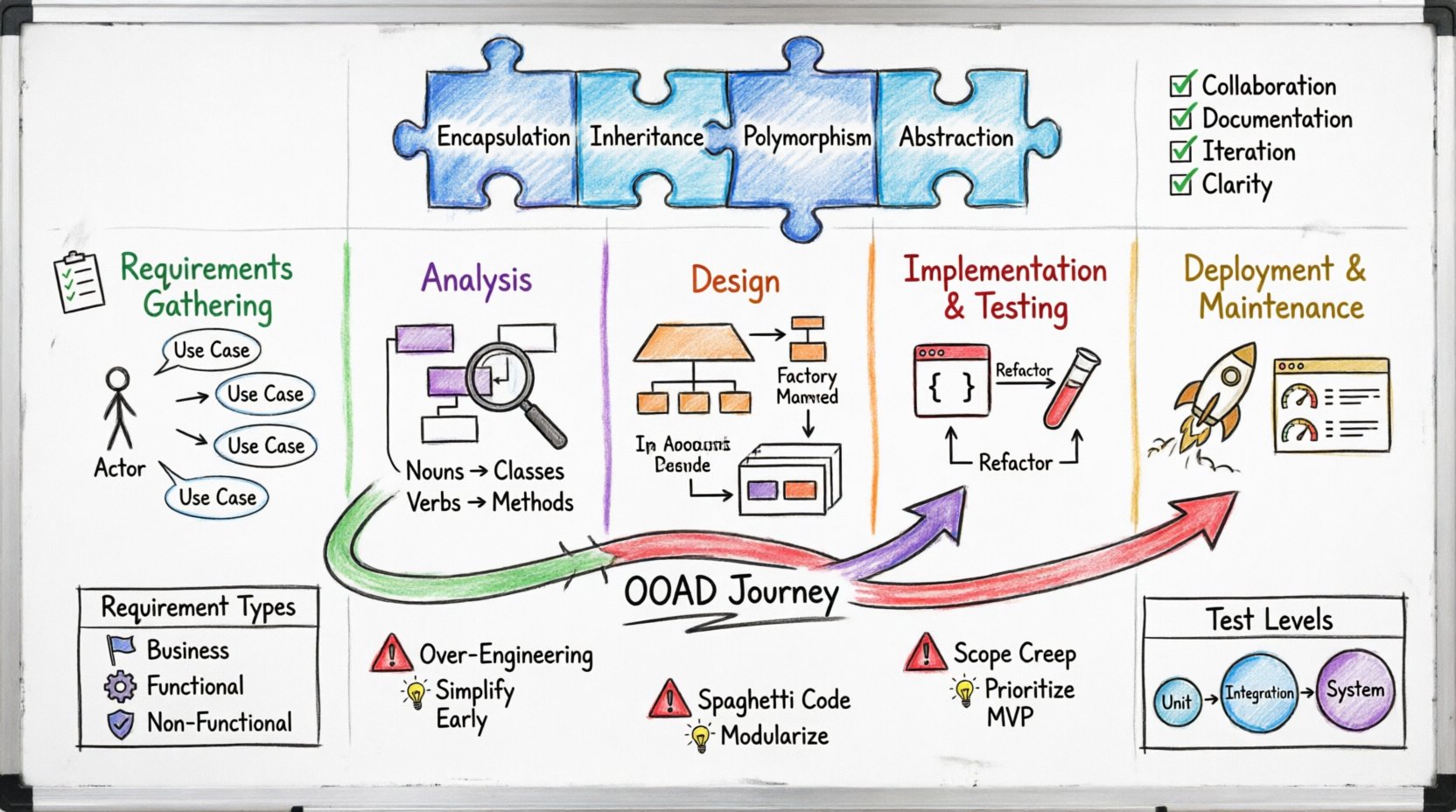
1. Understanding the Core Concepts 🧩
Before diving into the phases, it is essential to grasp the fundamental pillars that support Object-Oriented (OO) methodologies. These principles guide how data and behavior are organized.
- Encapsulation: Bundling data with the methods that operate on that data, restricting direct access to some of an object’s components.
- Inheritance: Allowing new classes to adopt properties and behaviors from existing classes, promoting code reuse.
- Polymorphism: The ability of different objects to respond to the same message in different ways.
- Abstraction: Hiding complex implementation details and showing only the necessary features of an object.
OOAD applies these concepts systematically. It separates the what (analysis) from the how (design), ensuring that the solution matches the problem before implementation begins.
2. Phase One: Requirements Gathering 📋
The journey begins with understanding the problem domain. This phase is about capturing user needs and system constraints without worrying about technical solutions. The goal is to create a clear picture of functionality.
Identifying Actors and Use Cases
Actors represent roles that interact with the system. They can be human users or external systems. Use cases describe the interactions between actors and the system to achieve specific goals.
- Primary Actors: Those who initiate the use case.
- Secondary Actors: Those who support the primary actor or system.
- Use Case Diagrams: Visual representations mapping out these interactions.
During this stage, teams must ask critical questions:
- Who is using the system?
- What are they trying to achieve?
- What are the constraints (time, budget, security)?
Documenting Functional Requirements
Functional requirements define what the system must do. These are often captured in user stories or formal specifications. They serve as the contract between stakeholders and developers.
| Requirement Type | Description | Example |
|---|---|---|
| Business Requirement | High-level goal of the organization | Increase sales by 20% |
| Functional Requirement | Specific system behavior | System must generate invoice PDF |
| Non-Functional Requirement | Quality attributes | Response time under 2 seconds |
3. Phase Two: Object-Oriented Analysis 🔍
Once requirements are clear, the analysis phase translates them into a domain model. This phase ignores technical implementation details and focuses purely on the domain concepts.
Identifying Classes and Objects
Analysis involves identifying nouns from the requirement documents. These nouns often become classes. Verbs become methods or behaviors.
- Noun Extraction: From “The user creates an order,” “User” and “Order” are potential classes.
- Relationships: Determine how classes interact. Are they associations, aggregations, or compositions?
- Attributes: List the properties belonging to each class.
Behavioral Modeling
Objects are not just data containers; they have behavior. State diagrams and sequence diagrams help visualize how objects interact over time.
- Sequence Diagrams: Show the flow of messages between objects in a specific scenario.
- State Machine Diagrams: Define the lifecycle of an object (e.g., Order status: Pending, Shipped, Delivered).
Validating the Domain Model
The model must be reviewed against the requirements. Does every use case have a corresponding flow in the model? Are all necessary entities identified? This step prevents costly changes later in development.
4. Phase Three: Object-Oriented Design 🛠️
Design bridges the gap between the abstract analysis model and the concrete code. Here, technical decisions are made regarding architecture, patterns, and interfaces.
System Architecture
The overall structure of the system is defined. This includes layering (e.g., Presentation, Business Logic, Data Access) and component separation. The goal is to minimize dependencies between modules.
- High-Level Design: Defines major components and their interactions.
- Low-Level Design: Details specific classes, interfaces, and algorithms.
Design Patterns
Design patterns are proven solutions to common problems. Using them ensures the system is robust and easier to maintain.
- Creational Patterns: Handle object creation mechanisms (e.g., Factory, Singleton).
- Structural Patterns: Deal with class and object composition (e.g., Adapter, Decorator).
- Behavioral Patterns: Manage communication between objects (e.g., Observer, Strategy).
Interface Design
Interfaces define contracts for how components interact. By programming to interfaces, the system becomes flexible. If a concrete implementation changes, other parts of the system remain unaffected.
Database Design
While OOAD focuses on objects, persistence is crucial. The object model must be mapped to the data storage layer. This process involves:
- Defining entity relationships.
- Optimizing for read/write performance.
- Ensuring data integrity and normalization.
5. Phase Four: Implementation and Testing 🧪
With a solid design blueprint, coding begins. The design guides the implementation, ensuring that the code reflects the intended architecture.
Writing Clean Code
Code should be readable and self-documenting. Adhering to naming conventions and structure reduces cognitive load for developers.
- Use descriptive names for variables and methods.
- Keep functions short and focused on a single task.
- Eliminate code duplication (DRY principle).
Testing Strategies
Testing ensures the design was implemented correctly. Different levels of testing are required:
| Test Level | Focus | Method |
|---|---|---|
| Unit Testing | Individual components | Automated scripts |
| Integration Testing | Component interaction | API calls |
| System Testing | End-to-end functionality | User scenarios |
Refactoring
Refactoring is the process of improving the internal structure of code without changing its external behavior. It is essential when the initial design needs adjustment based on coding realities.
6. Phase Five: Deployment and Maintenance 🚀
The final phase involves releasing the software to the production environment and ensuring it remains operational.
Deployment Strategies
How the software reaches the end-user matters. Strategies include:
- Big Bang: Releasing the entire system at once.
- Phased Rollout: Releasing features to subsets of users.
- Blue-Green Deployment: Running two identical environments to switch traffic seamlessly.
Monitoring and Support
Once deployed, the system must be monitored for performance issues and bugs. Logging and alerting mechanisms are vital.
- Track error rates and response times.
- Gather user feedback for future iterations.
- Plan for security patches and updates.
7. Common Challenges and Solutions ⚠️
Implementing OOAD is not without difficulties. Understanding common pitfalls helps teams navigate them.
Over-Engineering
Designing for every possible future scenario leads to complex, rigid systems. Solution: Follow the YAGNI (You Ain’t Gonna Need It) principle. Build only what is needed now.
Spaghetti Code
Unstructured code with high coupling makes maintenance impossible. Solution: Enforce strict separation of concerns and rely on design patterns.
Scope Creep
Requirements change frequently, disrupting the design. Solution: Use an iterative approach. Revisit the analysis phase when significant changes occur.
8. Key Takeaways for Success ✅
Successful OOAD relies on discipline and communication. Here are the core pillars to remember:
- Collaboration: Analysts and developers must work closely throughout the process.
- Documentation: Keep models up to date with the code.
- Iteration: Accept that design evolves. Be willing to refactor.
- Clarity: Ensure diagrams and requirements are understandable to all stakeholders.
By adhering to these principles, teams can deliver software that stands the test of time. The investment in analysis and design pays dividends in reduced technical debt and higher quality releases.
9. Integrating OOAD into Modern Workflows 🔄
While OOAD is a classic methodology, it adapts well to modern agile practices.
- Agile Alignment: OOAD fits into sprint planning. Design tasks can be broken down into user stories.
- Continuous Integration: Automated tests ensure design integrity is maintained as code changes.
- DevOps: Deployment pipelines automate the transition from design to production.
Modern tools support the visualization of these models, allowing teams to collaborate in real-time. However, the underlying logic remains the same: understand the problem, model the solution, and build it.
10. Final Thoughts on System Quality 🎯
The quality of a software system is determined long before the first line of code is written. Object-Oriented Analysis and Design provides the roadmap for that quality. It transforms vague ideas into concrete structures.
When teams commit to this process, they reduce risk. They identify logical errors early when they are cheap to fix. They create a shared language between business stakeholders and technical teams. This alignment is the true value of OOAD.
As systems grow in complexity, the need for structured design increases. Skipping analysis to save time often results in longer development cycles later. Investing in a thorough walkthrough ensures that the final product meets the needs of the users effectively.
Adopting these practices creates a culture of quality. It encourages developers to think critically about structure and behavior. It fosters a mindset where maintainability is as important as functionality. In the long run, this approach leads to sustainable software ecosystems.
Remember, the goal is not just to build software, but to build software that lasts. OOAD is the tool that makes longevity possible.