
Building robust software requires more than just writing code. It demands a structured approach to understanding problems and organizing solutions. Object-Oriented Analysis and Design (OOAD) provides this framework. By focusing on objects, their interactions, and their responsibilities, developers create systems that are maintainable, scalable, and adaptable. This guide explores practical scenarios designed to sharpen your design thinking. We will walk through specific exercises, evaluate design choices, and establish criteria for success without relying on hype or shortcuts.
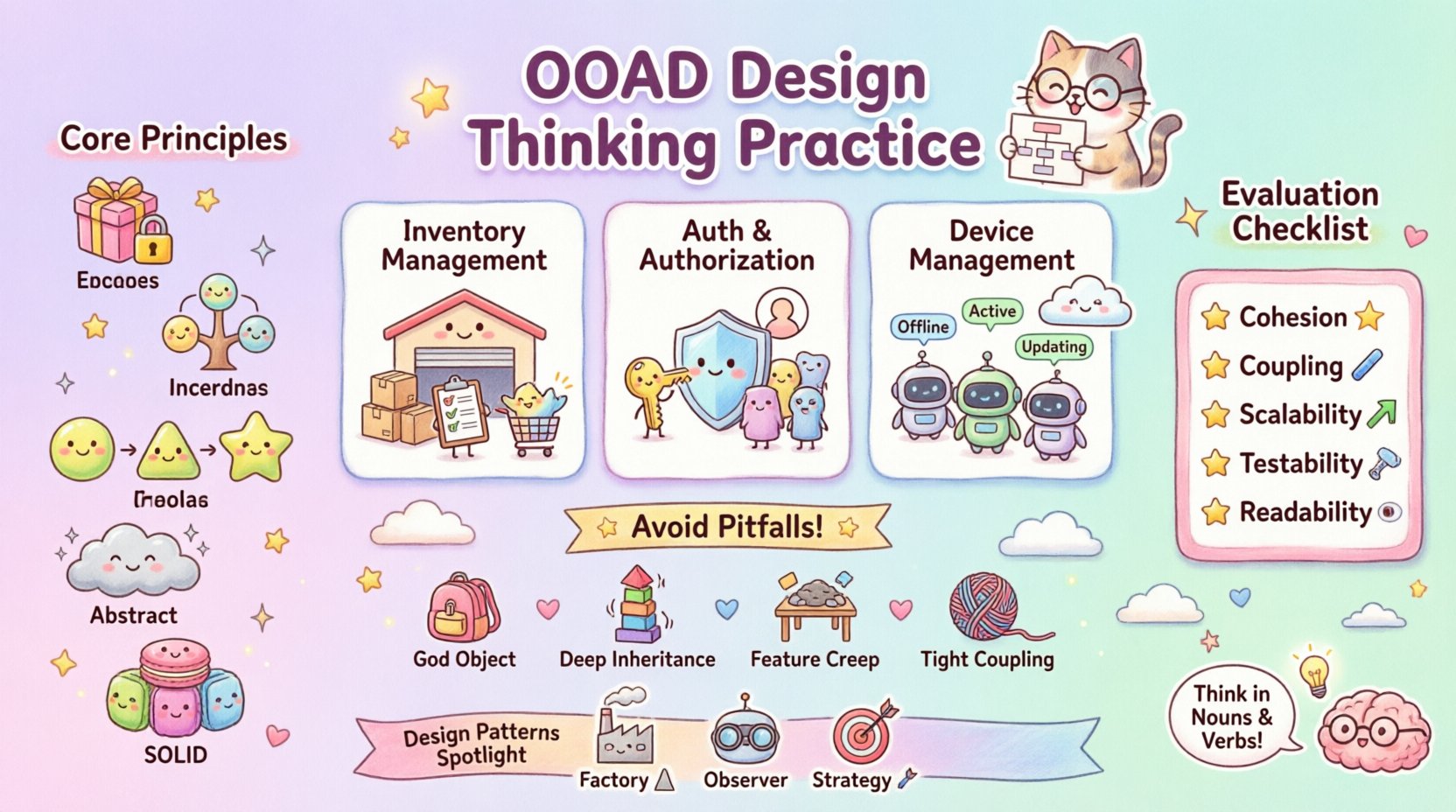
Understanding the Core Principles 🏗️
Before diving into complex scenarios, it is essential to ground ourselves in the fundamental pillars of object-oriented thinking. These principles guide the creation of classes and their relationships. Without a solid grasp of these concepts, design scenarios can quickly become tangled webs of dependencies.
- Encapsulation: Hiding internal state and requiring interaction through well-defined interfaces.
- Inheritance: Establishing hierarchies to share common behaviors and attributes.
- Polymorphism: Allowing objects to be treated as instances of their parent class, enabling flexibility.
- Abstraction: Simplifying complex reality by modeling classes appropriate to the perspective of the user.
- SOLID Principles: A set of five principles intended to make software designs more understandable, flexible, and maintainable.
Each scenario below challenges you to apply these principles in a realistic context. The goal is not just to produce a diagram, but to justify every relationship and responsibility assigned to an object.
Scenario 1: E-Commerce Inventory Management 🛒
Imagine a system managing stock for an online retailer. The business logic is complex because items vary in type (physical, digital, subscription), shipping rules differ, and stock levels must be accurate across multiple warehouses. This scenario tests your ability to model variability and constraints.
Exercise Steps
- Identify Key Entities: List the nouns found in the problem statement. Examples include Product, Warehouse, Order, Customer, and InventoryRecord.
- Define Responsibilities: For each entity, determine what data it holds and what actions it performs. Does a Product object know about shipping costs? Usually not. Does an InventoryRecord know how to reserve stock? Yes.
- Determine Relationships: Map out how these entities interact. A Product can exist in many Warehouses. An Order contains many InventoryRecords.
- Apply Polymorphism: Consider how different product types (e.g., Perishable vs. Standard) might be handled. Use a base Product class and specific subclasses.
Design Considerations
- Should stock availability be checked at the Product level or the InventoryRecord level? Answer: InventoryRecord. A product exists globally, but stock is local to a warehouse.
- How do you handle concurrent updates to the same stock item? Answer: Implement a locking mechanism or optimistic concurrency control within the InventoryRecord.
- What happens if an order fails payment? Answer: The InventoryRecord must be able to release the reserved quantity.
Class Structure Example
| Class Name | Key Attributes | Key Methods |
|---|---|---|
| Product | id, name, description, basePrice | getDetails(), updatePrice() |
| InventoryRecord | productId, warehouseId, quantity, reservedQuantity | reserve(), release(), checkAvailability() |
| Order | orderId, customerId, items[], status | addItem(), calculateTotal(), cancel() |
Scenario 2: User Authentication and Authorization 🔐
Security is a critical concern in modern systems. This scenario focuses on verifying identity and determining access rights. The design must be secure, extensible for new login methods, and efficient in performance.
Exercise Steps
- Model Users and Roles: Create a User class that holds credentials. Create a Role class to define permissions.
- Separate Concerns: Do not mix authentication logic (checking passwords) with authorization logic (checking permissions). Create separate components for each.
- Handle Multiple Auth Types: The system might support passwords, tokens, or biometrics. Use an interface or abstract class for AuthenticationMethod.
- Session Management: Design an object to manage active sessions, ensuring a user cannot be logged in from multiple devices simultaneously if required.
Design Considerations
- Security: Never store plain text passwords. The User class should only hold a hashed value.
- Extensibility: If you need to add two-factor authentication later, the design should allow it without rewriting the core User logic.
- Performance: Authorization checks happen on every request. Cache roles where possible to reduce database lookups.
Interaction Flow
1. User submits credentials.
2. AuthenticationController validates against the CredentialStore.
3. If valid, an AuthToken is generated.
4. AuthorizationService checks if the User has the required Role for the requested Action.
5. Resource is accessed or access is denied.
Scenario 3: IoT Device Management System 📡
The Internet of Things introduces unique challenges. Devices are often resource-constrained, communicate over unreliable networks, and need to be managed remotely. This scenario tests your ability to model state machines and communication protocols.
Exercise Steps
- Define Device States: A device might be Offline, Connecting, Active, Error, or Updating. Use a State Pattern to manage transitions.
- Handle Connectivity: Create a NetworkManager class responsible for sending data and receiving commands. It should handle retries and timeouts.
- Telemetry Data: Model data points as objects. Temperature, Humidity, and Voltage might all share a common TelemetryData interface.
- Command Execution: Commands sent from the cloud (e.g., “Reboot”) should be queued and executed safely by the Device.
Design Considerations
- State Management: A device cannot be “Active” and “Updating” at the same time. Enforce strict state transitions.
- Resource Limits: Do not create complex objects that consume too much memory. Keep data structures lightweight.
- Asynchronous Operations: Commands should often be asynchronous. The Device should acknowledge receipt but process later.
Evaluation Criteria for Your Designs 📊
Once you have modeled a scenario, how do you know if your design is good? Use the following checklist to evaluate your work objectively.
- Cohesion: Does each class have a single, well-defined purpose? If a class does too many things, it has low cohesion.
- Coupling: Are classes dependent on each other’s internal implementation details? High coupling makes changes difficult. Aim for low coupling.
- Scalability: Can the design handle more data or users without significant refactoring? Look for bottlenecks in your data structures.
- Testability: Can you write unit tests for each class independently? If a class requires a database connection to instantiate, it is hard to test.
- Readability: Can another developer understand the flow within 5 minutes? Clear naming and structure matter.
Common Modeling Pitfalls ⚠️
Even experienced designers make mistakes. Below is a table highlighting common errors and how to correct them.
| Pitfall | Description | Correction Strategy |
|---|---|---|
| God Object | A class that knows everything and does everything. | Split responsibilities into smaller, focused classes. |
| Deep Inheritance | Creating hierarchies that are too deep (more than 3 levels). | Prefer composition over inheritance. Use interfaces for behavior sharing. |
| Feature Creep | Adding features to a class that do not belong there. | Revisit the Single Responsibility Principle. Move logic to appropriate managers. |
| Tight Coupling | Classes depend on concrete implementations rather than abstractions. | Depend on interfaces or abstract base classes. |
Iterative Refinement Process 🔁
Design is rarely perfect on the first try. The process of Object-Oriented Analysis and Design is iterative. You must be willing to revisit your models as requirements evolve.
- Review Regularly: Schedule design reviews with peers. Fresh eyes catch issues you might miss.
- Refactor Continuously: If you find yourself changing a class frequently to accommodate new requirements, the design might be flawed.
- Document Decisions: Keep a record of why you chose a specific pattern. This helps future developers understand the context.
- Validate Against Requirements: Ensure every class and relationship serves a business need, not just a technical preference.
Advanced Pattern Application in Scenarios 🧩
Specific design patterns can solve recurring problems within these scenarios. Applying them correctly demonstrates mastery of the design thinking process.
Factory Pattern
In the Inventory scenario, creating different types of products (Fragile, Standard) might require different logic. A Factory class can encapsulate the creation process, keeping the client code clean.
Observer Pattern
In the IoT scenario, the Dashboard needs to update whenever a device sends new data. The Observer pattern allows the Device to notify the Dashboard without the Device needing to know about the Dashboard.
Strategy Pattern
In the E-Commerce scenario, shipping costs might be calculated differently based on location. A ShippingStrategy interface allows you to swap calculation algorithms without changing the Order class.
Building a Robust Mental Model 🧠
Ultimately, the goal of these exercises is to build a mental model that translates naturally into code. When you see a requirement, you should instinctively think about the objects involved and their interactions.
- Think in Nouns and Verbs: Nouns become classes; verbs become methods.
- Question Relationships: Ask “Does this object need to know about that object?” If the answer is “no,” remove the link.
- Focus on Behavior: Classes are not just data containers. They are active participants in the system.
- Keep It Simple: Complexity is the enemy of maintainability. If a design feels overly complicated, simplify it.
By consistently practicing with these scenarios, you develop the intuition needed to create systems that stand the test of time. The focus remains on structure, clarity, and adaptability rather than speed of implementation. This disciplined approach ensures that the software you build is a solid foundation for future growth.