In the landscape of software development, the disconnect between what a business needs and what a system delivers is a common source of friction. This gap often arises when Object-Oriented Analysis and Design (OOAD) processes are treated as isolated technical exercises rather than collaborative bridges. To build robust systems, teams must ensure that technical design decisions directly reflect the underlying business requirements. This guide explores how to align these two critical areas effectively, ensuring clarity, maintainability, and value delivery.
When teams fail to align analysis with design, the result is often technical debt. Features are built that do not solve actual problems, or the architecture becomes too rigid to adapt to changing needs. By focusing on the core principles of OOAD, development teams can create systems that are both technically sound and business-relevant.
📋 Understanding the Core Phases of OOAD
Object-Oriented Analysis and Design is not a single event but a structured process. It involves modeling the problem space (Analysis) and the solution space (Design). While these phases overlap in modern agile workflows, understanding their distinct goals helps in maintaining alignment.
🔍 The Analysis Phase: Defining the “What”
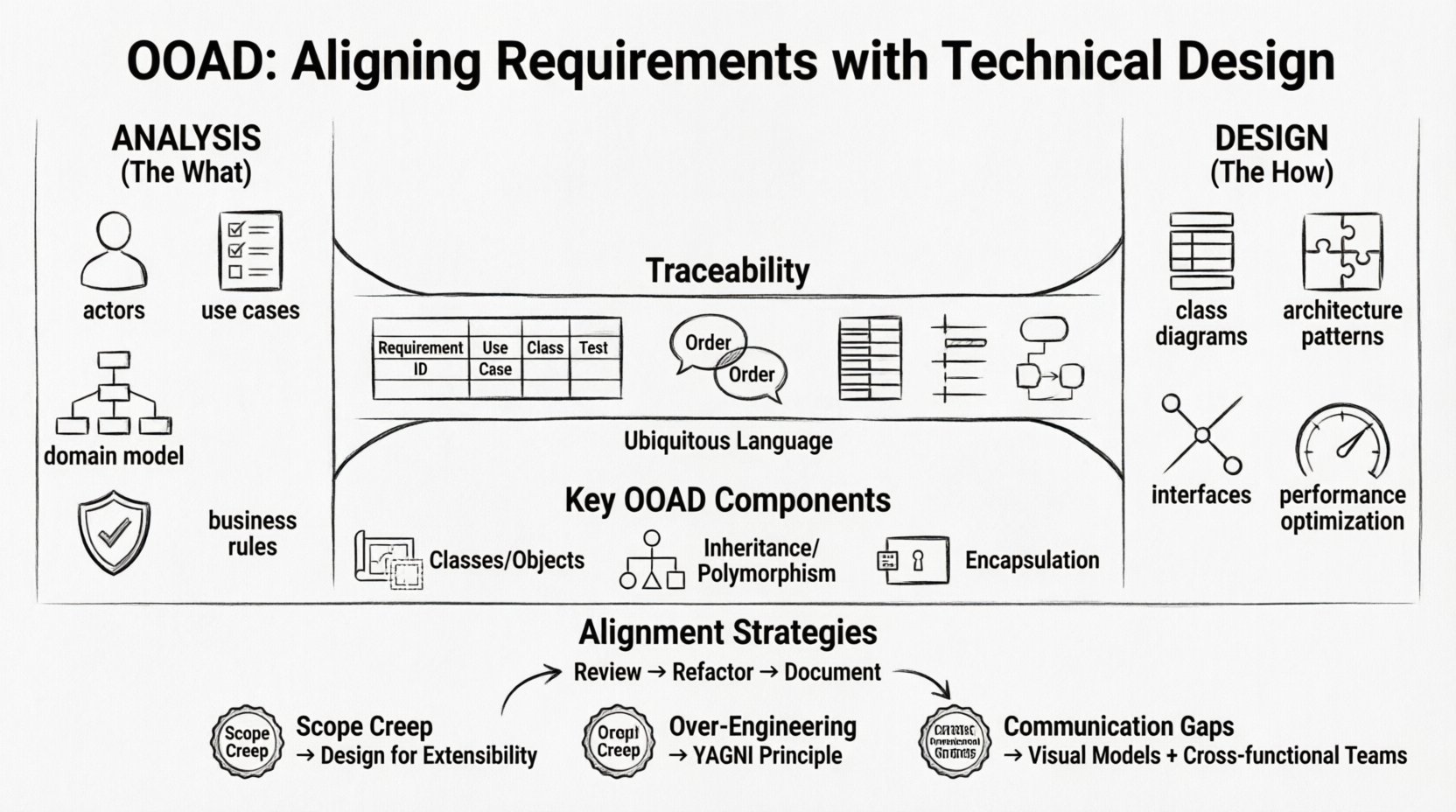
The Analysis phase focuses on understanding the problem domain without worrying about the technology stack. The goal is to identify the objects, their attributes, and their behaviors as they exist in the real world or the business context.
- Identify Actors: Who interacts with the system? (e.g., Customers, Administrators, External APIs).
- Define Use Cases: What actions do these actors perform to achieve a goal?
- Model the Domain: What are the core entities involved? (e.g., Orders, Products, Users).
- Establish Rules: What constraints govern the behavior of these entities?
During this stage, the team produces models that represent the business logic. These models serve as the contract between stakeholders and developers. If the analysis is unclear, the design will inevitably drift.
⚙️ The Design Phase: Defining the “How”
The Design phase translates the analysis models into a technical blueprint. Here, the focus shifts to implementation details, such as data storage, interfaces, and system architecture.
- Refine Classes: Turn domain concepts into code structures.
- Select Patterns: Apply architectural patterns to solve recurring problems.
- Define Interfaces: Specify how different parts of the system communicate.
- Optimize Performance: Consider resource usage and scalability.
A well-executed design phase ensures that the technical solution remains faithful to the requirements established during analysis.
🔗 Bridging Business Needs to Technical Logic
The most critical aspect of OOAD is the traceability between a business requirement and a technical artifact. Every piece of code should have a justification rooted in a specific need.
1. Traceability Matrices
Creating a mapping document helps track requirements throughout the development lifecycle. This document links high-level business goals to specific design elements.
- Requirement ID: A unique identifier for the business need.
- Use Case: The scenario describing the interaction.
- Class/Module: The technical component implementing the logic.
- Test Case: The verification step to ensure compliance.
2. Ubiquitous Language
Terminology is a frequent point of failure. Business stakeholders might use terms like “Client” while developers use “User” or “Account.” Establishing a Ubiquitous Language ensures everyone uses the same vocabulary.
- Hold regular glossary reviews.
- Update models immediately when terms change.
- Use domain-specific terms in code variable names.
3. Visual Modeling
Diagrams serve as a universal communication tool. They allow non-technical stakeholders to verify logic before code is written.
- Class Diagrams: Show structure and relationships.
- Sequence Diagrams: Show interaction flow over time.
- State Diagrams: Show lifecycle transitions of an object.
🧩 Key Components of Object-Oriented Models
To achieve alignment, the team must understand the fundamental building blocks of OOAD. These components form the vocabulary used to construct the system.
🏷️ Classes and Objects
A class is a blueprint, while an object is an instance of that blueprint. In alignment, the class definition must reflect the real-world entity it represents.
- Attributes: Data stored within the object (e.g.,
price,status). - Methods: Behaviors the object can perform (e.g.,
calculateDiscount()). - Relationships: How objects connect (e.g.,
inherits from,contains,uses).
🔗 Inheritance and Polymorphism
These mechanisms allow for code reuse and flexibility. However, they must be used carefully to avoid complex hierarchies that obscure business logic.
- Inheritance: Use when one object is a specialized type of another (e.g.,
SpecialOrderis aStandardOrder). - Polymorphism: Use when different objects respond to the same message in different ways.
🛡️ Encapsulation
Encapsulation hides internal state and exposes only necessary interfaces. This protects the integrity of the data and ensures that business rules cannot be bypassed.
- Keep attributes private or protected.
- Expose public methods to validate inputs.
- Prevent direct manipulation of critical data.
🛠️ Strategies for Alignment
Alignment is not accidental; it requires deliberate strategies and processes. The following table outlines the differences between Analysis and Design, highlighting where alignment checks should occur.
| Feature | Analysis Focus | Design Focus | Alignment Check |
|---|---|---|---|
| Granularity | Business concepts | Code structures | Does the code structure reflect the concept? |
| State | Business rules | Data types | Are all business rules enforced by data types? |
| Interaction | Workflows | APIs/Methods | Do methods cover all workflow steps? |
| Constraints | Regulations | Validation Logic | Is validation logic derived from regulations? |
Iterative Feedback Loops
Alignment is maintained through continuous feedback. Developers should not wait until the end of a sprint to check if the design matches requirements. Instead, they should engage in pair programming or design reviews.
- Review Models: Walk through diagrams with stakeholders.
- Refactor Early: Change the design if requirements change.
- Document Decisions: Record why a specific design choice was made.
🚧 Common Challenges and Solutions
Even with the best intentions, teams face obstacles when trying to align requirements with design. Recognizing these challenges early allows for proactive mitigation.
1. Scope Creep
Requirements often expand during development. If the design is rigid, accommodating new features becomes difficult.
- Solution: Design for extensibility using interfaces and dependency injection.
- Solution: Prioritize requirements to focus on core functionality first.
2. Over-Engineering
Developers sometimes create complex solutions for simple problems. This leads to unnecessary maintenance overhead.
- Solution: Apply the YAGNI principle (You Ain’t Gonna Need It).
- Solution: Simplify class hierarchies; prefer composition over inheritance.
3. Communication Gaps
Business analysts may not understand technical constraints, and developers may not understand business nuances.
- Solution: Cross-functional teams where members learn from each other.
- Solution: Use visual models to facilitate discussion.
🔄 Continuous Refinement
Software is never truly “finished.” The relationship between requirements and design evolves as the product matures. This requires a mindset of continuous improvement.
Technical Debt Management
Every deviation from the ideal design accumulates debt. Teams must allocate time to pay this down.
- Schedule regular refactoring sprints.
- Monitor code complexity metrics.
- Ensure new features do not introduce new inconsistencies.
Documentation as Code
Documentation often becomes outdated quickly. The best practice is to treat documentation as part of the codebase.
- Store diagrams in version control.
- Update documentation alongside code commits.
- Automate documentation generation where possible.
🏁 Moving Forward
Aligning team requirements with technical design decisions is a fundamental discipline for successful software engineering. It requires a commitment to clarity, communication, and structure.
By adhering to the principles of Object-Oriented Analysis and Design, teams can ensure that the final product is not just functional, but valuable. The process involves understanding the domain deeply, modeling it accurately, and implementing it with care.
Success in this area is measured by the ease with which the system adapts to change. When requirements shift, a well-aligned system absorbs the change without collapsing. This resilience is the hallmark of a mature development practice.
Start by reviewing your current models. Check if every class has a business purpose. Verify if every requirement is implemented. These small steps build a foundation for robust, aligned, and effective software systems.
Remember, the goal is not just to write code, but to solve problems. Keep the business need at the center of every design decision.