When a venture capital firm reviews a potential investment, they do not simply look at a spreadsheet of numbers. They look at the narrative behind the numbers. A SWOT analysis for venture capital serves as a foundational document that reveals the structural integrity of a business model. It is not merely an internal audit tool; it is a strategic communication device designed to convince stakeholders of viability. Understanding what venture capitalists expect to see in a SWOT analysis can significantly alter the trajectory of a funding round. This guide breaks down the specific elements investors scrutinize, offering a roadmap for founders to present their ventures with clarity and confidence.
Understanding the VC Lens on SWOT 🧐
Venture capitalists operate under a unique set of pressures. They manage funds with finite lifecycles and limited partners who demand returns. Consequently, their evaluation of a SWOT analysis differs from a corporate board member or an internal strategist. They are not looking for perfection; they are looking for honesty and strategic foresight. A SWOT analysis that hides weaknesses often raises more red flags than it solves. The goal is to demonstrate that the founders understand their position in the market and have a plan to navigate it.
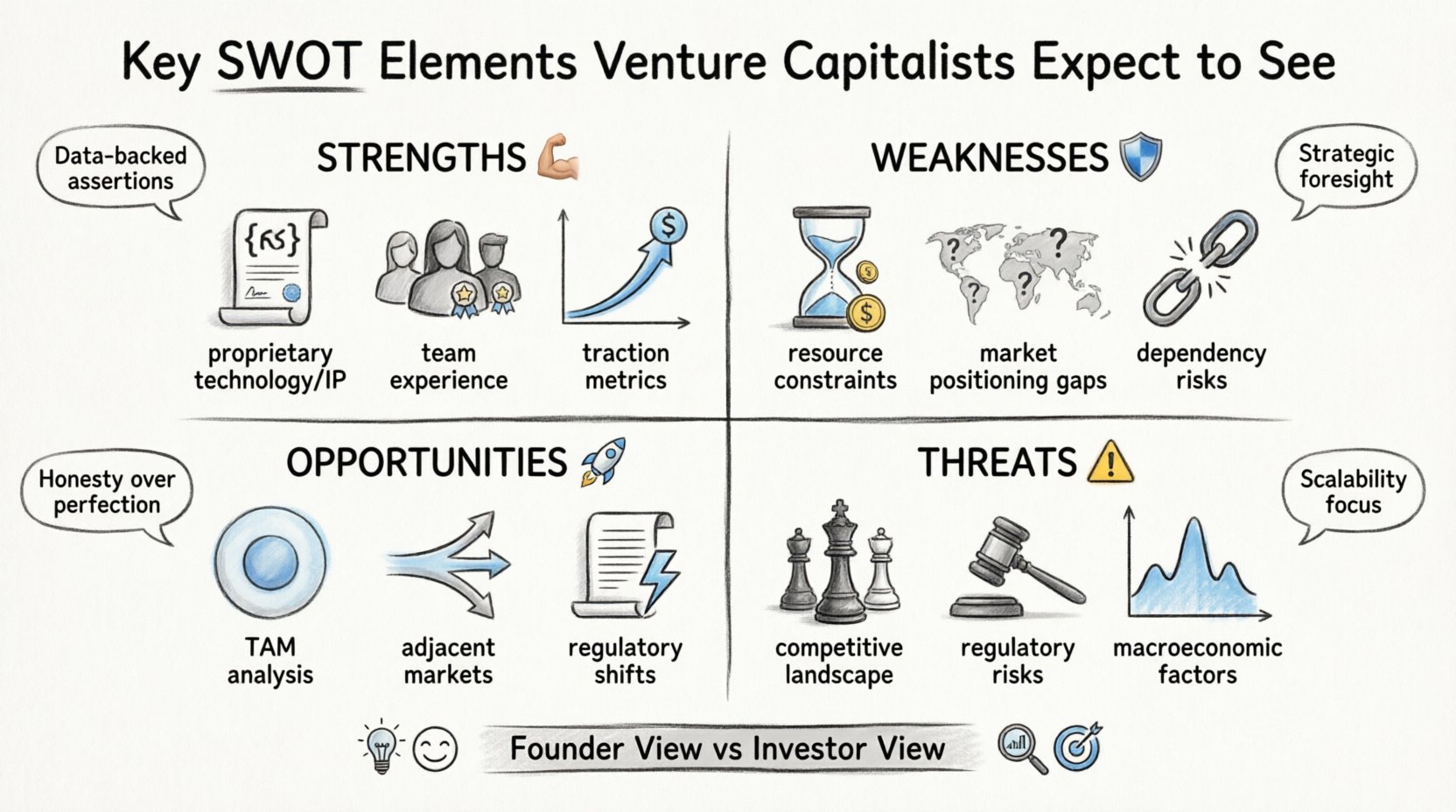
For a SWOT analysis to resonate with investors, it must move beyond generic statements. Phrases like “strong brand” or “good team” lack the specificity required for due diligence. Investors want to see data-backed assertions. They want to understand the relationship between the company’s internal capabilities and external market conditions. The following sections detail the specific components within each quadrant that signal a mature, investable business.
Strengths: The Foundation of Investment 💪
Strengths represent the internal attributes that give the company a competitive advantage. However, in the context of venture capital, these strengths must translate into scalability and defensibility. VCs assess whether these strengths can sustain growth over a long period.
Proprietary Technology and IP
Investors scrutinize the technical moat of a startup. A strength in this category is not just having a product, but having a product that is difficult to replicate. This includes:
- Patents and Trademarks: Filed or pending intellectual property that legally blocks competitors.
- Algorithm Efficiency: Proprietary code that offers performance advantages not available in the open market.
- Data Moats: Unique datasets collected by the company that improve the product over time, creating a network effect.
When presenting this, founders should quantify the advantage. For example, instead of saying “our tech is fast,” specify the latency reduction or the cost savings per unit compared to the industry standard. This provides a tangible metric for value creation.
Team Experience and Track Record
The team is often the primary investment thesis for early-stage ventures. Investors look for evidence of execution capability. Key elements include:
- Industry Specificity: Founders who have worked in the specific sector they are entering understand the nuances of customer acquisition and regulation.
- Previous Exits: Founders who have successfully sold a business previously know the cycle of fundraising and scaling.
- Advisory Board: A roster of respected industry figures lends credibility and provides access to networks.
Transparency here is vital. Highlighting specific roles and the tenure of key hires demonstrates stability. Investors want to know that the team can survive the inevitable challenges of scaling.
Traction Metrics and Validation
Strengths are often validated by market behavior. Investors want to see that the product solves a real problem. Relevant metrics include:
- Recurring Revenue: Monthly Recurring Revenue (MRR) or Annual Recurring Revenue (ARR) growth rates.
- Customer Retention: Low churn rates indicate product-market fit.
- Expansion Revenue: Evidence that existing customers are buying more over time.
These numbers serve as proof points. They move the company from a theoretical opportunity to a validated business unit. When discussing strengths, always tie the metric back to the core value proposition.
Weaknesses: Transparency as a Strategic Tool 🛡️
Many founders hesitate to list weaknesses in a pitch deck or due diligence document. They fear it signals incompetence. However, venture capitalists expect to see a clear-eyed assessment of gaps. Omitting weaknesses suggests a lack of self-awareness or an attempt to deceive. Addressing them strategically shows maturity.
Resource Constraints
Every startup faces limitations. Acknowledging them allows investors to understand how their capital will be deployed to solve these problems. Common weaknesses include:
- Cash Burn Rate: Understanding how long the runway lasts without additional funding.
- Hiring Gaps: Missing roles that are critical for the next phase of growth.
- Operational Bottlenecks: Processes that slow down delivery or customer support.
By stating these weaknesses, the company demonstrates that it has identified the specific areas where investment is needed. It turns a liability into a specific use case for the capital being requested.
Market Positioning Gaps
It is often necessary to admit where the product does not yet lead. This might involve:
- Brand Awareness: Acknowledging that the market does not yet know the company.
- Geographic Reach: Limitations in current distribution channels.
- Feature Completeness: Known gaps in the product roadmap that are being prioritized.
Addressing these gaps with a timeline shows planning. It tells the investor, “We know we are weak here, and here is exactly how we will fix it with your support.” This builds trust.
Dependency Risks
Every business relies on third parties. A weakness in this area involves:
- Supply Chain: Reliance on a single vendor for critical components.
- Platform Risk: Dependence on a third-party platform (e.g., app stores, social media) for distribution.
Highlighting these dependencies shows that the company is aware of potential external shocks. It allows the investor to assess the risk profile accurately.
Opportunities: Scalability and Market Timing 🚀
Opportunities are external factors that the company can exploit to grow. In the venture capital context, this is where the potential for high returns is quantified. Investors are looking for pathways to massive scale.
Total Addressable Market (TAM)
Investors need to see that the market is large enough to support a significant return. This involves:
- Market Size: A clear definition of the total addressable market.
- Growth Rate: Evidence that the market is expanding, not shrinking.
- Fragmentation: A market that is currently fragmented offers opportunities for consolidation.
Founders should not just state the number. They should explain the logic behind the number. Is it based on user count? Is it based on revenue? The methodology matters as much as the result.
Adjacent Markets and Expansion
A single product is rarely enough for a venture-scale return. Investors look for the ability to expand. This includes:
- Geographic Expansion: Plans to enter new regions or countries.
- Product Line Extensions: Leveraging existing technology to solve adjacent problems.
- Enterprise Upsell: Moving from small business customers to large enterprise contracts.
This demonstrates the ceiling of the business. It shows that the initial investment is just the entry point into a larger ecosystem.
Regulatory and Economic Shifts
External changes can create new openings. For example:
- Regulatory Changes: New laws that make the company’s solution more valuable.
- Economic Trends: Shifts in consumer behavior that favor the product.
- Technological Breakthroughs: New hardware or software standards that the company can integrate with.
Identifying these opportunities shows that the company is agile and responsive to the macro environment.
Threats: Risk Mitigation Strategies ⚠️
Threats are external factors that could harm the business. While weaknesses are internal, threats are external forces beyond the company’s control. A SWOT analysis that ignores threats is naive. VCs want to see that the company has a plan to survive these challenges.
Competitive Landscape
Direct and indirect competition is a constant threat. Investors expect to see:
- Competitor Analysis: Who are the incumbents and who are the disruptors?
- Barriers to Entry: What stops others from copying the business?
- Price Wars: The risk of competitors lowering prices to gain share.
Addressing this threat involves outlining the company’s defensive strategy. This could be through branding, technology, or customer loyalty programs.
Regulatory and Legal Risks
In many sectors, regulation is the biggest threat. This includes:
- Data Privacy: Compliance with laws like GDPR or CCPA.
- Industry Standards: Changes in safety or reporting requirements.
- Litigation: The risk of being sued by competitors or customers.
Founders should demonstrate that they have legal counsel and are proactive about compliance. This reduces the perceived risk for the investor.
Macroeconomic Factors
External economic conditions can impact even the best businesses. Threats include:
- Interest Rates: Higher rates can reduce the valuation of the company and make fundraising harder.
- Inflation: Rising costs for talent and infrastructure.
- Recession: Reduced spending by customers.
Showing resilience against these factors is crucial. This might involve maintaining a healthy cash reserve or diversifying revenue streams.
Comparing Perspectives: Founder vs. Investor 🧩
It is helpful to visualize how the same SWOT element is viewed differently by the founding team versus the venture capitalist. The following table outlines these differences.
| SWOT Element | Founder Perspective | Investor Perspective |
|---|---|---|
| Strength | Focus on innovation and product quality. | Focus on defensibility and scalability. |
| Weakness | Focus on gaps to be filled. | Focus on risks to capital preservation. |
| Opportunity | Focus on growth and new customers. | Focus on exit potential and ROI. |
| Threat | Focus on survival and adaptation. | Focus on downside protection and mitigation. |
Understanding this divergence helps founders tailor their presentation. They must translate their internal vision into the language of value creation and risk management that investors understand.
Common Mistakes Found in VC SWOTs ❌
Even experienced founders make errors when constructing these documents. Recognizing these pitfalls can prevent unnecessary friction during due diligence.
- Being Vague: Using adjectives like “strong” or “fast” without data.
- Ignoring Competition: Claiming there is no competition is a red flag.
- Overpromising: Listing opportunities that are unrealistic or too far in the future.
- Underestimating Threats: Dismissing regulatory or market risks as “not our problem.”
- Lack of Alignment: The SWOT does not match the financial projections or the pitch deck.
Consistency across all documents is essential. If the SWOT says one thing and the financial model says another, trust erodes immediately.
Actionable Steps to Refine Your SWOT 🛠️
To ensure your SWOT analysis meets the high standards of venture capitalists, follow these steps.
- Gather Data: Collect internal metrics and external market research. Do not rely on anecdotes.
- Validate Assumptions: Test your strengths and weaknesses with customers and partners.
- Review with Advisors: Have mentors or industry experts critique your analysis for blind spots.
- Align with Strategy: Ensure every point in the SWOT connects to the long-term strategic plan.
- Update Regularly: A SWOT is not a one-time document. It should evolve as the company grows and the market changes.
By following this process, you create a living document that serves as both a strategic guide and an investor communication tool.
Final Considerations on Due Diligence 📝
The SWOT analysis is just one piece of the due diligence puzzle. However, it sets the tone for the entire relationship. It shows how the founders think, how they assess risk, and how they plan for the future. A well-constructed SWOT analysis demonstrates that the team is ready to handle the responsibilities of institutional capital.
Venture capital is a partnership. The SWOT analysis is the blueprint for that partnership. It defines where the company is, where it is going, and how it plans to get there while managing the inevitable obstacles. By focusing on specific, data-driven elements within each quadrant, founders can build the confidence necessary to secure funding.
Remember, the goal is not to present a perfect picture. The goal is to present a realistic picture with a clear path to improvement. Investors invest in people and plans. They want to know that the team understands the terrain and has the map to navigate it. A robust SWOT analysis provides that map.
As you refine your own analysis, keep the investor’s perspective in mind. They are looking for clarity, honesty, and a path to value. Address the elements they expect, avoid the common pitfalls, and use the data to support your narrative. This approach will strengthen your position in the market and increase the likelihood of a successful fundraising outcome.
Ultimately, the SWOT analysis is a testament to your strategic thinking. It is the difference between a pitch that gets heard and a pitch that gets funded. Treat it with the rigor it deserves, and you will find it serves as a powerful tool for growth beyond the initial investment round.