Starting a new venture, launching a project, or planning a career shift often brings a mix of excitement and uncertainty. Many individuals hesitate to dive into strategic planning because they believe they lack formal business training. This hesitation is unfounded. Strategic thinking is a skill that can be learned, and one of the most effective tools for this is the SWOT analysis. You do not need an MBA or decades of corporate experience to understand your own potential and the environment you operate in. This guide provides a clear path to conducting a SWOT analysis effectively, ensuring you build a solid foundation for your decisions.
Whether you are an aspiring entrepreneur, a freelancer, or someone managing a community project, understanding your internal capabilities and external circumstances is crucial. This document breaks down the process into manageable steps, removing the jargon and focusing on practical application. By the end of this reading, you will have a structured framework to evaluate your situation objectively.
What is a SWOT Analysis? 🤔
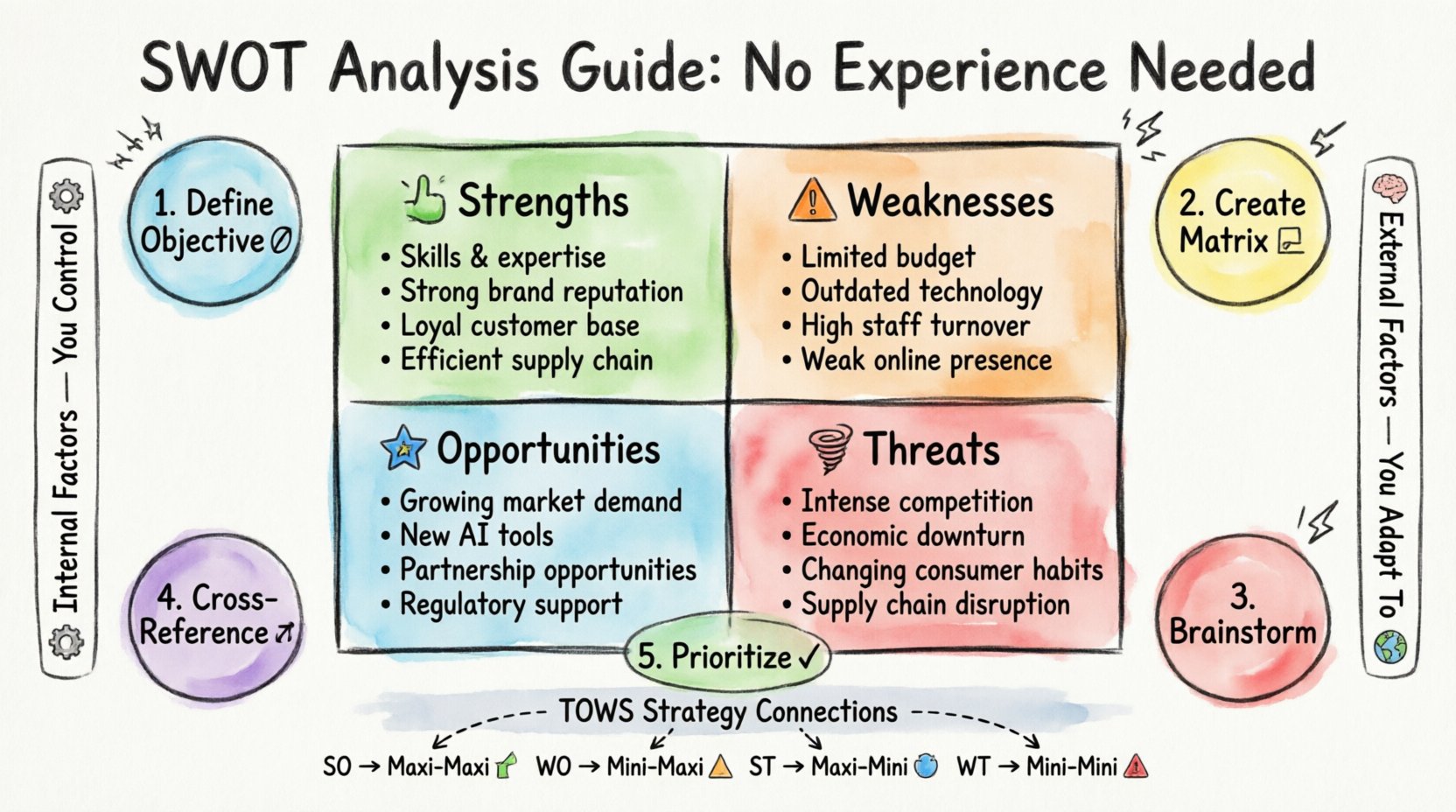
A SWOT analysis is a strategic planning technique used to identify Strengths, Weaknesses, Opportunities, and Threats. It is not merely a checklist; it is a snapshot of your current reality. The acronym stands for:
- Strengths: Internal attributes that give you an advantage.
- Weaknesses: Internal attributes that place you at a disadvantage.
- Opportunities: External conditions that you could exploit to your benefit.
- Threats: External conditions that could cause trouble for you.
The power of this tool lies in its simplicity. It divides factors into two categories: internal (Strengths and Weaknesses) and external (Opportunities and Threats). Internal factors are things you can control or change. External factors are things you must react to or adapt to. Understanding this distinction is the first step in strategic planning.
Why Experience Is Not a Prerequisite 🚀
Many people assume that strategic analysis requires years of data and market research. While that helps, the core of a SWOT analysis is honest self-reflection and observation. You do not need to be a business expert to know if you are good at organizing, if you have limited funds, if a competitor is lowering prices, or if a new technology is emerging.
Here is why you can start today:
- Universal Logic: The concepts of advantage and disadvantage apply to any context, from a personal career to a small business.
- Observable Data: You can see your own skills and the market around you without complex financial modeling.
- Iterative Process: You do not need to get it perfect the first time. You can update this analysis as you learn more.
Breaking Down the Four Pillars 🧱
To conduct a thorough analysis, you must understand what goes into each quadrant. Below is a detailed breakdown to help you identify relevant points.
1. Strengths (Internal & Positive) 💪
Strengths are resources and capabilities that you possess. These are the things that allow you to do better than others. When brainstorming strengths, focus on what sets you apart.
- Skills: Are you proficient in coding, writing, or sales?
- Assets: Do you own equipment, a website, or a physical location?
- Reputation: Do you have a network of loyal clients or friends?
- Process: Do you have a unique workflow that saves time?
2. Weaknesses (Internal & Negative) ⚠️
Weaknesses are internal limitations. These are areas where you lack resources or skills compared to others. Identifying these is often the hardest part, as it requires honesty. However, acknowledging a weakness is the first step to fixing it.
- Resource Gaps: Do you lack capital, time, or manpower?
- Skill Gaps: Are there technical areas where you feel unqualified?
- Reputation: Are there past failures that people remember?
- Location: Is your location inconvenient for customers?
3. Opportunities (External & Positive) 🌟
Opportunities are external chances to improve your position. These are trends or changes in the environment that you can leverage. You cannot create these, but you can position yourself to take advantage of them.
- Market Trends: Is there a growing demand for your service?
- Regulatory Changes: Are new laws that favor your industry?
- Technology: Are there new tools that reduce your costs?
- Competitor Moves: Did a competitor exit the market, leaving a gap?
4. Threats (External & Negative) 🌪️
Threats are external obstacles that could jeopardize your success. These are risks you cannot control but must mitigate. Ignoring threats is a common mistake that leads to failure.
- Economic Shifts: Is inflation rising or is the economy slowing?
- Competition: Are new players entering your space with more funding?
- Technology: Is your current method becoming obsolete?
- Regulations: Are there new compliance requirements you must meet?
Preparation: Gathering Your Data 📝
Before you fill out the chart, you need information. A SWOT analysis built on guesses is not useful. You need facts. Here is how to gather the necessary data without needing a research team.
- Self-Reflection: Set aside quiet time to think about your own capabilities. Write down your top three skills and top three areas for improvement.
- Feedback: Ask colleagues, friends, or mentors what they think you are good at and where you struggle. External perspectives often see blind spots.
- Market Observation: Look at your competitors. What are they doing? What are customers complaining about? This reveals opportunities and threats.
- Industry News: Read trade publications or follow industry news to spot trends.
Step-by-Step Execution Guide 📋
Once you have gathered your thoughts, follow this structured process to build your analysis.
Step 1: Define the Objective 🎯
Clarify what you are analyzing. Are you launching a specific product? Planning a career change? Opening a new branch? The objective dictates what factors are relevant. A broad objective yields a broad analysis, while a specific objective yields actionable insights.
Step 2: Create the Matrix 📊
Draw a square divided into four sections. Label them Strengths, Weaknesses, Opportunities, and Threats. You can do this on paper, a whiteboard, or a digital document. Visualizing the grid helps separate internal thoughts from external thoughts.
Step 3: Brainstorm Each Quadrant 🧠
Fill in the boxes. Be specific. Instead of writing “Good marketing,” write “Strong social media following with high engagement.” Instead of “Bad money,” write “Limited cash flow for inventory.” Specificity leads to better strategy.
Step 4: Cross-Reference and Analyze 🔗
Now, look for connections between the quadrants. This is where strategy is born. How can you use your strengths to take advantage of opportunities? How can you fix your weaknesses to avoid threats? This step transforms a list into a plan.
Step 5: Prioritize and Act ✅
You cannot act on everything at once. Rank your findings by impact and urgency. Focus on the items that offer the highest return for the least amount of effort. Create a timeline for implementation.
Understanding Internal vs. External Factors 🔄
One of the most common errors beginners make is confusing internal and external factors. To ensure accuracy, review this table.
| Factor Type | Control Level | Examples |
|---|---|---|
| Strengths | Internal (You control it) | Staff skills, brand reputation, proprietary technology |
| Weaknesses | Internal (You control it) | Limited budget, outdated equipment, lack of experience |
| Opportunities | External (You cannot control it) | New market trends, competitor failure, regulatory changes |
| Threats | External (You cannot control it) | Economic recession, new competitors, supply chain issues |
If you list a threat as a weakness, you may try to “fix” it internally when you should be reacting to it externally. For example, if the economy is bad (Threat), you cannot fix the economy (Internal). You must adjust your pricing or spending (Reaction).
Turning Analysis into Action Strategy 🛠️
Completing the chart is only half the work. The real value comes from connecting the dots. This process is often called TOWS analysis, where you match the elements to create strategies.
SO Strategies (Maxi-Maxi) 📈
Use your Strengths to maximize Opportunities. This is the growth strategy. If you have a strong email list (Strength) and there is a new product trend (Opportunity), launch the product to your list immediately.
WO Strategies (Mini-Maxi) 📉
Overcome Weaknesses by taking advantage of Opportunities. This is the improvement strategy. If you lack coding skills (Weakness) but there is a free online course available (Opportunity), take the course to bridge the gap.
ST Strategies (Maxi-Mini) 🛡️
Use Strengths to minimize Threats. This is the defensive strategy. If you have strong cash reserves (Strength) and the economy is slowing (Threat), you can afford to lower prices to keep customers while competitors struggle.
WT Strategies (Mini-Mini) 🚧
Minimize Weaknesses and avoid Threats. This is the survival strategy. If you have limited staff (Weakness) and a new regulation requires more paperwork (Threat), you must hire a contractor or automate the process to survive.
Common Mistakes to Avoid 🚫
Even with a clear guide, pitfalls exist. Being aware of them will save you time and effort.
- Being Too Vague: “High Quality” is not a strength. “99% Customer Satisfaction Rate” is a strength. Specificity matters.
- Ignoring the Negative: It is tempting to focus only on Strengths and Opportunities. Weaknesses and Threats are often more critical to address before growth.
- Confusing Cause and Effect: Do not list “Lack of Sales” as a weakness. That is a result. The weakness might be “Poor Marketing Skills” which caused the lack of sales.
- Static Analysis: A SWOT analysis is a snapshot in time. It becomes outdated quickly. Review it regularly, perhaps quarterly.
- Group Bias: If working with a team, ensure everyone speaks up. Dominant voices can skew the results towards their own perspective.
Practical Example: The Freelance Writer 📝
Let us apply this to a hypothetical scenario. Imagine a freelance writer named Alex. Alex wants to expand their business.
- Strength: Alex has 5 years of experience in tech writing.
- Weakness: Alex has no dedicated marketing budget.
- Opportunity: There is a shortage of tech writers in the current market.
- Threat: AI writing tools are becoming more common.
From this, Alex can derive a strategy. Because there is a shortage (Opportunity) and Alex has experience (Strength), Alex should focus on high-volume contracts. To avoid the AI threat (Threat) and the lack of marketing budget (Weakness), Alex should focus on networking and LinkedIn rather than paid ads. This connects the analysis directly to action.
Tools for Documentation 📄
You do not need expensive software to record your analysis. In fact, simplicity often leads to better focus. Consider these methods:
- Pen and Paper: Great for brainstorming sessions. It removes digital distractions.
- Whiteboard: Ideal for team collaboration. Allows for easy movement of ideas.
- Spreadsheet: Useful for tracking metrics alongside your qualitative thoughts.
- Notebook: Good for personal reflection and tracking changes over time.
Choose the medium that makes you comfortable writing down your thoughts. The goal is clarity, not presentation.
Refining Your Strategy Over Time 🔍
Once you have your initial plan, do not treat it as a final document. The business environment changes. New competitors appear. Skills develop. Your SWOT analysis should evolve.
- Set Review Dates: Schedule a time every three months to revisit the analysis.
- Track Progress: Check off items that have been turned into strengths or opportunities that have been seized.
- Update Threats: New regulations or technologies may introduce new risks.
- Adjust Goals: If your strengths have grown, your goals should become more ambitious.
Final Thoughts on Strategic Planning 💡
Strategic planning is not about predicting the future perfectly. It is about preparing for multiple possibilities. By conducting a SWOT analysis, you are not guessing; you are making informed decisions based on your current reality.
Even without prior business experience, you possess the necessary tools to succeed: observation, honesty, and logic. The framework provided here is designed to organize those natural abilities into a coherent plan. Remember that the goal is not to create a perfect document, but to create a path forward that you can walk with confidence.
Start small. Define your objective. Fill in the quadrants. Connect the dots. Take action. The journey of a thousand miles begins with a single step, and the SWOT analysis is the map that guides that first step.