
In the fast-paced world of software development, the pressure to deliver features quickly often outweighs the need for careful planning. Teams frequently prioritize writing code over defining structure. However, this approach often leads to fragile systems that are difficult to maintain. Object-Oriented Analysis and Design (OOAD) offers a structured approach to building robust software. It shifts the focus from immediate output to long-term stability.
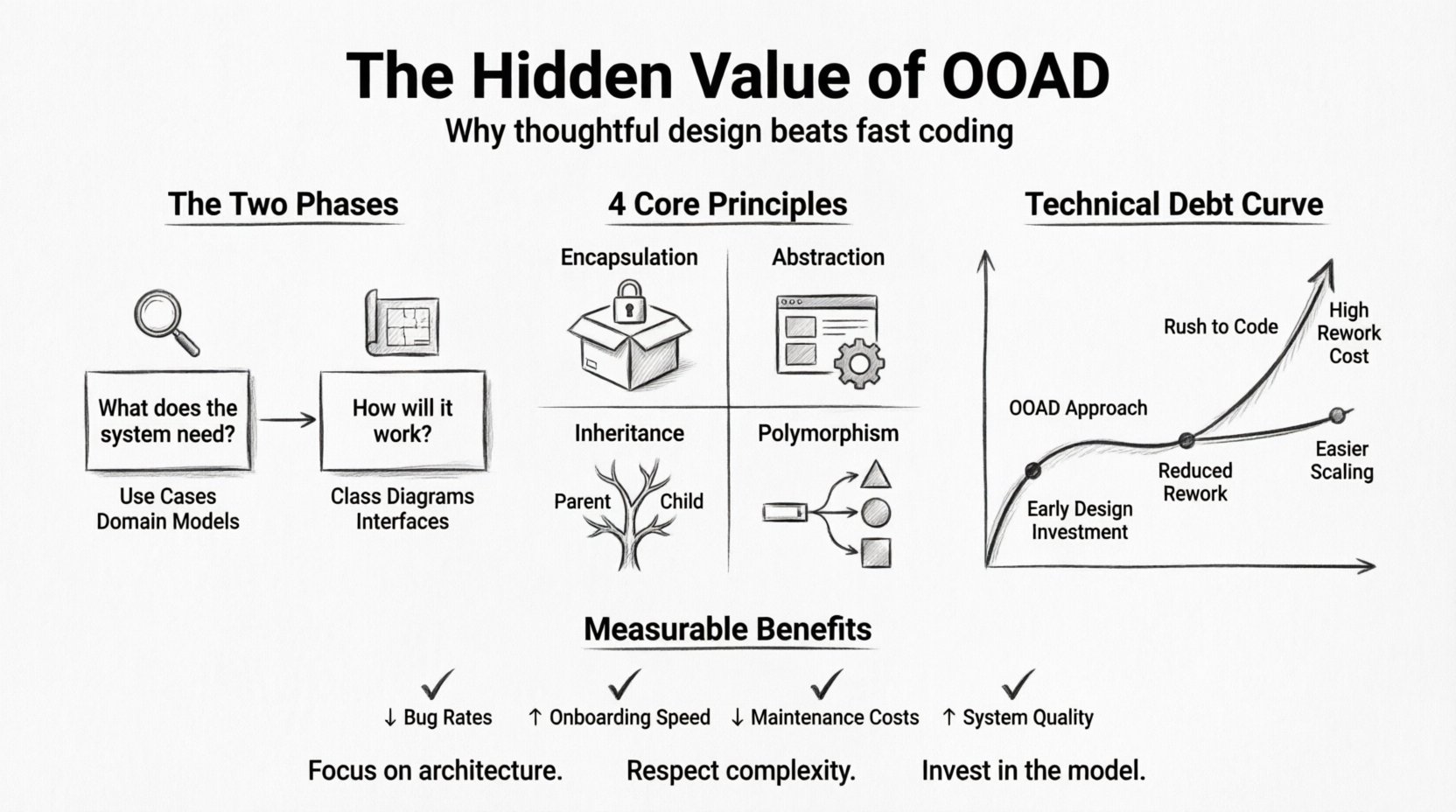
Understanding Object-Oriented Analysis and Design 🧐
Object-Oriented Analysis and Design is a methodical process used to analyze and design systems. It focuses on objects rather than actions. Objects contain both data and behavior. This approach mirrors real-world entities, making the software easier to understand and modify.
The process generally involves two main phases:
- Analysis: Understanding what the system needs to do. This involves identifying requirements and creating models of the problem domain.
- Design: Deciding how the system will do it. This involves creating models of the solution domain, defining classes, and specifying interactions.
By separating what the system does from how it does it, OOAD allows developers to change the implementation without breaking the functionality. This separation is crucial for complex applications.
The Illusion of Speed ⏳
Many teams believe that skipping design phases saves time. They write code immediately to see results. While this feels faster initially, it often creates hidden costs later. This phenomenon is known as technical debt.
When code is written without a plan:
- Modules become tightly coupled, meaning changes in one area break others.
- Logic is duplicated across the codebase, leading to inconsistencies.
- Documentation is missing, making onboarding new developers difficult.
- Testing becomes harder because there is no clear boundary between components.
The initial speed gain is quickly consumed by the time spent fixing bugs and refactoring broken logic. A slower start with OOAD often results in a faster development cycle in the long run.
Core Principles of Object-Oriented Design 🧱
Effective OOAD relies on several foundational principles. These principles guide the structure of the software and ensure it remains flexible.
1. Encapsulation
Encapsulation bundles data and methods together. It restricts direct access to some of an object’s components. This protects the internal state from unintended interference. When data is hidden, it is safer to modify the implementation.
2. Abstraction
Abstraction simplifies complexity by hiding unnecessary details. Users of a class only need to know the public interface. They do not need to understand the internal logic. This reduces the cognitive load for developers working on different parts of the system.
3. Inheritance
Inheritance allows new classes to be created based on existing classes. This promotes code reuse. Common behaviors are defined once in a parent class and shared by child classes. This reduces redundancy and ensures consistency across similar entities.
4. Polymorphism
Polymorphism allows objects of different types to be treated as objects of a common super-type. This flexibility enables the system to handle different scenarios without changing the code that calls them. It makes the system more adaptable to future changes.
Analysis vs. Design: A Detailed Breakdown 📊
Understanding the distinction between analysis and design is vital. Confusing these two stages leads to poor architecture.
| Aspect | Analysis Phase | Design Phase |
|---|---|---|
| Focus | Problem Domain | Solution Domain |
| Questions | What does the system need? | How will the system achieve it? |
| Artifacts | Use Cases, Domain Models | Class Diagrams, Sequence Diagrams |
| Stakeholders | Users, Business Analysts | Developers, Architects |
During the analysis phase, the goal is to understand the business rules. You identify the actors and their goals. You create a domain model that represents real-world concepts. This model is independent of technology.
During the design phase, you translate the domain model into a technical solution. You decide on data structures, algorithms, and communication protocols. You define the interfaces that components will use. This phase bridges the gap between requirements and code.
Reducing Technical Debt 🛠️
Technical debt accumulates when shortcuts are taken during development. It is the cost of additional rework caused by choosing an easy solution now instead of a better approach that would take longer.
OOAD helps manage this debt by:
- Establishing Standards: Consistent naming conventions and structure make the codebase predictable.
- Facilitating Refactoring: Well-designed systems are easier to refactor. You can change internal logic without affecting external behavior.
- Improving Testability: Decoupled components can be tested in isolation. This ensures quality at every stage.
Ignoring OOAD often leads to a monolithic structure. In such systems, a small change can ripple through the entire application. Proper design isolates these changes, limiting their impact.
The Role of Collaboration 👥
Software development is a team effort. OOAD provides a common language for developers, designers, and stakeholders.
- Visual Models: Diagrams allow team members to discuss the system without getting bogged down in syntax.
- Shared Understanding: A clear design document ensures everyone agrees on how the system works.
- Knowledge Transfer: When developers leave, the design remains. New team members can understand the system faster.
Without a clear design, knowledge becomes trapped in individual minds. This creates a bottleneck where only specific people can modify certain parts of the code. OOAD distributes this knowledge across the structure of the system itself.
Common Pitfalls to Avoid ⚠️
Even with the best intentions, teams can misapply OOAD. Here are common mistakes to watch out for.
- Over-Engineering: Creating complex structures for simple problems. Not every system needs a complex hierarchy.
- Under-Planning: Skipping the analysis phase and jumping straight to coding. This often leads to mismatched requirements.
- Ignoring Requirements: Focusing too much on design patterns and not enough on what the user actually needs.
- Rigid Adherence: Refusing to adapt the design when requirements change. Flexibility is key.
Scalability and Future-Proofing 📈
Software rarely stays static. Requirements evolve, and user bases grow. A system built with OOAD principles is designed to handle growth.
Consider the following scenarios:
- New Features: Adding a new feature is easier when components are independent.
- Performance Optimization: Bottlenecks are easier to identify in a well-structured system.
- Technology Migration: If you need to switch databases or frameworks, a clean design makes the transition smoother.
Without a solid foundation, scaling often requires rewriting large portions of the code. OOAD minimizes the need for rewrites by ensuring the core logic is stable.
Implementation Strategy 🔄
How do you start applying these concepts? Here is a practical approach.
- Gather Requirements: Talk to users and stakeholders. Understand the business goals.
- Create a Domain Model: Identify the key entities and their relationships.
- Define Interfaces: Specify how components will interact.
- Implement Iteratively: Write code in small increments, testing frequently.
- Review and Refine: Regularly review the code against the design. Adjust as needed.
This cycle ensures that the code remains aligned with the design. It prevents the design from becoming obsolete as the system evolves.
The Cost of Change Curve 📉
The cost of fixing a defect increases significantly as the project progresses. In the early stages, a change is cheap. Later, it becomes expensive.
OOAD addresses this by front-loading the effort. You spend more time designing early to reduce costs later. This is the opposite of the waterfall method where design happens once at the start. In OOAD, design is an ongoing activity that evolves with the project.
By investing in analysis and design, you reduce the friction of change. You create a system that welcomes modification rather than resisting it.
Measuring Success 📏
How do you know if OOAD is working? Look for these indicators:
- Reduced Bug Rates: Fewer errors in production.
- Faster Onboarding: New developers become productive quickly.
- Lower Maintenance Costs: Less time spent fixing old code.
- Higher Quality: Better user experience and system performance.
These metrics provide objective evidence that the design effort is paying off. They justify the initial investment in planning.
Final Thoughts on Sustainable Development 🌱
Writing code is only part of the job. Building a system that lasts requires thought and structure. Object-Oriented Analysis and Design provides the tools to achieve this. It is not about slowing down. It is about moving in the right direction.
Teams that prioritize design over speed often find themselves in a better position over time. They build systems that are resilient, understandable, and adaptable. This is the true value of OOAD.
Focus on the architecture. Respect the complexity. Invest in the model. The code will follow.