Object-Oriented Analysis and Design (OOAD) has served as the backbone of software architecture for decades. Its principles of encapsulation, inheritance, and polymorphism continue to influence how systems are conceptualized and built. However, the software landscape is shifting rapidly. New architectural paradigms, evolving development methodologies, and emerging technologies are reshaping how we apply these classic techniques.
This guide explores the trajectory of OOAD in the context of modern engineering. We will examine how traditional practices adapt to agile environments, how domain-driven design refines boundary definitions, and how automation influences the analysis phase. Understanding these shifts is essential for maintaining robust, scalable, and maintainable systems.
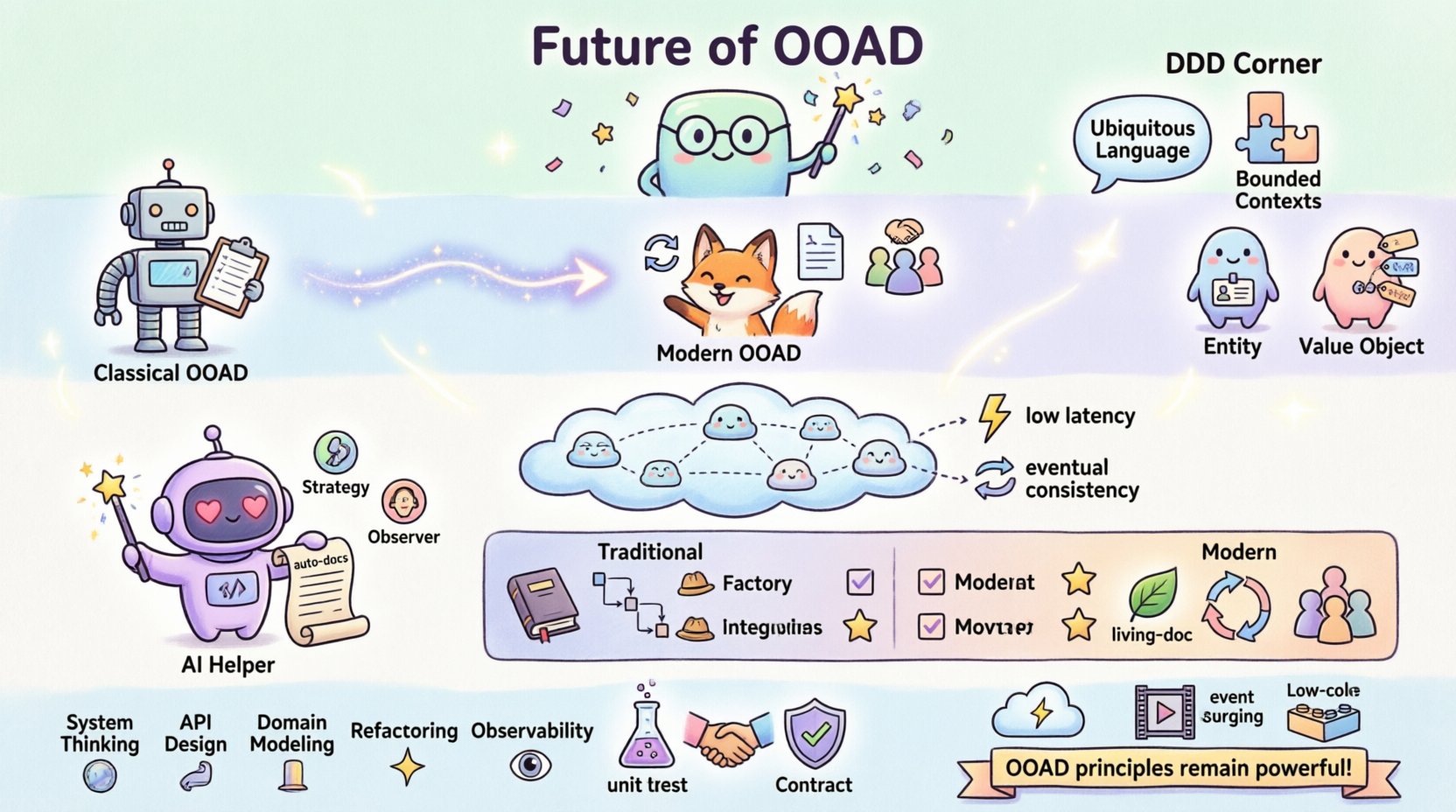
🔄 The Evolution from Classical to Modern Approaches
Traditionally, OOAD followed a structured path. Teams would analyze requirements in depth before moving to design, often resulting in extensive documentation. This approach prioritized stability and predictability. While effective for large-scale enterprise systems, it sometimes struggled with the pace of modern market demands.
Today, the focus has shifted toward adaptability. The core tenets of object-oriented thinking remain relevant, but the delivery mechanisms have changed. Here is how the methodology has evolved:
- Iterative Refinement: Instead of a linear process, design is now continuous. Models evolve alongside the code.
- Lightweight Documentation: Living documentation and code-centric design replace static UML diagrams.
- Collaborative Modeling: Design is no longer the sole responsibility of architects. Cross-functional teams participate in shaping the structure.
This shift does not discard object-oriented principles. Rather, it contextualizes them within a faster feedback loop. The goal remains the same: create software that is easy to understand and modify, but the path to get there is more fluid.
🧠 Domain-Driven Design and Object Boundaries
One of the most significant influences on modern OOAD is Domain-Driven Design (DDD). DDD emphasizes that software should reflect the specific business domain it serves. This alignment ensures that the object structure mirrors real-world concepts accurately.
When applying DDD to OOAD, several critical concepts emerge:
- Ubiquitous Language: A shared vocabulary between developers and domain experts reduces ambiguity. Terms used in code match terms used in business discussions.
- Bounded Contexts: Large systems are split into distinct contexts. Each context has its own model. This prevents the “God Object” anti-pattern where one class tries to understand everything.
- Entities and Value Objects: Entities are defined by identity, while value objects are defined by attributes. DDD clarifies when to use which, improving data integrity.
In a modern context, these boundaries are often implemented as microservices or modular monoliths. The object model must support these boundaries without leaking dependencies. This requires rigorous attention to how objects interact across context boundaries.
🌐 Microservices and Object-Oriented Principles
The move toward microservices architecture has introduced new challenges for object-oriented design. In a monolithic application, objects communicate via in-memory method calls. In a distributed system, these calls become network requests.
Designing objects for a distributed environment requires a different mindset. Key considerations include:
- Network Latency: Minimizing the number of calls between services. Objects should encapsulate logic to reduce round-trips.
- Data Consistency: Distributed transactions are complex. Objects must manage state in a way that tolerates eventual consistency rather than relying on immediate atomicity.
- Service Boundaries: An object’s responsibility should align with a service’s capability. This keeps coupling low and cohesion high.
It is crucial to avoid distributing object-oriented structures blindly. If a class relies heavily on internal methods that now need to cross network boundaries, refactoring becomes necessary. The object model must be aware of the deployment topology.
🤖 AI and Automated Design Assistance
Artificial Intelligence is beginning to play a role in the analysis and design phases. While AI does not replace the human designer, it offers tools to accelerate the process and identify potential issues.
Potential applications include:
- Pattern Suggestion: Analyzing code to suggest design patterns that fit the current structure.
- Refactoring Recommendations: Identifying code smells and proposing object-oriented improvements.
- Documentation Generation: Automatically generating design documentation from existing codebases to keep models in sync.
However, human oversight remains critical. AI can suggest structural changes, but it cannot fully grasp the business intent behind the design. The judgment of the engineer is required to validate if the automated suggestions align with long-term goals.
📊 Comparison: Traditional vs. Modern OOAD
To understand the differences clearly, we can compare the traditional waterfall approach with the modern adaptive approach.
| Aspect | Traditional OOAD | Modern OOAD |
|---|---|---|
| Documentation | Heavy upfront specification | Living documentation, code-centric |
| Design Timing | Before implementation | Just-in-time and iterative |
| Team Structure | Specialized roles (Analyst, Architect) | Collaborative cross-functional teams |
| Change Management | Change control boards | Continuous integration and deployment |
| Focus | Process adherence | Business value delivery |
| Scalability | Vertical scaling focus | Horizontal and distributed scaling |
⚠️ Challenges in Modern Object Design
While modern trends offer flexibility, they introduce specific challenges that engineers must navigate. Recognizing these early helps in planning better architectures.
- Complexity in Distributed Systems: Tracking state across multiple services can be difficult. Object boundaries must be clearly defined to prevent hidden dependencies.
- Learning Curve: New paradigms like event-driven architecture require understanding asynchronous flows. This differs from the synchronous calls familiar in traditional OOP.
- Tooling Gaps: Many design tools are built for monolithic structures. Adapting them for microservices or modular systems often requires configuration or custom plugins.
- Technical Debt: The speed of agile development can lead to shortcuts. Without discipline, object hierarchies can become deeply coupled, making future changes expensive.
🛠️ Essential Skills for Future-Oriented Design
To remain effective in this evolving landscape, practitioners need to cultivate specific competencies. These skills go beyond syntax and focus on structural thinking.
- System Thinking: Understanding how components interact within the broader ecosystem. This includes data flow, network constraints, and failure modes.
- API Design: Defining clear interfaces for object interaction, especially when objects are remote. This ensures loose coupling.
- Domain Modeling: The ability to translate business rules into object structures without over-engineering.
- Refactoring Proficiency: Knowing how to safely modify object structures without breaking existing behavior. This is crucial for maintaining agility.
- Observability: Designing objects with logging and tracing in mind. Understanding how an object behaves in production is as important as how it works in development.
📈 The Role of Testing in Modern OOAD
Testing strategies have evolved alongside design methodologies. In modern OOAD, testing is not a separate phase but an integral part of the design process.
Key testing approaches include:
- Unit Testing: Ensures individual objects behave correctly in isolation. This validates encapsulation.
- Integration Testing: Verifies that objects communicate correctly across boundaries. This is vital for microservices.
- Contract Testing: Ensures that the interface of an object or service remains stable even when the internal implementation changes.
By embedding tests into the design cycle, teams can refactor with confidence. This supports the iterative nature of modern development without sacrificing stability.
🔮 Looking Ahead: What to Expect Next
As technology continues to advance, the principles of OOAD will likely continue to adapt. We can anticipate further integration with cloud-native technologies. The concept of the “object” may expand to include serverless functions or event streams.
Key areas to watch include:
- Serverless Architecture: How state is managed in stateless environments. Objects may need to be ephemeral.
- Event Sourcing: Storing state as a sequence of events. This changes how objects reconstruct their state.
- Low-Code Platforms: Visual modeling tools that generate code. Understanding the underlying object model remains important to maintain control.
The core philosophy of OOAD—organizing software around objects that represent real-world concepts—remains powerful. The tools and environments change, but the need for structured, maintainable design persists.
🧩 Conclusion on the Trajectory
The future of Object-Oriented Analysis and Design is not about abandoning the past. It is about refining the application of these principles to fit contemporary constraints. By embracing domain-driven design, adapting to distributed architectures, and leveraging automation, engineers can maintain the benefits of OOP while meeting modern demands.
Success in this field requires a balance between theoretical knowledge and practical adaptability. Continuous learning and a focus on business value will guide the evolution of design practices. As long as software requires structure and logic, the object-oriented approach will remain a foundational element of engineering.
Staying informed about these trends ensures that designs remain robust and capable of supporting the growth of the applications they serve.