
Customer journey mapping has traditionally been a static exercise. Teams would gather data, create personas, and draw linear paths through a spreadsheet or whiteboard. This approach offered clarity but lacked the dynamism required in today’s digital ecosystem. As we move forward, the integration of Artificial Intelligence (AI) into these processes represents a fundamental shift. It transforms journey mapping from a retrospective documentation activity into a proactive orchestration engine.
This guide examines the structural changes AI brings to customer experience (CX) strategy. We will explore how predictive capabilities, real-time data processing, and automated decision-making alter the way organizations understand and influence customer behavior. The goal is not to replace human insight but to augment it with computational power.
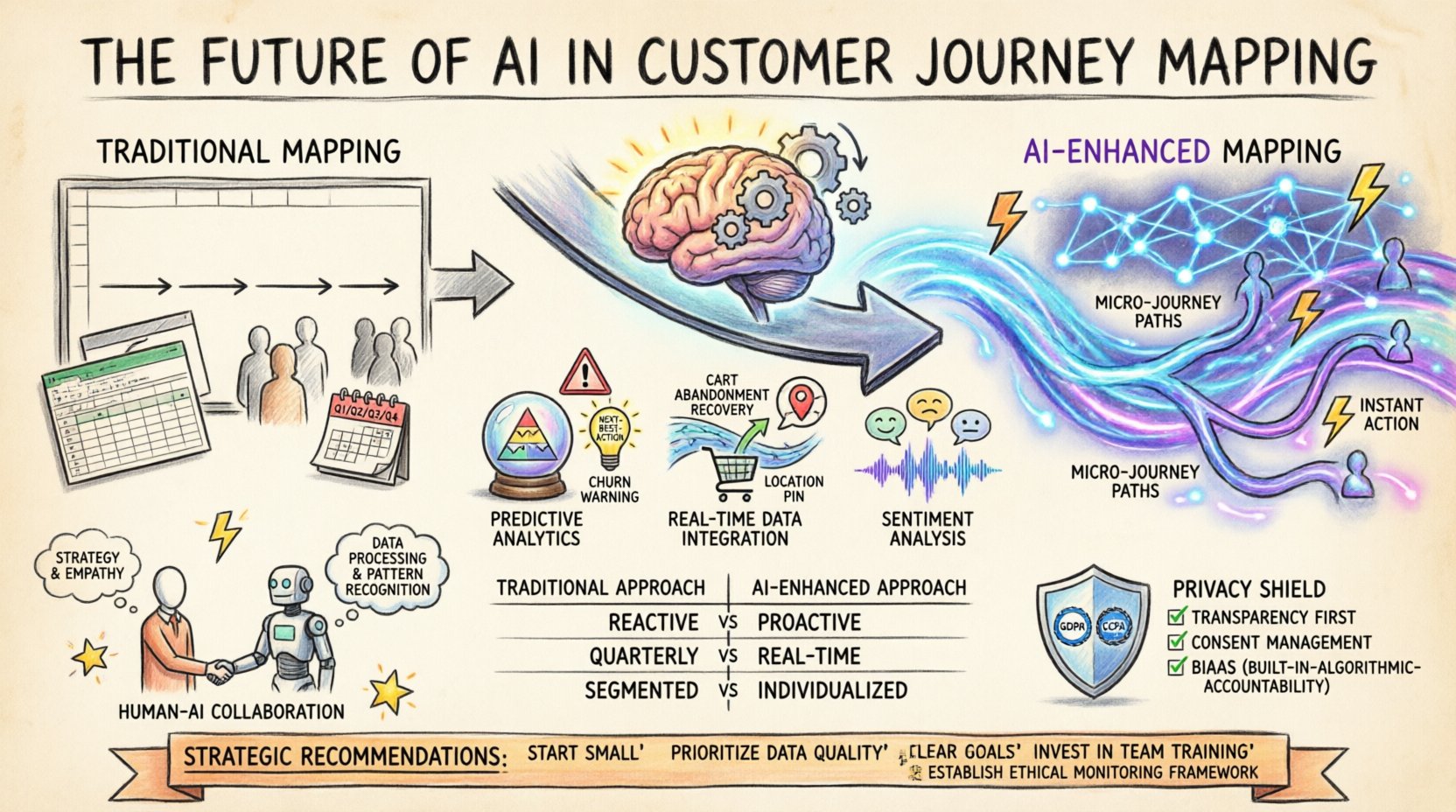
📊 The Evolution: From Static Maps to Dynamic Orchestration
Historically, journey mapping relied on aggregated data points. A marketing team might look at conversion rates from a specific landing page to a checkout screen. This is a high-level view that misses the nuance of individual interactions. AI introduces the ability to process individual-level data at scale without manual intervention.
- Legacy Approach: Based on average behaviors, periodic updates, and manual hypothesis testing.
- AI-Driven Approach: Based on individual real-time behaviors, continuous learning, and automated hypothesis validation.
The transition involves moving away from a “one-size-fits-all” model. Instead of mapping a single “ideal” journey, AI enables the creation of thousands of micro-journeys that adapt to specific user contexts. This granularity allows for precision that manual mapping cannot achieve.
🔍 Core Capabilities of AI in Journey Mapping
To understand the impact, we must identify the specific technical capabilities that drive this change. These are not just features but fundamental shifts in data processing logic.
1. Predictive Analytics
Predictive analytics uses historical data to forecast future outcomes. In the context of a customer journey, this means anticipating the next step a user is likely to take before they actually take it. This capability relies on machine learning models trained on vast datasets of past interactions.
- Churn Prediction: Identifying signals that indicate a customer is likely to discontinue service.
- Next Best Action: Suggesting the most relevant content or offer based on current behavior.
- Intent Recognition: Detecting purchase intent early in the consideration phase.
2. Real-Time Data Integration
Traditional mapping often suffers from latency. By the time data is collected, analyzed, and acted upon, the customer’s context may have changed. AI systems process streams of data in real-time, allowing for immediate adjustments to the journey.
- Immediate response to cart abandonment.
- Dynamic content adaptation based on time of day or location.
- Instant routing of support queries based on sentiment analysis.
3. Sentiment Analysis
Understanding *how* a customer feels is as important as understanding *what* they do. Natural Language Processing (NLP) allows systems to analyze text from reviews, chat logs, and social media to gauge sentiment. This adds an emotional layer to the journey map that quantitative data alone cannot provide.
📉 Comparison: Traditional vs. AI-Enhanced Journey Mapping
| Feature | Traditional Mapping | AI-Enhanced Mapping |
|---|---|---|
| Data Source | Surveys, Analytics Reports | Behavioral Streams, IoT, Transaction Logs |
| Update Frequency | Quarterly or Annually | Real-Time or Near Real-Time |
| Segmentation | Demographic-based | Behavioral and Contextual |
| Insight Depth | Aggregate Averages | Individual Micro-Journeys |
| Actionability | Strategic Planning | Automated Execution |
This table highlights the operational differences. The AI-enhanced model reduces the gap between insight and action. In a traditional model, insights often sit in reports for months. In an AI model, insights trigger immediate workflow adjustments.
🧠 Predictive Analytics and Proactive Engagement
One of the most significant shifts is the move from reactive to proactive engagement. In a reactive model, a customer encounters a problem, contacts support, and receives help. In a proactive model, the system identifies the friction point before the customer even realizes it exists.
Example Scenario:
- A user visits a product page repeatedly but does not purchase.
- Traditional: A retargeting email is sent 24 hours later.
- AI-Driven: The system detects hesitation, analyzes the specific product features viewed, and serves a comparison chart or a specific testimonial relevant to those features immediately.
This requires a robust data infrastructure. The AI must have access to the entire history of the user’s interaction to make accurate predictions. Without comprehensive data, predictive models risk bias or inaccuracy.
Key Components of Predictive Models
- Feature Engineering: Selecting the right variables that correlate with desired outcomes.
- Model Training: Feeding historical data to the algorithm to find patterns.
- Validation: Testing the model against new data to ensure accuracy.
- Deployment: Integrating the model into the customer experience workflow.
🛡️ Data Privacy and Ethical Considerations
As AI capabilities grow, the reliance on personal data increases. This creates a tension between personalization and privacy. Organizations must navigate regulatory landscapes like GDPR and CCPA while still delivering value.
Privacy by Design
Privacy should not be an afterthought. It must be embedded into the architecture of the AI journey mapping system. This includes:
- Data Minimization: Collecting only what is necessary for the specific journey step.
- Consent Management: Ensuring users have explicitly agreed to how their data is used.
- Anonymization: Using aggregated data for training models where possible to protect individual identities.
Ethical AI
There is a risk of manipulation. If a system knows a user’s vulnerabilities, it could exploit them. Ethical guidelines must govern how AI influences behavior. The objective should be to help the customer achieve their goals, not just to extract value for the business.
- Transparency in how recommendations are generated.
- Avoidance of dark patterns that trick users into actions they did not intend.
- Regular audits of AI decisions to check for bias against specific demographics.
🤝 The Human-AI Collaboration Model
A common fear is that AI will replace human strategists. In reality, the most effective models view AI as a co-pilot. The machine handles the volume and velocity of data, while humans provide the context, empathy, and strategic direction.
Where Humans Lead
- Strategic Vision: Defining what success looks like and setting the ethical boundaries.
- Empathy: Understanding the emotional nuances that algorithms might miss.
- Crisis Management: Handling exceptions that fall outside the scope of training data.
Where AI Leads
- Data Processing: Sifting through millions of data points instantly.
- Pattern Recognition: Finding correlations that are invisible to the human eye.
- Execution: Personalizing content at scale without human intervention.
This collaboration ensures that the journey map remains human-centric. The technology serves the strategy, not the other way around.
📈 Measuring Success in an Automated Landscape
With the introduction of AI, the metrics for success must evolve. Traditional metrics like conversion rate are still relevant, but they are lagging indicators. Leading indicators become more important.
Key Performance Indicators (KPIs)
- Prediction Accuracy: How often does the AI correctly anticipate the next step?
- Engagement Depth: Are users spending more time interacting with the content suggested by AI?
- Friction Reduction: Is the time to complete a task decreasing due to automated assistance?
- Customer Effort Score (CES): Is the journey feeling smoother and less complicated?
- Retention Rate: Are customers staying longer due to better personalized experiences?
It is crucial to track these metrics continuously. AI models degrade over time as market conditions change. Regular retraining and monitoring are essential to maintain performance.
🔮 Long-Term Trends and Strategic Implications
Looking ahead, several trends are shaping the future of AI in this space. Understanding these will help organizations prepare for the next phase of evolution.
Generative AI Integration
While predictive AI tells you what will happen, generative AI can create the content to guide the customer. Instead of selecting from a pre-defined library of emails, the system can generate unique copy for each user in real-time based on their current mood and context.
- Dynamic Content Creation: Writing product descriptions that highlight features most relevant to the user.
- Conversational Interfaces: Chatbots that hold natural, context-aware conversations rather than rigid scripts.
Omni-Channel Synchronization
AI will become the glue that holds different channels together. A customer might start a journey on mobile, switch to desktop, and finish on a call center. AI ensures the context is preserved across all these touchpoints.
- Seamless handoffs between digital and physical stores.
- Consistent messaging across email, social, and support channels.
- Unified customer view that updates instantly across all systems.
Autonomous Agents
In the distant future, AI agents may manage entire journeys autonomously. These agents would negotiate terms, resolve issues, and complete transactions with minimal human oversight. This requires high levels of trust and robust governance frameworks.
🧩 Implementation Challenges
Adopting these technologies is not without hurdles. Organizations must be aware of the barriers to entry.
Data Silos
AI requires access to all relevant data. Often, customer data is scattered across CRM, ERP, marketing automation, and support tools. Breaking down these silos is a prerequisite for AI success.
Talent Gap
There is a shortage of professionals who understand both data science and customer experience strategy. Building a team that bridges this gap is critical.
Legacy Infrastructure
Old systems may not support the real-time data processing required by modern AI. Upgrading infrastructure can be costly and time-consuming.
🎯 Strategic Recommendations
For organizations looking to integrate AI into their journey mapping, the following steps provide a structured approach.
- Start Small: Pilot AI on a single journey or segment before scaling.
- Focus on Data Quality: Ensure the data feeding the models is accurate and clean.
- Define Clear Goals: Know what problem you are solving (e.g., reducing churn, increasing conversion).
- Invest in Training: Upskill teams to work alongside AI tools.
- Monitor Ethically: Establish governance committees to oversee AI usage.
🔚 Final Thoughts
The future of customer journey mapping is not about replacing the map with a GPS. It is about upgrading the map to a live navigation system. AI provides the ability to see traffic, weather, and road conditions in real-time, allowing for dynamic rerouting to ensure the best possible experience.
Organizations that embrace this shift will gain a significant competitive advantage. They will be able to anticipate needs, reduce friction, and build deeper relationships with their customers. However, success depends on a balanced approach. Technology must serve human needs, not the other way around. By combining computational power with human empathy, businesses can create journeys that are not just efficient, but meaningful.
The journey is continuous. As AI capabilities evolve, so too must the strategies used to apply them. Staying informed and adaptable is the only way to ensure long-term success in this rapidly changing landscape.