Understanding how customers interact with a brand is not a new concept, but the tools and methodologies have shifted dramatically over time. What began as simple sketches on napkins has transformed into complex data-driven models. This guide explores the history of customer journey mapping, the changes in data collection, and the strategic shifts that have defined modern customer experience (CX) management. 🧭
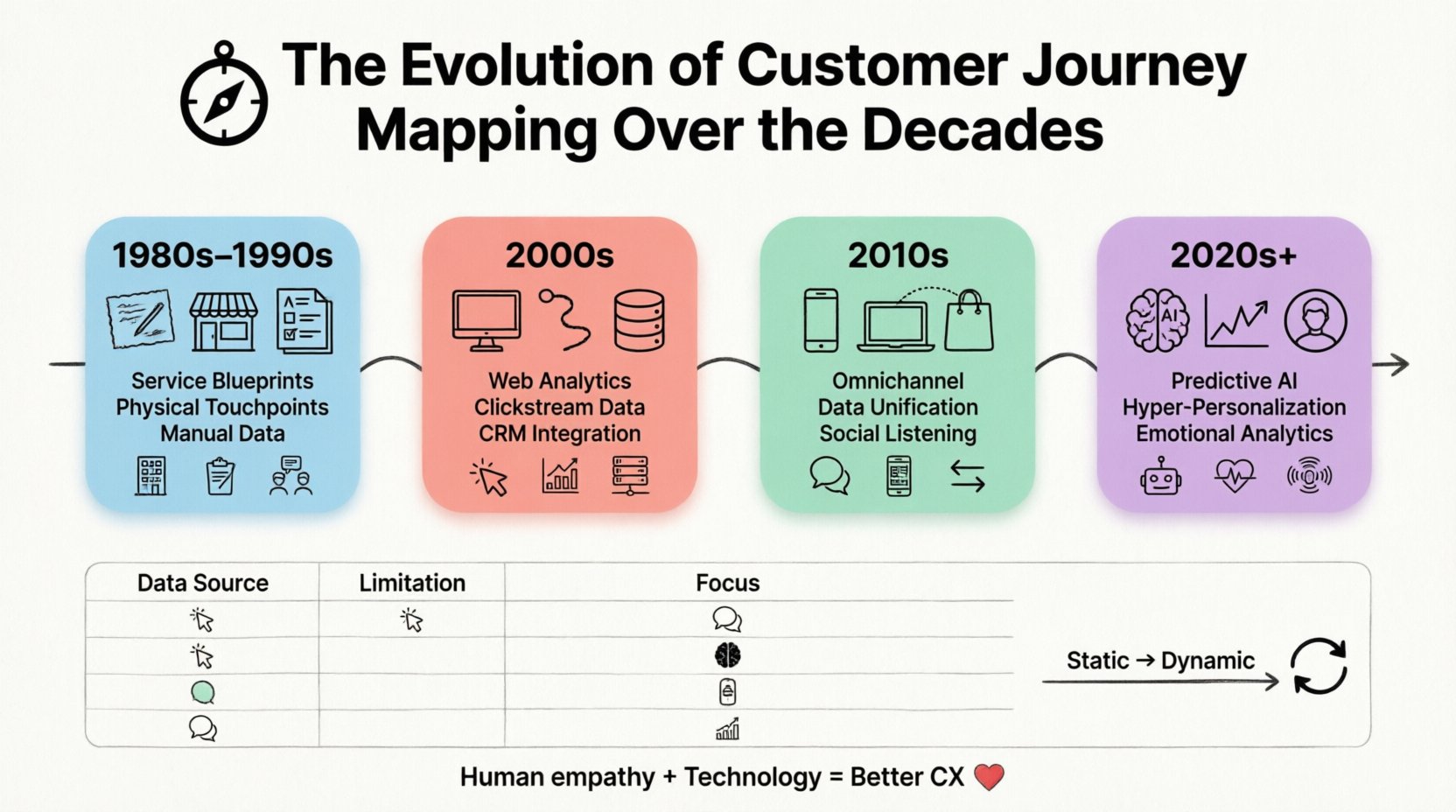
1. The Foundation: Service Blueprints and Physical Touchpoints (1980s-1990s) 🏢
In the early days of customer experience management, the focus was heavily on physical interactions. Before the internet, businesses could not track digital footprints. Instead, they relied on direct observation and service design techniques.
- Service Blueprinting: This was the precursor to modern mapping. It involved layering different views of a service process to understand the relationship between customer actions and internal back-stage activities.
- Physical Evidence: Maps focused on tangible elements like store layout, packaging, and face-to-face sales interactions.
- Manual Data Collection: Information came from paper surveys, focus groups, and direct feedback forms.
During this era, the goal was consistency. Companies sought to ensure that every interaction, whether in a bank lobby or a retail store, felt uniform. The limitations were clear: data was retrospective and often qualitative. There was no real-time visibility into customer sentiment.
2. The Digital Dawn: Web Analytics and Clickstream Data (2000s) 💻
The turn of the millennium brought the widespread adoption of the World Wide Web. As customers began shopping online, companies needed new ways to track behavior. This era marked the transition from purely physical mapping to hybrid models.
- Clickstream Analysis: Businesses started tracking where users clicked, how long they stayed on a page, and where they dropped off.
- Session Replay: Early tools allowed teams to watch recordings of user sessions to see technical issues or confusion.
- Database Integration: Customer Relationship Management (CRM) systems began linking transactional data with interaction data.
While this provided more quantitative data, it often lacked context. A user might leave a page quickly because they found the answer, not because they were frustrated. The maps were becoming more detailed but sometimes missed the emotional nuance of the experience. Companies started to realize that a digital path was not the only path; they needed to understand the full lifecycle.
3. The Data Explosion: Big Data and Omnichannel Shift (2010s) 📱
As smartphones became ubiquitous, the customer journey fragmented. A user might research on a laptop, compare prices on a phone, and purchase in a physical store. This complexity forced a major shift in how organizations approached mapping.
The concept of omnichannel emerged. It was no longer about a single channel but about the seamless integration of all channels.
- Data Unification: Organizations struggled to merge data from web, mobile, call centers, and point-of-sale systems.
- Customer Segmentation: Maps were no longer static; they were dynamic based on user behavior and demographic data.
- Social Listening: Feedback moved beyond direct surveys to public social media mentions and reviews.
This decade was defined by the challenge of integration. Without a unified view, maps became siloed. A marketing team might map a different journey than the support team. The industry began to realize that a single customer profile was necessary for an accurate map.
4. The Modern Era: AI, Predictive Insights, and Hyper-Personalization (2020s) 🤖
Today, journey mapping is driven by advanced analytics and artificial intelligence. The focus has shifted from describing what happened to predicting what will happen next.
- Predictive Modeling: Algorithms analyze historical patterns to predict churn risk or future purchase intent.
- Real-Time Triggering: Actions can be triggered instantly based on current behavior, such as offering a discount when a user hesitates.
- Emotional Analytics: Text analysis and voice recognition are used to gauge sentiment during interactions.
- Integration of Offline and Online: IoT devices and location data bridge the gap between digital and physical again, but with higher precision.
The objective is no longer just satisfaction; it is value creation and lifetime value maximization. The maps are now living documents that update automatically as data flows in.
Comparison of Mapping Methodologies Across Decades ⏳
To better understand the progression, we can compare the key characteristics of each era.
| Decade | Primary Data Source | Focus Area | Key Limitation |
|---|---|---|---|
| 1980s-1990s | Paper Surveys, Observation | Physical Touchpoints | Slow, Qualitative, Retrospective |
| 2000s | Web Analytics, CRM | Digital Funnels | Lack of Context, Siloed Channels |
| 2010s | Social Media, Mobile Data | Omnichannel Consistency | Data Integration Complexity |
| 2020s+ | AI, IoT, Real-Time Streams | Prediction & Personalization | Data Privacy & Ethics |
Methodology Shifts: From Static to Dynamic 🔄
One of the most significant changes in the evolution of journey mapping is the shift from static diagrams to dynamic processes.
Static Maps (Past)
- Created once a year or during a major project.
- Displayed in PowerPoint or printed on walls.
- Used primarily for strategic planning meetings.
- Risked becoming outdated quickly due to market changes.
Dynamic Maps (Present)
- Updated continuously based on real-time data streams.
- Integrated directly into operational workflows.
- Accessible to frontline employees for immediate decision-making.
- Capable of A/B testing different journey variations.
This shift requires a cultural change. It is not just about having better technology; it is about accepting that customer behavior is fluid. A map that was accurate last quarter may be irrelevant today.
The Role of Emotion in Journey Mapping ❤️
While data has become more sophisticated, the core of mapping remains human-centric. Early maps focused on steps and tasks. Modern maps place a heavier emphasis on emotional states.
- Emotional Valence: Tracking the highs and lows of the experience, not just completion rates.
- Pain Point Identification: Pinpointing specific moments of frustration that cause churn.
- Delight Moments: Identifying opportunities to exceed expectations.
Techniques for capturing emotion have evolved. Instead of asking “Was this easy?”, teams now analyze tone of voice in call recordings or sentiment in support tickets. This qualitative layer adds depth to the quantitative data.
Challenges in the Evolution ⚠️
Despite technological advances, significant challenges remain. The evolution has not been without friction.
- Data Privacy: As tracking becomes more precise, regulations like GDPR and CCPA have imposed stricter boundaries on data collection.
- Data Quality: More data does not always mean better insights. Dirty data can lead to incorrect journey assumptions.
- Siloed Organizations: Even with better tools, departments often compete rather than collaborate on the customer view.
- Over-Reliance on Automation: There is a risk that human empathy is lost when AI drives all journey decisions.
Best Practices for Modern Mapping 🛠️
Regardless of the technology used, certain principles remain constant. To build effective maps, organizations should adhere to the following standards.
- Start with the Customer, Not the Business: Avoid designing maps based on internal processes. Focus on the user’s goals and needs.
- Validate with Real Users: Never assume you know how the journey works. Test hypotheses with actual customers.
- Map the Negative: Spend as much time mapping the failure points as the success paths.
- Collaborate Across Teams: Involve support, sales, marketing, and product teams to get a complete picture.
- Iterate Frequently: Treat the map as a living document. Update it as new channels or behaviors emerge.
The Future of Customer Journey Mapping 🔮
Looking ahead, the trajectory suggests a move toward even more integrated and predictive systems. We are moving away from linear paths toward networked experiences.
- Networked Journeys: Customers do not follow a straight line. They loop back, skip steps, and use multiple devices simultaneously. Future maps will visualize these complex networks.
- Proactive Intervention: Systems will detect friction before the customer notices and resolve it automatically.
- Contextual Relevance: Maps will adapt to the specific context of the user, including location, time of day, and current mood.
The goal remains the same: to understand the human behind the data. Technology is merely the vessel for this understanding. As we move forward, the organizations that succeed will be those that balance advanced analytics with genuine human empathy.
Conclusion 🏁
The history of customer journey mapping reflects the broader history of technology and commerce. From paper blueprints to AI-driven insights, the tools have changed, but the need to understand the customer has not. By studying these evolutions, businesses can avoid past pitfalls and leverage current capabilities to build better experiences. The journey is never truly finished; it is an ongoing process of learning and adaptation.
Success lies in the ability to adapt methodologies to the current landscape while keeping the human element at the center. Whether through a simple sketch or a complex algorithm, the map is a guide to value creation. As data privacy and technology continue to evolve, so too will the strategies used to navigate the customer landscape. The focus must remain on delivering genuine value at every touchpoint.