Entering the field of User Experience (UX) design requires more than just an eye for aesthetics. It demands a deep understanding of human behavior, needs, and pain points. User research forms the backbone of evidence-based design. Without it, decisions rely on guesswork rather than data. This guide provides a comprehensive overview of the methodologies you need to know as you begin your career.
Whether you are designing for mobile applications, web platforms, or physical products, the principles of research remain consistent. The goal is to reduce risk and create solutions that resonate with the people who use them. This article covers the fundamental approaches, how to execute them, and common pitfalls to avoid.
Understanding Research Fundamentals 🔍
Before diving into specific techniques, it is crucial to grasp the two main categories of research: qualitative and quantitative. Each serves a distinct purpose and answers different types of questions.
Qualitative vs. Quantitative Research
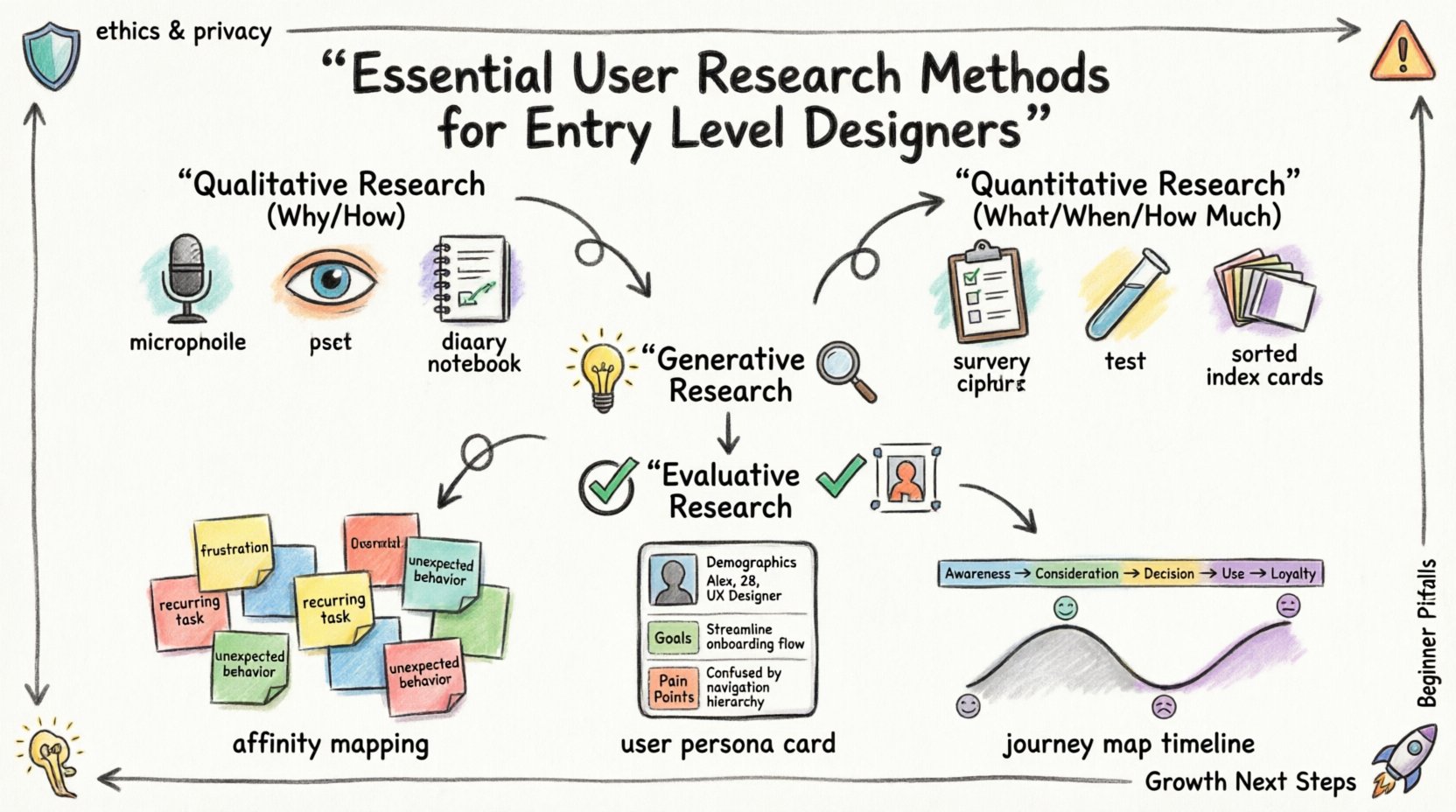
Qualitative research focuses on the why and how of user behavior. It explores motivations, feelings, and underlying reasons. This is often found in one-on-one interactions or open-ended discussions. Quantitative research, on the other hand, focuses on the what, when, and how much. It deals with numbers, statistics, and measurable data points.
| Feature | Qualitative Research | Quantitative Research |
|---|---|---|
| Primary Goal | Gain insights and understanding | Measure and quantify variables |
| Data Type | Non-numerical (text, video, audio) | Numerical (stats, metrics) |
| Sample Size | Small (typically 5-10 participants) | Large (hundreds or thousands) |
| Best Used For | Discovering problems, understanding context | Validating hypotheses, measuring performance |
A robust UX strategy often combines both. You might use qualitative methods to discover a problem and quantitative methods to measure how widespread that problem is.
Qualitative Research Methods 🗣️
Qualitative research is your primary tool for empathy. It helps you see the world through the user’s eyes. Here are the most effective methods for entry-level designers.
1. User Interviews 🎤
Interviews are conversations designed to gather detailed information about a specific topic. They can be structured (using a fixed set of questions) or unstructured (more conversational). This method is excellent for understanding motivations and past behaviors.
- Preparation: Define your research goals clearly. What do you want to learn?
- Recruitment: Find participants who match your target audience profile.
- Questioning: Avoid leading questions. Instead of asking “Did you like this feature?”, ask “How did you feel when using this feature?”
- Listening: Focus on active listening. Allow silence to let participants think. Take detailed notes or record the session with permission.
- Analysis: Review transcripts to identify recurring themes and patterns.
2. Contextual Inquiry 👀
Also known as contextual observation, this method involves observing users in their natural environment. You watch them perform tasks as they normally would, rather than in a lab setting. This reveals environmental factors that might affect their experience.
- Environment: Go to where the user works or lives. Observe distractions, tools they use nearby, and physical constraints.
- Shadowing: Follow the user silently. Do not interrupt unless necessary to clarify a behavior.
- Think Aloud: Ask users to verbalize their thoughts while they work. This provides real-time insight into their decision-making process.
3. Diary Studies 📓
Diary studies ask participants to record their experiences over a period of time. This is useful for understanding behaviors that occur infrequently or over long durations, such as budgeting or planning trips.
- Duration: Can last from a few days to several weeks.
- Format: Participants might use a physical journal or a digital app to log entries.
- Reflection: Entries often include photos, screenshots, or reflections on how a task made them feel.
- Check-ins: Researchers may schedule periodic calls to discuss the diary entries and ask follow-up questions.
Quantitative Research Methods 📊
While qualitative data tells a story, quantitative data proves it. These methods help you validate assumptions with hard numbers.
1. Online Surveys 📝
Surveys allow you to gather data from a large number of people quickly. They are ideal for measuring satisfaction levels, gathering demographic information, or validating feature requests.
- Question Design: Keep questions short and clear. Mix multiple-choice, Likert scales (1-5 ratings), and open-ended text fields.
- Distribution: Share via email lists, social media, or existing user communities.
- Sample Size: Aim for a statistically significant number of responses to ensure accuracy.
- Bias Check: Review questions to ensure they do not lead the respondent toward a specific answer.
2. Usability Testing 🧪
Usability testing involves watching users attempt to complete specific tasks with a product. This is typically done during the design or development phase. It highlights friction points and confusion.
- Tasks: Define specific goals for the user, such as “Find a pair of shoes and add them to the cart.”
- Metrics: Track success rates, time on task, and error rates.
- Moderation: Can be moderated (a facilitator guides the user) or unmoderated (users complete tasks independently via software).
- Iterate: Use findings to refine the interface before launch.
3. Card Sorting 🗂️
Card sorting is a technique used to understand how users categorize information. It helps in designing information architecture and navigation structures.
- Open Card Sorting: Participants create their own categories. This reveals mental models of the domain.
- Closed Card Sorting: Participants sort items into predefined categories. This validates your proposed structure.
- Hybrid: A mix of both to test flexibility and structure.
Generative vs. Evaluative Research 🔄
Understanding the stage of the design process is vital for selecting the right method. Research generally falls into two buckets based on timing.
Generative Research
This occurs at the beginning of a project. The goal is to discover problems and opportunities. You are generating ideas and insights that will shape the product direction.
- Timing: Early stages, before design begins.
- Methods: User interviews, ethnography, surveys.
- Outcome: User personas, problem statements, opportunity maps.
Evaluative Research
This happens after you have a prototype or a live product. The goal is to test whether your solution works as intended.
- Timing: Mid to late stages, during or after development.
- Methods: Usability testing, A/B testing, heuristic evaluation.
- Outcome: Design improvements, bug fixes, validation of hypotheses.
Synthesis and Analysis 🧩
Gathering data is only half the work. Synthesis is the process of making sense of what you collected. Without synthesis, data remains just information.
Affinity Mapping 📌
Affinity mapping involves organizing observations into groups based on natural relationships. This helps in identifying patterns across different users.
- Write Notes: Capture individual insights on sticky notes or digital cards.
- Grouping: Place related notes together without forcing them into categories initially.
- Naming: Once groups form, assign a theme or title to each cluster.
- Insights: Discuss what these themes mean for the product strategy.
User Personas 👤
Personas are fictional characters created to represent different user types within your targeted demographic. They help designers keep the user in focus.
- Demographics: Age, location, occupation.
- Goals: What they want to achieve.
- Pain Points: What frustrates them currently.
- Behavior: How they interact with technology.
User Journey Maps 🗺️
A journey map visualizes the process a person goes through to accomplish a goal. It tracks their emotions and actions over time.
- Stages: Awareness, Consideration, Action, Retention.
- Touchpoints: Where the user interacts with the brand or product.
- Emotional Curve: Plot how the user feels at each stage (frustrated, happy, confused).
- Opportunities: Identify moments where the experience can be improved.
Building a Research Plan 📋
Before starting, you need a plan. This ensures you respect everyone’s time and get the data you need.
- Define Objectives: What questions must be answered?
- Select Methods: Choose the right mix of qualitative and quantitative.
- Recruit Participants: Create a screener to find the right people.
- Set Timeline: Allocate time for planning, execution, and analysis.
- Budget: Account for incentives, tools, and labor.
Ethics and Privacy 🛡️
As a designer, you are handling sensitive information about real people. Ethical considerations are non-negotiable.
- Informed Consent: Always explain the purpose of the research and get permission before recording.
- Data Privacy: Store data securely. Anonymize responses when sharing findings.
- Respect: Allow participants to withdraw at any time.
- Transparency: Be honest about how their data will be used.
Common Pitfalls for Beginners ⚠️
Even experienced researchers make mistakes. Here are common traps to avoid in your early career.
- Asking Leading Questions: “Don’t you think this button is blue?” implies the answer. Ask “What color is this button?”
- Ignoring Silence: Users often have valuable thoughts after a pause. Don’t rush to fill the quiet.
- Designing for Yourself: Your experience is not the user’s experience. Rely on data, not intuition.
- Over-researching: You do not need perfect data to make progress. Research enough to reduce risk, then test your solution.
- Skipping Synthesis: Don’t just collect notes. Analyze them to find the story.
Next Steps for Growth 🚀
Research is a continuous learning process. As you gain experience, you will develop your own style and toolkit.
- Read Case Studies: Look at how other designers approach problems.
- Join Communities: Engage with other researchers to share findings.
- Practice: Start with low-stakes projects to refine your skills.
- Stay Curious: Keep asking questions about why people do what they do.
By mastering these essential user research methods, you will build a foundation for creating meaningful, accessible, and effective digital experiences. The journey from junior designer to expert is paved with data, empathy, and iteration. Start applying these methods today and watch your designs improve.