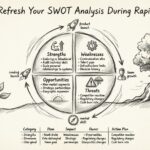
Strategic planning requires more than just a brainstorming session; it demands a structured approach to understanding your organization’s position in the market. The SWOT analysis framework remains a cornerstone of business strategy, yet its effectiveness relies entirely on the quality of inquiry. Without precise questions, the output becomes a collection of vague opinions rather than actionable data. This guide details the specific questions necessary to extract meaningful insights during your SWOT session.
Setting the Stage for Strategic Clarity 🎯
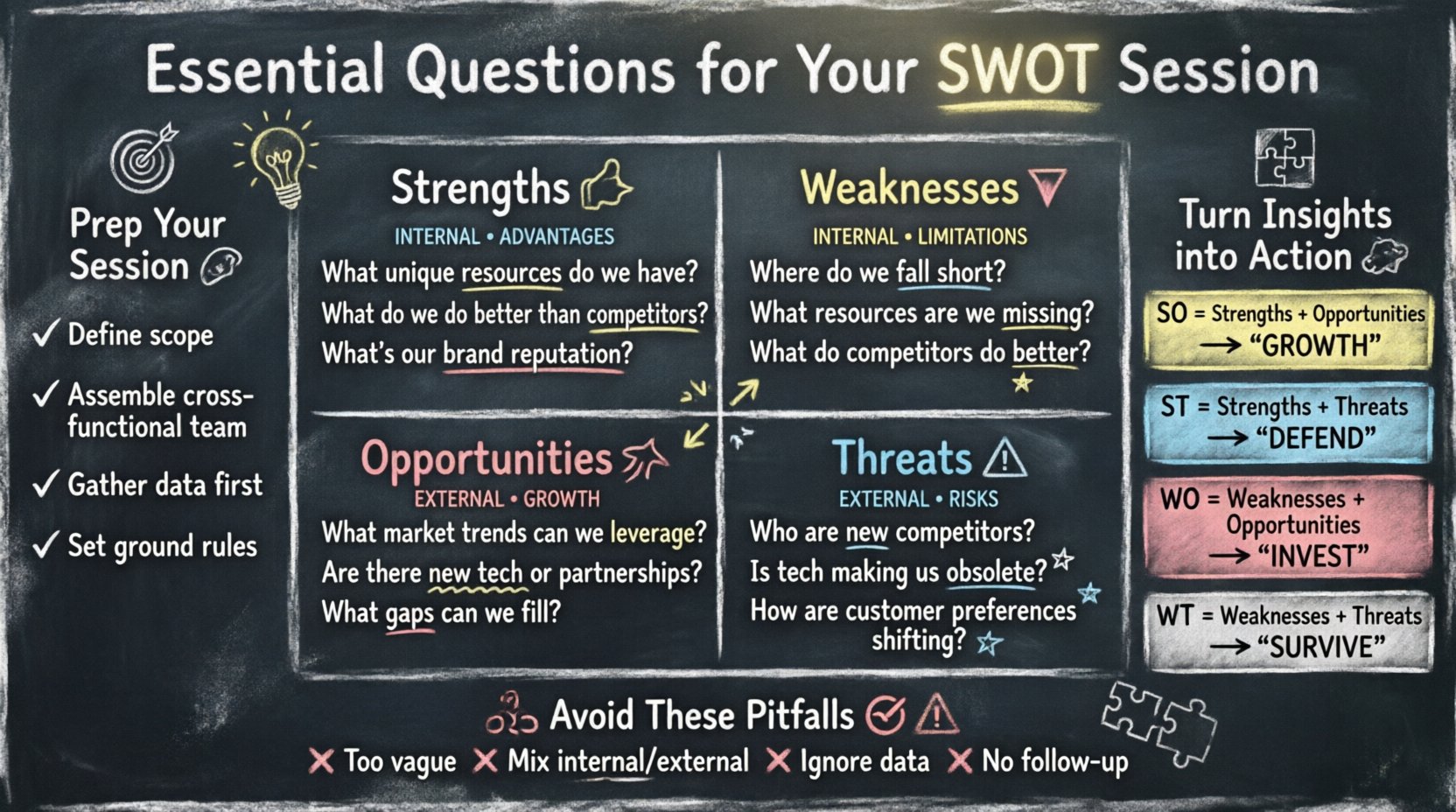
Before diving into the four quadrants of Strengths, Weaknesses, Opportunities, and Threats, preparation is vital. A successful session requires the right participants, the right environment, and the right data. The goal is to create a space where honest assessment can occur without fear of repercussion.
- Define the Scope: Are you analyzing the entire organization, a specific department, or a new product launch? Narrowing the focus prevents the conversation from becoming too broad.
- Assemble the Right Team: Include cross-functional representatives. A marketing lead sees different strengths than an engineer. Diverse perspectives prevent blind spots.
- Gather Preliminary Data: Enter the room with market reports, financial statements, and customer feedback. Let the discussion be guided by evidence, not just intuition.
- Establish Ground Rules: Encourage open dialogue. Every opinion is valid during the analysis phase. Critique ideas, not people.
When the environment is set correctly, the subsequent questions yield higher quality results. You are not just filling out a template; you are diagnosing the health of the business.
Understanding the Internal Landscape: Strengths & Weaknesses 🏗️
Strengths and Weaknesses are internal factors. They exist within your control. This section of the analysis requires a deep dive into resources, capabilities, and processes. The distinction between a strength and a weakness often depends on how well the asset is leveraged.
Identifying Your Strengths 💪
Strengths are attributes that give you an advantage over competitors. They are not merely what you do well, but what you do better than others. To uncover these, ask the following questions:
- What unique resources do we possess? This could include proprietary technology, exclusive partnerships, or a prime physical location.
- Which processes are more efficient than our competitors? Look at operational workflows. Do we have faster turnaround times or lower error rates?
- What is our brand reputation? How do customers perceive our reliability and quality? Is there a loyal customer base that recommends us organically?
- Who are our key personnel? Do we have a team with specialized skills or experience that is difficult to replicate?
- What financial reserves do we have? Strong cash flow allows for investment during downturns that competitors cannot afford.
- What intellectual property do we hold? Patents, trademarks, and copyrights create barriers to entry for others.
Answering these questions requires honesty. If a strength is only perceived as such by leadership but not by the market, it does not count as a competitive advantage. Validate every claim against market reality.
Recognizing Your Weaknesses 📉
Weaknesses are internal limitations that place you at a disadvantage. Identifying these is often more difficult because it involves admitting fault or lack of capability. However, ignoring them guarantees future failure. Consider these inquiries:
- Where do we consistently fall short? Look at metrics. Is customer satisfaction low in a specific area? Is delivery slow?
- What resources are we lacking? Do we need more capital, better technology, or more staff to function effectively?
- Are there gaps in our skillset? Does the current team lack expertise in emerging technologies or critical management functions?
- How dependent are we on key individuals? If a single person leaves, does the operation halt? This is a structural weakness.
- What are our competitors doing better? Benchmark your processes against industry leaders. Where is the gap?
- Is our infrastructure outdated? Legacy systems can slow down innovation and increase maintenance costs.
The objective here is not to dwell on negativity, but to identify areas that require investment or change. A weakness acknowledged is a problem to be solved, not a character flaw.
Scanning the External Environment: Opportunities & Threats 🌍
Opportunities and Threats are external factors. They exist outside your organization. You cannot control them directly, but you can adapt to them. This analysis requires looking outward at the market, the economy, and societal trends.
Spotting Opportunities 🚀
Opportunities are favorable conditions in the external environment that the organization can exploit. They represent potential for growth or improvement. To find them, you must stay informed:
- What are the emerging market trends? Is there a shift in consumer behavior that aligns with your capabilities?
- Are there new technologies we can adopt? Automation, AI, or new communication tools might streamline operations or create new products.
- Is the regulatory landscape changing? New laws might open up markets or remove barriers for competitors.
- Can we expand geographically? Are there untapped regions or demographics where demand is rising?
- Are there gaps in the competitor’s offerings? If rivals are ignoring a specific niche, that is an opening for you.
- What partnerships are possible? Can collaborations with other firms provide access to new channels or resources?
Opportunities are not just luck; they are signals in the market that require敏锐 observation. If you do not recognize them, they will be seized by your competition.
Assessing Threats ⚠️
Threats are external elements that could cause trouble for your business. They are risks that must be mitigated or planned for. Ignoring threats is a strategic error:
- Who are the new entrants? Are startups or established companies entering your space with a disruptive model?
- What are the economic indicators? Inflation, interest rates, or recession risks can impact spending power.
- Is technology making our product obsolete? Disruption often comes from outside the industry.
- Are there supply chain vulnerabilities? Reliance on a single supplier or region creates risk.
- How are consumer preferences shifting? If customers move away from your core offering, the threat is real.
- What are the regulatory compliance costs? Stricter regulations can reduce margins or restrict operations.
Threats require contingency planning. The goal is not to eliminate all risk, which is impossible, but to build resilience against the most likely negative outcomes.
Internal vs. External Analysis: A Comparison 📋
To clarify the distinction between these categories, refer to the table below. This visual aid helps ensure that items are placed in the correct quadrant.
| Category | Control Level | Focus | Example |
|---|---|---|---|
| Strengths | Internal | Capabilities | Proprietary Patent |
| Weaknesses | Internal | Limited Resources | Outdated Software |
| Opportunities | External | Market Growth | New Demographic Trend |
| Threats | External | Market Risk | Competitor Price Cut |
Ensuring items are categorized correctly is crucial. A new technology is a threat if it disrupts you, but an opportunity if you can adopt it. The context determines the classification.
Bridging the Gap: Strategy Synthesis 🧩
Completing the four quadrants is only the first step. The true value of a SWOT analysis lies in connecting the dots. You must create strategies that utilize your strengths to capture opportunities, use strengths to defend against threats, fix weaknesses to seize opportunities, and minimize weaknesses to avoid threats.
- SO Strategies (Maxi-Maxi): How can you use your internal strengths to maximize external opportunities? This is your aggressive growth path.
- ST Strategies (Maxi-Mini): How can you use your strengths to minimize external threats? This is your defensive strategy.
- WO Strategies (Mini-Maxi): How can you overcome weaknesses to take advantage of opportunities? This often requires investment or change.
- WT Strategies (Mini-Mini): How can you minimize weaknesses and avoid threats? This is your survival or cost-reduction strategy.
These combinations turn a static list into a dynamic action plan. Without this synthesis, the SWOT analysis remains an academic exercise.
Common Pitfalls to Avoid 🚫
Even with the right questions, teams often stumble during the execution phase. Awareness of these common errors helps maintain the integrity of the session.
- Being Too Vague: “Good customer service” is not a strength. “98% customer retention rate” is. Specificity drives action.
- Confusing Internal with External: Misclassifying factors leads to incorrect strategies. Do not list “Market Growth” as a Strength.
- Ignoring Data: Relying on gut feelings without supporting metrics reduces the validity of the findings.
- Lack of Follow-Up: If the session ends without assigned owners for action items, the work is wasted.
- Groupthink: If one dominant voice controls the conversation, diverse perspectives are lost. Facilitate equal participation.
- Stagnation: A SWOT is not a one-time event. Market conditions change, and so must your analysis.
Table: Action Plan Template
Once the synthesis is complete, move to execution. Use a structured table to track progress.
| Strategy Type | Goal | Key Action | Owner | Deadline |
|---|---|---|---|---|
| SO | Increase Market Share | Launch New Product Line | Product Lead | Q3 2024 |
| ST | Protect Margin | Negotiate Supplier Contracts | Procurement | Q2 2024 |
| WO | Improve Efficiency | Upgrade Legacy Systems | IT Director | Q4 2024 |
| WT | Reduce Risk | Diversify Supply Chain | Operations | Q1 2025 |
Moving from Analysis to Action 🏁
The final phase is execution. A SWOT analysis is only as good as the decisions made based on it. Assign responsibility for every strategic initiative identified. Set clear timelines and metrics for success.
- Communicate the Findings: Ensure all stakeholders understand the strategy. Alignment is key to execution.
- Monitor Progress: Review the action plan regularly. Are the strategies working? Is the data changing?
- Adapt as Needed: If a weakness cannot be fixed quickly, adjust the strategy to work around it.
- Repeat the Process: Schedule the next analysis in six or twelve months. Strategy is iterative.
By rigorously answering the essential questions outlined in this guide, you transform a simple framework into a powerful tool for decision-making. The clarity gained during this session provides a roadmap for navigating uncertainty and securing long-term growth.
Remember, the objective is not to create a perfect document, but to facilitate a conversation that leads to tangible results. Focus on the questions, trust the data, and commit to the actions that follow.