Many organizations conduct a SWOT analysis and place the results in a drawer. They gather data, identify strengths, weaknesses, opportunities, and threats, and then file the document away. The analysis itself is often thorough, yet the intended outcome—strategic improvement—never materializes. This disconnect between insight and execution is a common challenge in strategic planning. To move forward, you must transform abstract observations into tangible steps.
This guide details how to convert SWOT findings into concrete business actions. We will explore the methodology for prioritizing insights, mapping them to specific strategies, and establishing a framework for accountability. By following this process, you ensure that your strategic planning yields measurable results rather than just a static report. Let us dive into the mechanics of turning analysis into action.
Why Analysis Often Stalls Without Execution 🛑
Understanding why SWOT analysis frequently fails to drive change is the first step toward success. Organizations often mistake the completion of the matrix for the completion of the strategy. The following factors contribute to this stagnation:
- Overwhelming Volume of Data: Lists of strengths and weaknesses can become lengthy. Without filtering, teams struggle to identify what matters most.
- Lack of Prioritization: Not every finding requires immediate attention. Treating all items as equally critical dilutes focus and resources.
- Abstract Language: Statements like “improve customer service” are too vague. They lack the specificity needed for operational teams to act.
- Missing Ownership: When no single person is responsible for a specific outcome, accountability fades. Tasks get passed around until they disappear.
- Absence of Metrics: Without defined success criteria, it is impossible to know if the action plan is working.
To avoid these pitfalls, you must shift your mindset from documenting the current state to designing the future state. The goal is not just to see the landscape, but to navigate it effectively.
The TOWS Matrix: Bridging the Gap 🌉
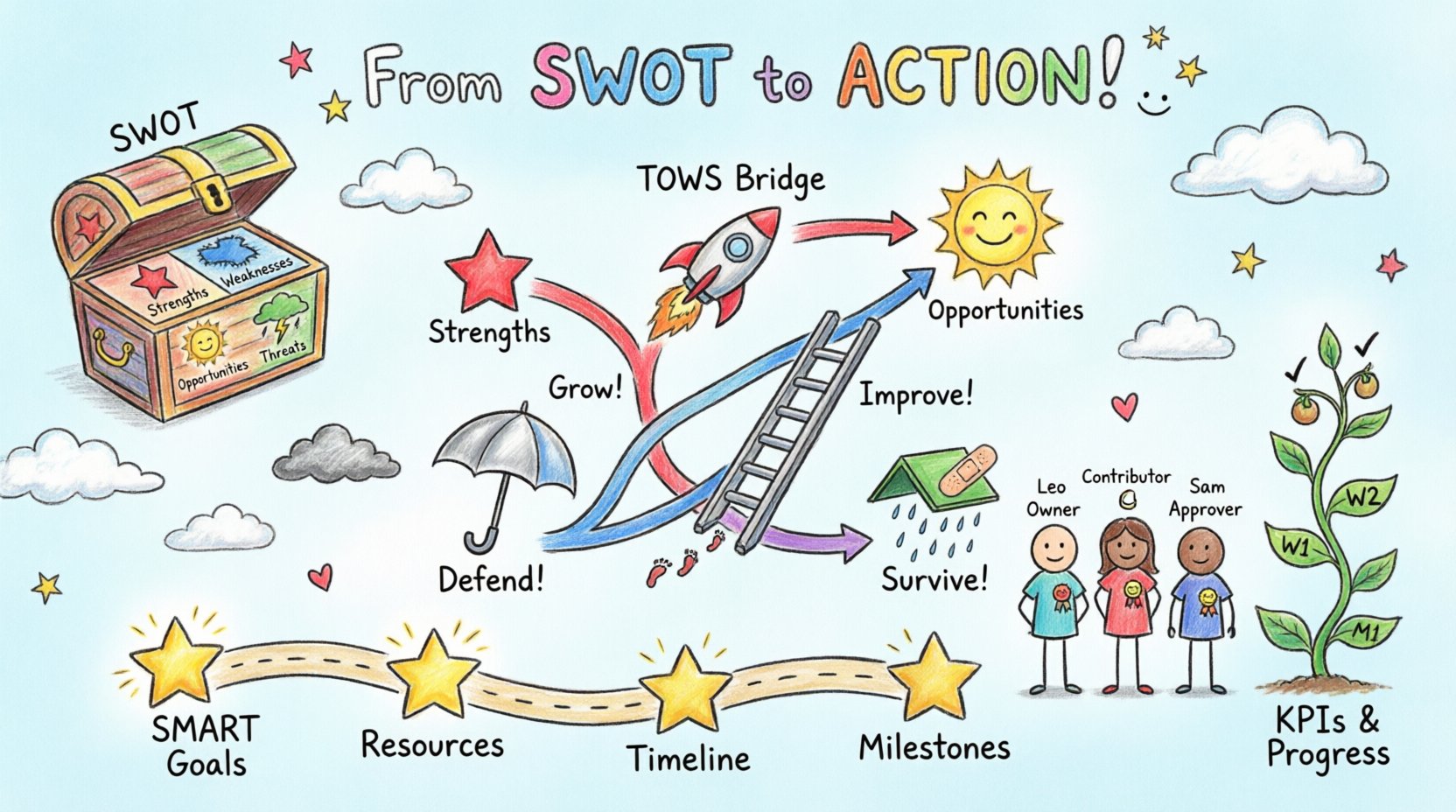
Once the SWOT analysis is complete, the next logical step is to cross-reference the internal factors (Strengths and Weaknesses) with the external factors (Opportunities and Threats). This approach is often referred to as the TOWS Matrix. It forces you to look at how specific internal capabilities interact with the external environment.
Instead of viewing these four categories in isolation, this method generates four distinct strategic directions. Each direction addresses a specific combination of factors:
- SO Strategies: Use Strengths to maximize Opportunities.
- WO Strategies: Use Opportunities to overcome Weaknesses.
- ST Strategies: Use Strengths to minimize Threats.
- WT Strategies: Minimize Weaknesses to avoid Threats.
This framework provides a structured way to generate actionable ideas. Below is a table illustrating how these combinations translate into concrete business actions.
| Strategy Type | Focus | Actionable Example |
|---|---|---|
| SO (Maxi-Maxi) | Leverage internal capabilities to capture external growth. | A strong brand reputation is used to launch a new product line in an emerging market. |
| WO (Mini-Maxi) | Overcome internal limitations by utilizing external trends. | Partner with a technology provider to upgrade outdated systems before competitors do. |
| ST (Maxi-Mini) | Use internal strengths to protect against external risks. | Leverage cash reserves to invest in defensive marketing during an economic downturn. |
| WT (Mini-Mini) | Reduce internal vulnerabilities to survive external threats. | Streamline operations to cut costs before a competitor lowers prices. |
Reviewing your findings through this lens ensures that every strategic move has a logical foundation. It prevents random actions and aligns resources with the most critical needs.
Strategic Quadrants Explained 🧩
To implement these strategies effectively, you need to understand the nuance of each quadrant. Each requires a different approach to resource allocation and risk management.
1. Strengths-Opportunities (SO) Strategies
These are aggressive strategies. They focus on growth and expansion. The logic is straightforward: you have something good (a strength), and the market wants something (an opportunity). Connect them.
- Identify your core competencies. What do you do better than anyone else?
- Scan the market for gaps that align with those competencies.
- Allocate budget to pursue these high-potential areas first.
- Example: A company with a highly skilled engineering team (Strength) identifies a demand for AI integration (Opportunity). The action is to form a dedicated R&D unit.
2. Weaknesses-Opportunities (WO) Strategies
These strategies focus on improvement and adaptation. You have an external chance to grow, but your internal state prevents you from taking it. The goal is to fix the barrier.
- Pinpoint the specific weakness blocking the opportunity.
- Determine if the weakness can be fixed internally or requires external partnership.
- Create a timeline for remediation.
- Example: A retailer wants to expand online (Opportunity) but lacks a robust logistics network (Weakness). The action is to outsource fulfillment to a third-party provider.
3. Strengths-Threats (ST) Strategies
These strategies focus on defense and protection. You have a strong position, but the environment is becoming hostile. Use your strength as a shield.
- Identify the most damaging threats in the current landscape.
- Map your strongest assets against these threats.
- Position your brand or products to be resilient.
- Example: A financial firm has strong liquidity (Strength) facing a market crash (Threat). The action is to acquire distressed assets while others are selling.
4. Weaknesses-Threats (WT) Strategies
These are defensive strategies designed for survival. Both internal and external factors are negative. The goal is to minimize damage and stabilize the organization.
- Conduct a risk assessment to find the most critical vulnerabilities.
- Develop contingency plans for worst-case scenarios.
- Reduce exposure to volatile areas.
- Example: A manufacturing plant faces rising energy costs (Threat) and has inefficient machinery (Weakness). The action is to invest in energy-efficient upgrades immediately.
Building Your Action Roadmap 🗺️
Once you have selected the strategies from the TOWS matrix, you must translate them into a roadmap. This document serves as the instruction manual for the organization. A robust roadmap includes specific details for every initiative.
Defining Specific Objectives
Generic goals lead to generic results. You need to define objectives that are precise. Use the SMART criteria to ensure clarity:
- Specific: What exactly needs to be done?
- Measurable: How will we know it is finished?
- Achievable: Do we have the resources to do this?
- Relevant: Does this align with the SWOT findings?
- Time-bound: When must this be completed?
Resource Allocation
Every action requires resources. These may include budget, personnel, time, or technology. Before approving an action, verify that the necessary resources exist.
- Review the current budget to see where funds can be redirected.
- Assess staff capacity. Are existing employees overloaded?
- Identify if external contractors or vendors are needed.
- Ensure that resources are prioritized based on strategic impact, not just historical spending habits.
Timeline and Milestones
Long-term goals can feel overwhelming without intermediate checkpoints. Break the roadmap into phases.
- Phase 1: Foundation. Set up the infrastructure or team required.
- Phase 2: Execution. Implement the core activities.
- Phase 3: Optimization. Refine the process based on early feedback.
- Phase 4: Review. Assess outcomes against the original objectives.
Assigning Ownership and Accountability 👥
Even the best plan will fail if no one takes responsibility. Accountability is the engine that drives execution. You must assign clear ownership for every item on the roadmap.
The Role of Leadership
Senior leaders cannot manage every detail. Their role is to empower teams to execute. Leaders should:
- Communicate the vision clearly to all stakeholders.
- Remove obstacles that hinder progress.
- Hold regular check-ins to monitor status.
- Provide support and guidance when teams face challenges.
Defining Responsibilities
For each action item, designate a lead owner. This person is responsible for the outcome, not just the activity. Use a responsibility matrix to clarify roles.
- Owner: The individual ultimately responsible for the task.
- Contributors: Team members who assist in the execution.
- Approvers: Individuals who must sign off on deliverables.
- Informees: Stakeholders who need to know the status.
Ensure that the owner has the authority to make decisions related to the task. If an owner must seek permission for every minor step, momentum will stall.
Tracking Progress and Adjusting Course 📈
Implementation is not a one-time event. It is a continuous cycle of action, measurement, and adjustment. You need a system to track performance against the plan.
Key Performance Indicators (KPIs)
Define metrics that matter. Avoid vanity metrics that look good but do not indicate real progress. Select KPIs that directly reflect the strategic intent.
- If the goal is to improve customer satisfaction, track Net Promoter Score (NPS) rather than just call volume.
- If the goal is to increase revenue, track profit margins rather than just gross sales.
- Ensure data collection is automated where possible to reduce manual error.
- Set thresholds for success and failure to trigger alerts.
Regular Review Cycles
Schedule periodic reviews to assess the health of the action plan.
- Weekly: Quick syncs for operational tasks and blockers.
- Monthly: Deeper dive into progress toward milestones.
- Quarterly: Strategic review to ensure alignment with business goals.
- Annually: Comprehensive reassessment of the SWOT and strategy.
During these reviews, be prepared to pivot. If an initiative is not delivering results, investigate why. Is the strategy flawed, or is the execution poor? Adjust the plan accordingly.
Common Implementation Pitfalls ⚠️
Even with a solid plan, organizations face obstacles. Being aware of common pitfalls helps you navigate them successfully.
1. Analysis Paralysis
Teams spend too much time analyzing and not enough time acting. They wait for perfect information. Remember that data is never 100% complete. Move forward with the best available information.
2. Scope Creep
As you start executing, new ideas often emerge. While innovation is good, adding too many tasks dilutes focus. Stick to the prioritized list unless a critical threat or opportunity arises.
3. Siloed Execution
Different departments may work on their own SWOT actions without coordinating. This leads to conflicting efforts. Ensure cross-functional collaboration is built into the action plan.
4. Ignoring Culture
A strategy that clashes with company culture will fail. If the culture values speed but the plan requires slow, deliberate research, resistance will occur. Align the actions with the values of the workforce.
5. Lack of Communication
Employees may not understand why a change is happening. Communicate the “why” behind the actions. Connect the daily tasks back to the SWOT findings so everyone sees the purpose.
Final Thoughts on Strategic Execution 💡
Converting SWOT findings into concrete business actions requires discipline and structure. It moves the organization from a passive observer of its environment to an active participant in shaping its future. By using the TOWS matrix, defining clear objectives, assigning ownership, and tracking progress, you create a pathway from insight to impact.
Remember that strategy is not static. The market changes, internal capabilities evolve, and new threats emerge. The SWOT analysis should be a living document that informs ongoing decision-making. Commit to the process, maintain accountability, and remain adaptable. This approach ensures that your strategic planning efforts translate into sustainable business growth and resilience.
Start today by reviewing your existing analysis. Identify the top three items that require immediate action. Assign owners. Set deadlines. The difference between a successful strategy and a forgotten report lies in the execution. Take the first step now.