
Building robust software requires more than just writing code that compiles. It demands a solid foundation in Object-Oriented Analysis and Design (OOAD). When the initial structure of your application is flawed, the cost of fixing it grows exponentially as the project scales. Developers often find themselves refactoring the same modules repeatedly because the core design decisions were made without a clear understanding of long-term maintainability.
This guide explores the most frequent pitfalls encountered during the analysis and design phases. We will identify specific anti-patterns, explain why they occur, and provide actionable strategies to correct them. By addressing these issues early, you can ensure your architecture remains flexible and resilient.
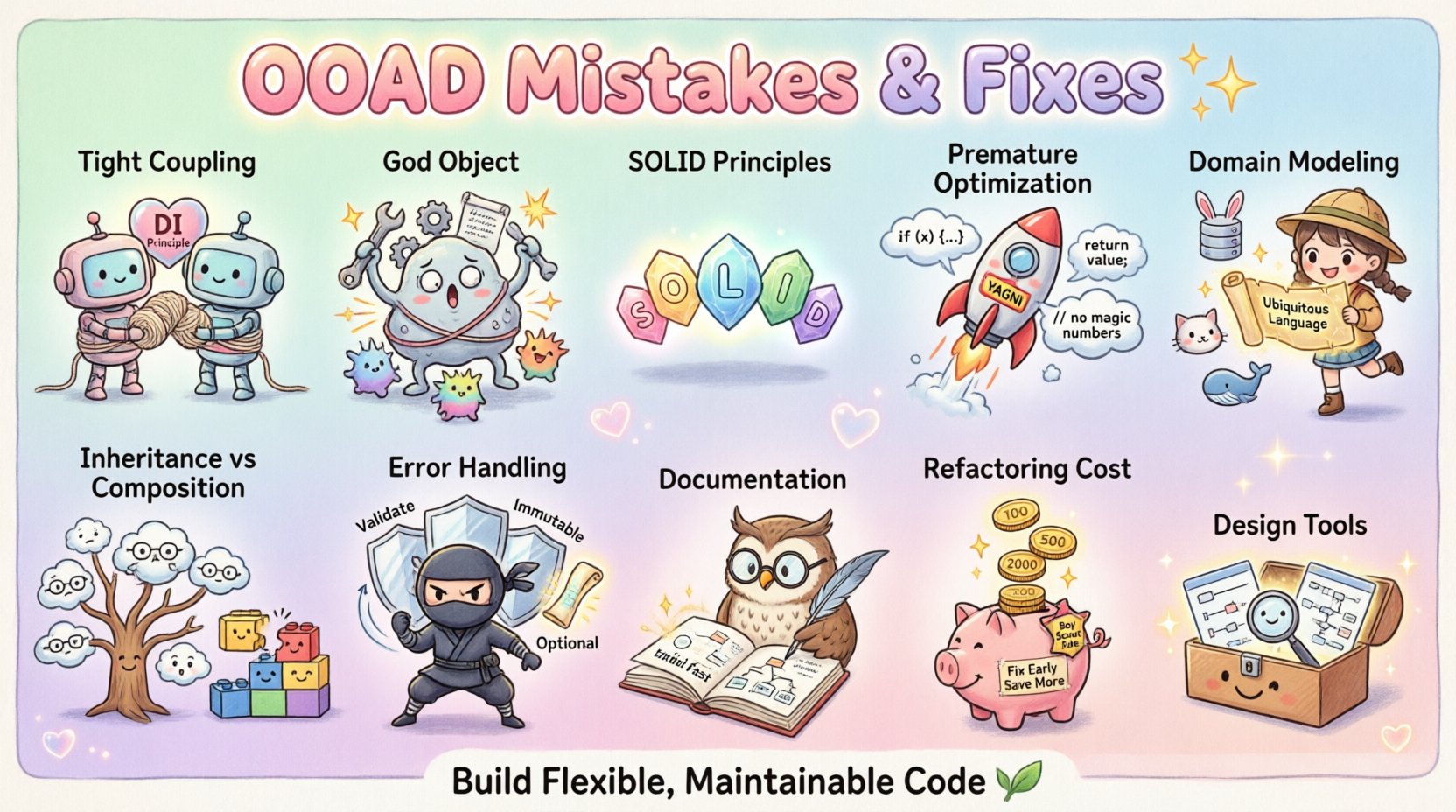
1. The Trap of Tight Coupling 🕸️
Tight coupling occurs when classes depend heavily on the internal implementation details of other classes. Instead of interacting through abstract interfaces, classes know too much about each other’s concrete types and methods. This creates a fragile system where changing one component forces changes in many others.
Why It Happens
- Direct Instantiation: Creating instances of concrete classes directly within other classes rather than using dependency injection.
- Excessive Knowledge: Classes passing complex data structures or internal state objects between one another.
- Lack of Abstraction: Failing to define interfaces or abstract base classes to decouple dependencies.
The Technical Impact
When coupling is high, the system becomes rigid. You cannot test a specific module in isolation because it requires the full chain of dependencies to be running. Refactoring becomes risky, as a change in one area has unpredictable ripple effects. Unit tests become difficult to write, leading to a reliance on slow integration tests.
The Solution
Apply the Dependency Inversion Principle. Depend on abstractions, not concretions. Use interfaces to define contracts. Implement dependency injection to provide dependencies rather than creating them internally. This allows you to swap implementations without altering the client code.
2. The “God Object” Anti-Pattern 🏛️
A God Object is a class that has become too large and responsible for too many distinct tasks. It often ends up handling logic related to data persistence, business rules, user interface updates, and file I/O all at once. This violates the core tenet of single responsibility.
Warning Signs
- The class has hundreds of methods.
- It requires a long time to load or instantiate.
- Any change to the business logic requires modifying this single file.
- Code reviewers struggle to understand the scope of changes.
The Solution
Refactor the God Object by extracting concerns into smaller, cohesive classes. Each class should have a single reason to change. For example, separate the data access logic from the business logic. Move presentation-specific logic into a controller or view layer. This improves readability and makes the codebase easier to navigate.
3. Misusing Inheritance vs. Composition 🧬
Inheritance is a powerful tool, but it is often overused in analysis and design. Deep inheritance hierarchies can lead to the “Fragile Base Class” problem. When a parent class changes, all child classes are affected, even if they do not need the change. Furthermore, inheritance is often used to implement behavior rather than to model an “is-a” relationship.
The Problem
Developers frequently create classes like Employee, Manager, and Director in a deep tree. If the Employee class changes its salary calculation logic, the Manager class might break unexpectedly. This tight coupling of hierarchy levels restricts flexibility.
The Solution
Adopt Composition over Inheritance. Instead of inheriting behavior, compose objects that provide that behavior. Use interfaces to share contracts and delegate functionality to helper objects. This allows you to change behavior at runtime without altering the class hierarchy. It also promotes reusability, as the same helper object can be used across different unrelated classes.
4. Ignoring SOLID Principles 🛑
The SOLID principles provide a roadmap for maintainable object-oriented design. Ignoring them during the analysis phase often leads to technical debt that accumulates over time. Each letter represents a specific guideline that, when followed, reduces complexity.
Breakdown of Principles
- S – Single Responsibility Principle: A class should have only one reason to change. Split responsibilities across multiple classes.
- O – Open/Closed Principle: Entities should be open for extension but closed for modification. Use interfaces to allow new functionality without touching existing code.
- L – Liskov Substitution Principle: Subtypes must be substitutable for their base types. If a child class changes the expected behavior of the parent, the hierarchy is flawed.
- I – Interface Segregation Principle: Clients should not be forced to depend on interfaces they do not use. Split large interfaces into smaller, specific ones.
- D – Dependency Inversion Principle: High-level modules should not depend on low-level modules. Both should depend on abstractions.
5. Premature Optimization and Over-Engineering 🚀
Conversely, some designers spend too much time anticipating future requirements that may never materialize. This leads to over-engineering. You might create complex factory patterns, abstract factories, or intricate caching layers before the application has even processed a single real transaction.
The Consequence
Complexity increases, but value does not. The code becomes difficult to understand for new developers. Debugging becomes harder because the logic is spread across many layers of indirection. The project moves slower because the initial implementation is too rigid.
The Solution
Follow the YAGNI (You Ain’t Gonna Need It) principle. Build only what is required for the current functionality. If a pattern is needed later, it can be introduced during refactoring. Keep the design simple until performance or scalability bottlenecks are proven by metrics.
6. Neglecting Domain Modeling 🗺️
One of the most critical errors in OOAD is separating the code from the business domain. Developers often model the database schema directly into the code structure, leading to anemic domain models. This means the classes only hold data (getters and setters) while the business logic resides in separate service classes.
The Issue
This approach violates the principle of encapsulation. Business rules are scattered across services, making it hard to enforce invariants. The domain logic becomes invisible, and the code becomes a collection of data transfer objects rather than a representation of the business reality.
The Solution
Focus on the Ubiquitous Language. Ensure your class names and methods match the terminology used by business stakeholders. Embed business logic within the domain objects. A Order object should know how to calculate its total price, not an external service. This makes the code self-documenting and easier to validate against business rules.
Design Audit Checklist 📋
To ensure your design is sound, use the following checklist during code reviews and architectural planning.
| Check | Yes/No | Notes |
|---|---|---|
| Are classes small and focused? | ||
| Do classes depend on interfaces? | ||
| Is inheritance limited to true “is-a” relationships? | ||
| Is business logic inside domain objects? | ||
| Are dependencies injected rather than created? | ||
| Is the design easy to test in isolation? |
7. Inadequate Error Handling and State Management ⚠️
Designing for the happy path is common, but failing to account for error states leads to unstable systems. Objects often assume data is always valid when it is passed in. This results in null pointer exceptions or inconsistent states when edge cases occur.
Best Practices
- Validate at Boundaries: Check input data as soon as it enters the system, before processing.
- Use Immutability: Where possible, make objects immutable. This prevents state from changing unexpectedly during processing.
- Fail Fast: If a pre-condition is not met, throw an exception immediately rather than allowing the system to proceed in an invalid state.
- Option Types: Use language features like Optional types to handle absence of values explicitly, rather than relying on null checks everywhere.
8. Documentation Gaps 📝
Code is the primary documentation, but it is not enough. Without clear documentation on the design decisions, future maintainers will struggle to understand why certain structures exist. This often leads to accidental refactoring that breaks the intended architecture.
What to Document
- Architectural Decisions: Record why a specific pattern was chosen over another.
- Class Responsibilities: Clearly state what a class does and what it does not do.
- Interactions: Use sequence diagrams to show how objects interact during complex workflows.
- Constraints: Document any performance or memory constraints that influenced the design.
9. The Cost of Refactoring vs. Prevention 💰
It is tempting to push design fixes to a later phase. However, the cost of fixing a design error increases as the codebase grows. A mistake caught during the analysis phase costs very little to fix. A mistake caught after deployment requires database migrations, API updates, and extensive regression testing.
Strategic Refactoring
If you inherit a legacy system, do not attempt to rewrite everything at once. Use the Boy Scout Rule: always leave the code cleaner than you found it. When touching a module for a feature, refactor the design slightly to improve it. This incremental approach reduces risk while steadily improving quality.
10. Tools for Analysis and Design 🛠️
While software tools vary, the principles remain constant. Use modeling tools to visualize class diagrams before writing code. Create prototypes to validate design assumptions. Utilize static analysis tools to detect coupling and complexity metrics automatically. These tools help identify violations of design principles without relying solely on human review.
Final Thoughts on Sustainable Design 🌱
Object-Oriented Analysis and Design is a continuous process, not a one-time task. As requirements evolve, your design must adapt. The goal is not to create a perfect system on day one, but to build a system that can evolve gracefully. By avoiding these common mistakes and adhering to established principles, you create a foundation that supports long-term growth.
Focus on simplicity, clarity, and maintainability. When in doubt, ask how easy it would be to change this design in six months. If the answer is difficult, reconsider your approach. A well-designed system is one that makes change easy, not one that is unchangeable.