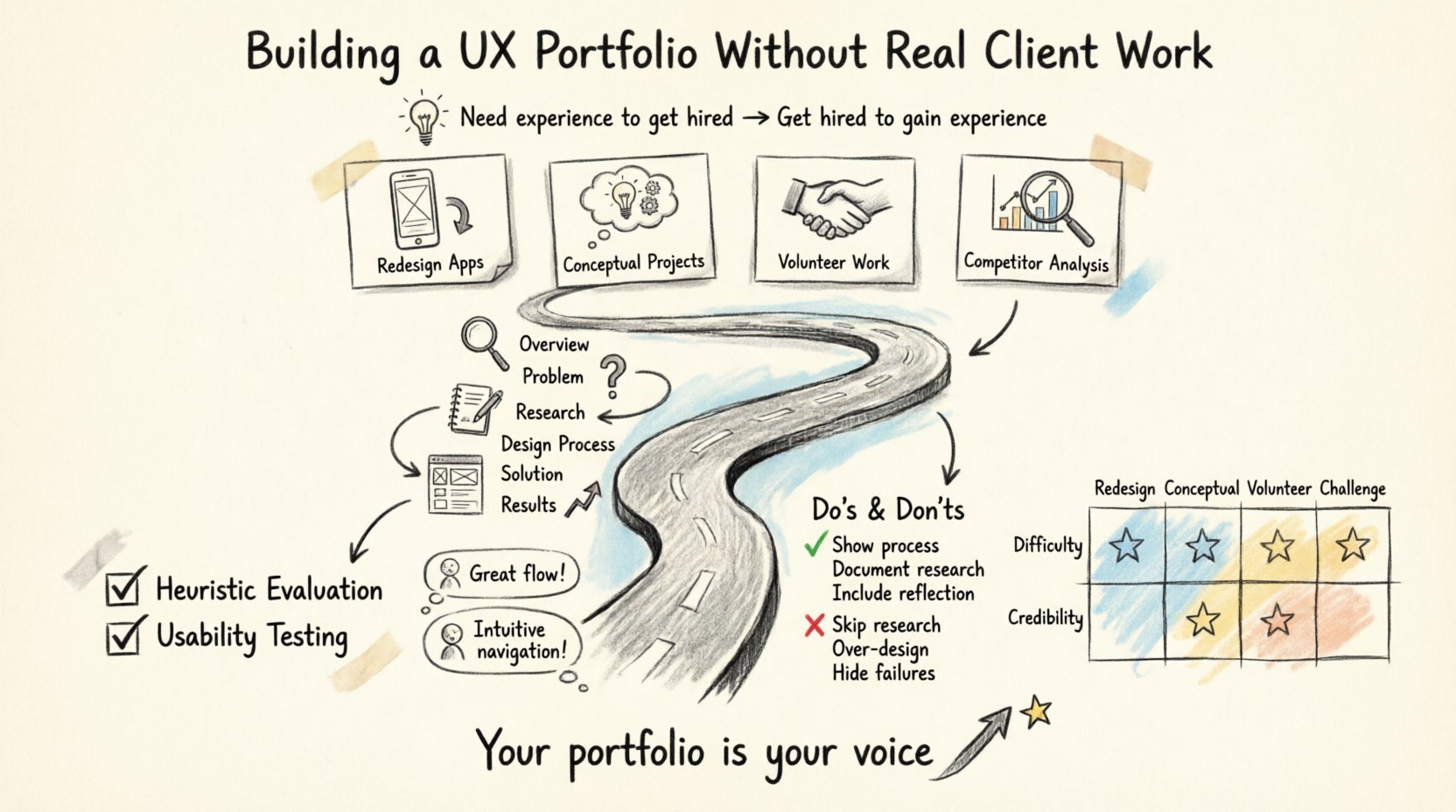
Entering the UX design field often presents a paradox. To get hired, you need experience. To get experience, you need to be hired. This catch-22 can feel daunting, but it is a hurdle that can be overcome with strategic planning and dedicated effort. A portfolio does not solely prove that you have worked for paying clients; it demonstrates your ability to think critically, solve problems, and communicate design decisions. This guide outlines how to construct a compelling UX portfolio when you lack real-world client projects, focusing on skill demonstration and process transparency.
The goal is to show, not just tell. Hiring managers want to see how you approach challenges, how you validate your ideas, and how you iterate based on feedback. Even without a paycheck attached to a project, you can simulate the professional environment and produce work that rivals client deliverables. Let us explore the steps to build this foundation.
Understanding the Purpose of a Case Study 🧠
Before selecting projects, it is vital to understand what a UX case study actually is. It is not merely a gallery of pretty screens. It is a narrative document that explains the “why” behind the “what.” A strong case study tells a story of discovery, struggle, and resolution. It highlights your problem-solving skills and your empathy for the user.
When you lack client work, the burden of proof shifts entirely to the depth of your process. You must document every step. If you skip the research phase to save time, you lose credibility. If you skip the testing phase, you lose trust. The portfolio becomes your evidence of competence.
Key Elements of a Strong Narrative
- Context: Define the problem space clearly. Who is the user? What is the pain point?
- Process: Show the work. Sketches, notes, failed attempts, and iterations are valuable.
- Outcome: What was the result? Even if it is conceptual, describe the intended impact.
- Reflection: What would you do differently? Show humility and a growth mindset.
Sourcing Project Ideas Without Clients 💡
Where do you find work if no one is hiring you? The answer lies in creativity and initiative. You do not need a contract to design. You need a problem to solve. There are several avenues to generate project content that demonstrates your skills effectively.
1. Redesign Existing Products
Take an app or website you use frequently and identify friction points. Perhaps the checkout process is confusing, or the navigation is cluttered. Select a specific task within that product and aim to improve it. This is a low-risk way to practice. It allows you to study established patterns while introducing your own solutions.
- Choose a popular tool: Look for apps with low ratings or common complaints.
- Focus on one task: Do not redesign the whole app. Focus on a specific flow, like “Reset Password” or “Add to Cart”.
- Justify changes: Explain why the original design failed and how your version succeeds.
2. Conceptual Projects
Create a product from scratch based on a real-world need. Imagine a service for a local community, a tool for a specific industry, or an app for a personal goal. This approach gives you total creative freedom. You can define the user, the problem, and the constraints yourself.
- Identify a niche: Think about problems you have faced personally.
- Define the persona: Create a detailed profile of the ideal user.
- Set constraints: Limit your scope to make the project manageable and realistic.
3. Volunteer Work
Non-profits and small organizations often need digital help but lack the budget. Reach out to local charities or student clubs. Offering pro bono work provides real-world feedback and a genuine stakeholder relationship. This adds significant weight to your portfolio.
- Find a cause: Look for organizations aligned with your values.
- Set expectations: Define the scope clearly to avoid scope creep.
- Document the relationship: Include quotes or feedback from the organization.
4. Competitor Analysis
Study the competition. If you identify a gap in the market, propose a solution. This shows you understand the landscape and can position a product strategically. It demonstrates business acumen alongside design skills.
Structuring the Case Study 📝
Once you have a project, you must present it professionally. A disorganized portfolio confuses the reader. Use a consistent structure for every case study. This allows hiring managers to scan your work quickly and find what they need.
The Standard Framework
Most successful case studies follow a logical flow. It mirrors the design process itself. This makes it easy for the reader to follow your thinking.
- Overview: Brief summary of the project and your role.
- Problem Statement: What needed to be solved?
- Research: How did you gather information?
- Design Process: Wireframes, sketches, and iterations.
- Final Solution: High-fidelity mockups and prototypes.
- Results: Metrics or qualitative feedback.
Visualizing the Timeline
Use visual aids to show how long the project took. Did you work on it for a week or a month? Transparency about time investment helps managers understand your workflow efficiency.
Validating Your Design Without Stakeholders 🔍
One of the biggest fears is that your work looks theoretical. To counter this, you must validate your decisions. Even without a paying client, you can gather data. This step separates hobbyists from professionals.
Heuristic Evaluation
Apply established usability principles to your own work. Check for consistency, error prevention, and accessibility. This shows you have internalized industry standards.
Usability Testing with Peers
Ask friends or fellow designers to use your prototype. Give them specific tasks to complete. Watch where they struggle. Record their comments. This provides real user feedback that you can analyze and present.
- Recruit participants: Find people who fit your target persona.
- Set tasks: “Find the search bar and buy a shirt”.
- Observe: Do not help them. Watch where they get stuck.
- Analyze: Look for patterns in the errors.
Presenting Your Work Effectively 🖼️
The delivery method matters. You need a platform that showcases your work well. This could be a personal website, a portfolio platform, or a PDF document. Ensure the site loads quickly and is easy to navigate.
Quality Over Quantity
It is better to have three excellent case studies than ten mediocre ones. Recruiters prefer depth over breadth. They want to see your thinking process, not just a slideshow of screens.
Accessibility
Ensure your portfolio itself is accessible. Use high contrast, readable fonts, and proper headings. This proves you practice what you preach. If your portfolio is hard to read, they will assume your designs are too.
Common Mistakes to Avoid 🚫
Even with good intentions, beginners often make errors that undermine their credibility. Being aware of these pitfalls can help you maintain a high standard.
- Skipping the research: Jumping straight to visuals makes the design look arbitrary.
- Over-designing: Spending too much time on pixels instead of structure.
- Ignoring mobile: Designing only for desktop when most users are on phones.
- No clear CTA: Failing to explain what action the user should take.
- Hidden failures: Showing only the final result without the messy middle.
Building Credibility Through Continuous Learning 📚
Your portfolio is a living document. It grows as you learn. Keep up with industry trends, read case studies from top designers, and participate in design challenges. This shows passion and commitment.
Participate in Challenges
Many design communities run weekly challenges. These provide a prompt and a deadline. They are excellent for practice and can be added to your portfolio as “conceptual work.”
Get Feedback
Share your work in public forums. Constructive criticism helps you improve. It also shows you are open to collaboration and growth.
Comparison of Project Types
Not all projects carry the same weight. Understanding the value of different project types helps you balance your portfolio.
| Project Type | Difficulty | Credibility | Best For |
|---|---|---|---|
| Redesign | Medium | High | Showing problem-solving skills |
| Conceptual | High | Medium | Showing creativity and vision |
| Volunteer | Medium | Very High | Showing real-world impact |
| Challenge | Low | Low | Showing speed and adaptability |
Final Thoughts on Portfolio Development ✨
Building a portfolio without clients is a marathon, not a sprint. It requires patience, persistence, and a willingness to learn. Focus on the quality of your thinking. Show that you understand the user. Show that you can iterate. When you present this work, you are not asking for a job; you are offering value. The portfolio is your voice in a crowded field. Make it speak clearly.
Remember that every designer started somewhere. Your journey is unique. Use your projects to tell your story. Highlight your strengths. Address your weaknesses by showing how you are improving them. With a well-structured portfolio, you can bridge the gap between student and professional. Start today. Document your process. Share your work. The right opportunity will follow.
Keep refining. Keep learning. Keep designing. The path to a successful career in UX is paved with consistent effort and thoughtful work. Trust the process, trust your skills, and trust that your portfolio is the key to your next chapter.