In the modern business landscape, the distinction between a company that survives and one that thrives often lies in how deeply it understands the people it serves. Customer-centricity is frequently cited as a goal, yet few organizations achieve it through mere intention. It requires a structural shift, a change in mindset, and a tangible tool to anchor that change. That tool is the customer journey map.
This guide explores how to move beyond simple diagrams and use mapping to build a sustainable culture where every decision, from product development to support interactions, is filtered through the lens of the customer experience. We will examine the mechanics of alignment, the psychology of empathy, and the operational frameworks required to make this shift permanent.
🧠 Why Mapping Matters Beyond the Diagram
Many organizations treat a customer journey map as a deliverable—a slide to present to stakeholders or a poster to hang in the lobby. This approach fails because it treats the map as a static artifact rather than a dynamic lens. When mapping is used correctly, it becomes the primary mechanism for building a customer-centric culture.
The core value of mapping lies in its ability to visualize the invisible. It reveals the friction points, emotional dips, and moments of delight that often go unnoticed in siloed departments. Marketing may see the first touchpoint, while support sees the last. Mapping connects these dots, creating a shared reality for the entire organization.
- Shared Language: It provides a common vocabulary for cross-functional teams to discuss the customer without ambiguity.
- Empathy Engine: It forces teams to step out of their functional roles and view the world through the user’s eyes.
- Data Synthesis: It integrates qualitative insights with quantitative metrics, offering a holistic view of performance.
- Accountability: It identifies specific owners for specific stages of the journey, clarifying who is responsible for the experience.
Without this shared understanding, departments often optimize for their own KPIs at the expense of the whole. Marketing might drive traffic that support cannot handle, or sales might promise features engineering cannot deliver. Mapping aligns these incentives toward a singular outcome: a seamless customer experience.
🏗️ The Four Pillars of a Customer-Centric Framework
To embed customer-centricity into the organizational DNA, the mapping process must rest on four foundational pillars. These pillars ensure that the work done today informs the strategy tomorrow.
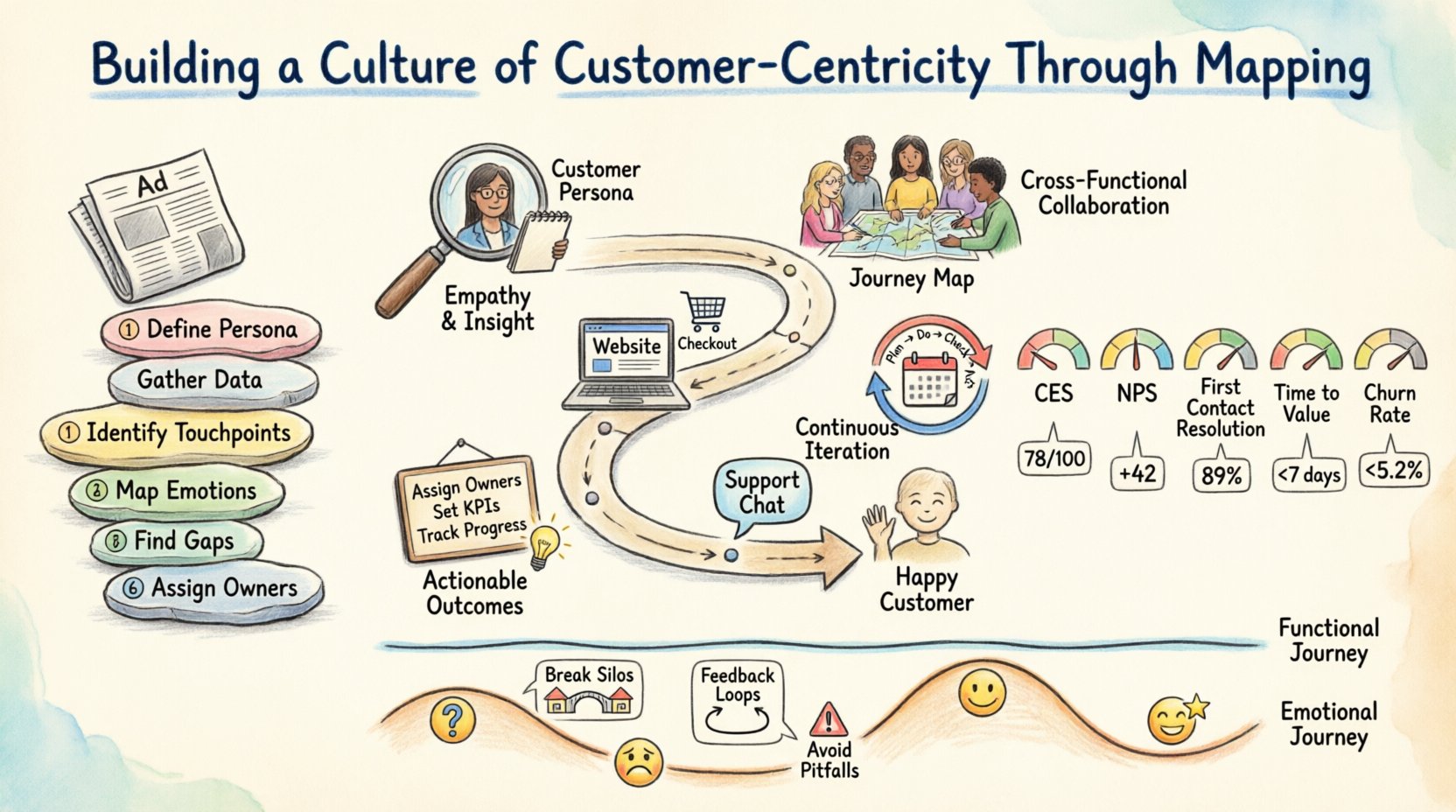
1. Empathy and Insight
A map built on assumptions is a map built on sand. The foundation of any effective journey map is deep, validated insight. This requires moving beyond demographic data (age, location) to psychographic data (motivations, fears, values). Interviews, observations, and direct feedback loops are essential here. The goal is to understand not just what the customer does, but why they do it.
2. Cross-Functional Collaboration
If only one department creates the map, it will only reflect that department’s perspective. A true culture of customer-centricity requires a workshop environment where Marketing, Sales, Product, Support, and Operations collaborate. This collaboration breaks down silos and ensures that the map reflects the reality of the entire organization, not just a single function.
3. Continuous Iteration
The market changes, customer behaviors evolve, and business strategies shift. A journey map created once a year is obsolete by the next quarter. Building a culture means committing to a process of continuous review and update. The map is a living document that grows as the business grows.
4. Actionable Outcomes
Insight without action is merely entertainment. Every mapping session must conclude with a list of prioritized actions. These actions might involve fixing a broken process, changing a script, or redesigning a feature. The culture is built by acting on the map, not just creating it.
🔄 Step-by-Step: Implementing the Mapping Process
Implementing a mapping initiative requires a structured approach to ensure consistency and depth. The following steps outline how to operationalize this process across an organization.
Step 1: Define the Scope and Persona
Not all customers are the same, and not all journeys are equal. Start by defining the specific persona you are mapping. Is it the new enterprise client? The power user? The budget-conscious consumer? Narrowing the scope ensures the map remains relevant and actionable. Define the specific journey stage as well, such as “Onboarding” or “Renewal”.
Step 2: Gather Qualitative and Quantitative Data
Collect data from multiple sources. Use surveys to understand satisfaction scores (NPS or CSAT). Use analytics to understand drop-off rates. Use support tickets to understand pain points. Most importantly, conduct interviews to understand the emotional context. This triangulation of data creates a robust foundation.
Step 3: Identify Touchpoints and Channels
List every interaction the customer has with the brand. This includes digital touchpoints (website, email, app) and physical ones (in-store, phone calls, packaging). Map these against the stages of the journey. A customer might research online, buy in-store, and seek support via chat.
Step 4: Map the Emotional Arc
Draw a line representing the emotional state of the customer throughout the journey. Where are they anxious? Where are they excited? Where are they frustrated? This emotional curve is often where the most significant opportunities for improvement lie. A functional success can still result in an emotional failure.
Step 5: Identify Gaps and Opportunities
Compare the current state (as-is) with the ideal state (to-be). Look for gaps where the customer expectation does not match the delivered experience. These gaps represent the opportunities for innovation and improvement.
Step 6: Assign Ownership and Actions
For every gap identified, assign an owner. This ensures accountability. Create a timeline for addressing these issues. The map becomes a project management tool, driving real change.
🤝 Breaking Down Internal Silos
One of the biggest barriers to customer-centricity is the internal structure of the organization. Departments often operate as fiefdoms, optimized for their own metrics rather than the customer’s success. Mapping provides a neutral ground to dissolve these barriers.
When a support lead sees the marketing campaign that drove a difficult interaction, they understand the context. When a product lead sees the support volume generated by a new feature, they understand the impact of their design decisions. This visibility fosters empathy between teams.
To facilitate this, consider the following strategies:
- Rotational Programs: Allow team members to shadow roles in other departments. Sales staff can sit in on support calls.
- Shared KPIs: Create metrics that require cross-functional cooperation to achieve. For example, a metric that rewards both Sales and Support for customer retention rates.
- Joint Workshops: Regularly convene teams to review the journey map together, ensuring everyone stays aligned on the vision.
📊 Defining Success Metrics
How do you know if the culture is shifting? You need metrics that reflect the customer experience, not just the business output. While revenue is important, it is a lagging indicator. Leading indicators measure the health of the relationship.
| Category | Metric | Why It Matters |
|---|---|---|
| Experience | Customer Effort Score (CES) | Measures how easy it is for the customer to resolve an issue. |
| Relationship | Net Promoter Score (NPS) | Measures loyalty and the likelihood of referral. |
| Efficiency | First Contact Resolution | Measures how quickly problems are solved without escalation. |
| Engagement | Time to Value | Measures how long it takes for a customer to realize the benefit of the product. |
| Retention | Churn Rate | Measures the percentage of customers who stop using the service. |
These metrics should be tracked over time to identify trends. If CES improves while NPS drops, it suggests the process is efficient but the emotional connection is weak. This granularity allows for targeted improvements.
🛑 Common Obstacles to Avoid
Building a customer-centric culture is difficult. Even with a solid framework, organizations often stumble into common traps that undermine their efforts. Recognizing these pitfalls early is crucial for long-term success.
1. The “Hero” Syndrome
One person cannot build a customer-centric culture. If a single executive champions the initiative without buy-in from the rest of the organization, the effort will likely fade when that person leaves. Culture must be distributed, not delegated.
2. Confusing the Map with the Reality
It is easy to fall in love with the diagram. Teams may spend weeks perfecting the visuals without actually implementing the changes. The map is a tool, not the destination. The goal is action, not aesthetics.
3. Ignoring the Employee Experience
Customers cannot have a positive experience if their employees are frustrated. Internal friction often manifests as external friction. Mapping the employee journey alongside the customer journey can reveal where internal processes are hindering service delivery.
4. Lack of Leadership Support
Without active participation from leadership, initiatives often stall. Leaders must model the behavior they expect. They must ask about customer feedback in meetings and prioritize experience improvements over short-term tactical wins.
🔄 Sustaining the Culture
Maintaining a customer-centric culture requires ongoing effort. It is not a destination but a practice. Here are strategies to ensure longevity.
- Regular Review Cycles: Schedule quarterly reviews of the journey map to incorporate new data and market shifts.
- Celebrate Wins: Publicly recognize teams or individuals who improve the customer experience. Positive reinforcement drives behavior.
- Customer Advisory Boards: Create a formal channel for customers to provide direct feedback to leadership.
- Training Programs: Invest in training that teaches empathy and customer-centric thinking to all new hires.
🌍 The Ripple Effect of Mapping
When an organization truly commits to mapping and customer-centricity, the benefits extend beyond the customer. It improves employee retention, as staff feel more connected to the impact of their work. It drives innovation, as deep insights reveal unmet needs. It builds resilience, as the organization adapts quickly to market changes.
The journey map becomes the compass for the entire enterprise. It guides product decisions, informs marketing messages, shapes support protocols, and influences strategic planning. When everyone looks at the same map, everyone walks in the same direction.
🔍 Deep Dive: Emotional vs. Functional Journeys
To further refine the culture, it is important to distinguish between the functional journey and the emotional journey. The functional journey is the series of steps a customer takes to complete a task. The emotional journey is the feeling they have at each step.
| Stage | Functional Action | Emotional State |
|---|---|---|
| Awareness | Sees an ad or post | Curious, Skeptical |
| Consideration | Compares options | Anxious, Hopeful |
| Purchase | Completes checkout | Relieved, Excited |
| Usage | Uses the product | Satisfied, Frustrated |
| Advocacy | Recommends to others | Proud, Loyal |
Focusing only on the functional actions can lead to a “correct but cold” experience. A customer might complete the checkout process (functional success) but feel rushed or confused (emotional failure). A customer-centric culture prioritizes the emotional state, ensuring that the functional steps support, rather than hinder, the desired feeling.
🛠️ Integrating Feedback Loops
Mapping is not a one-time event. It requires a constant stream of feedback to remain accurate. Integrating feedback loops into the daily workflow ensures the map reflects reality.
- Real-Time Feedback: Use in-app prompts to capture sentiment immediately after a transaction.
- Post-Interaction Surveys: Send brief surveys after support calls or sales meetings.
- Social Listening: Monitor social media channels for unsolicited feedback about the brand.
- Internal Feedback: Ask employees what barriers they face in serving the customer.
These data streams feed back into the mapping process. When a trend emerges, the map is updated. When a process breaks, the map highlights it. This creates a responsive organization that adapts to customer needs in real-time.
🚀 Final Thoughts on Execution
Building a culture of customer-centricity through mapping is a journey of its own. It requires patience, discipline, and a willingness to listen. It demands that leaders put aside their assumptions and embrace the reality of the customer experience. When done correctly, it transforms the organization from a collection of departments into a unified force dedicated to serving people.
The map is the tool, but the culture is the result. By focusing on empathy, collaboration, and action, organizations can create an environment where customer-centricity is not just a slogan, but the way they operate. This commitment pays dividends in loyalty, growth, and longevity. The path is clear; the only variable left is the willingness to walk it.
Start today. Gather your team. Look at the journey through their eyes. The map will show the way.