
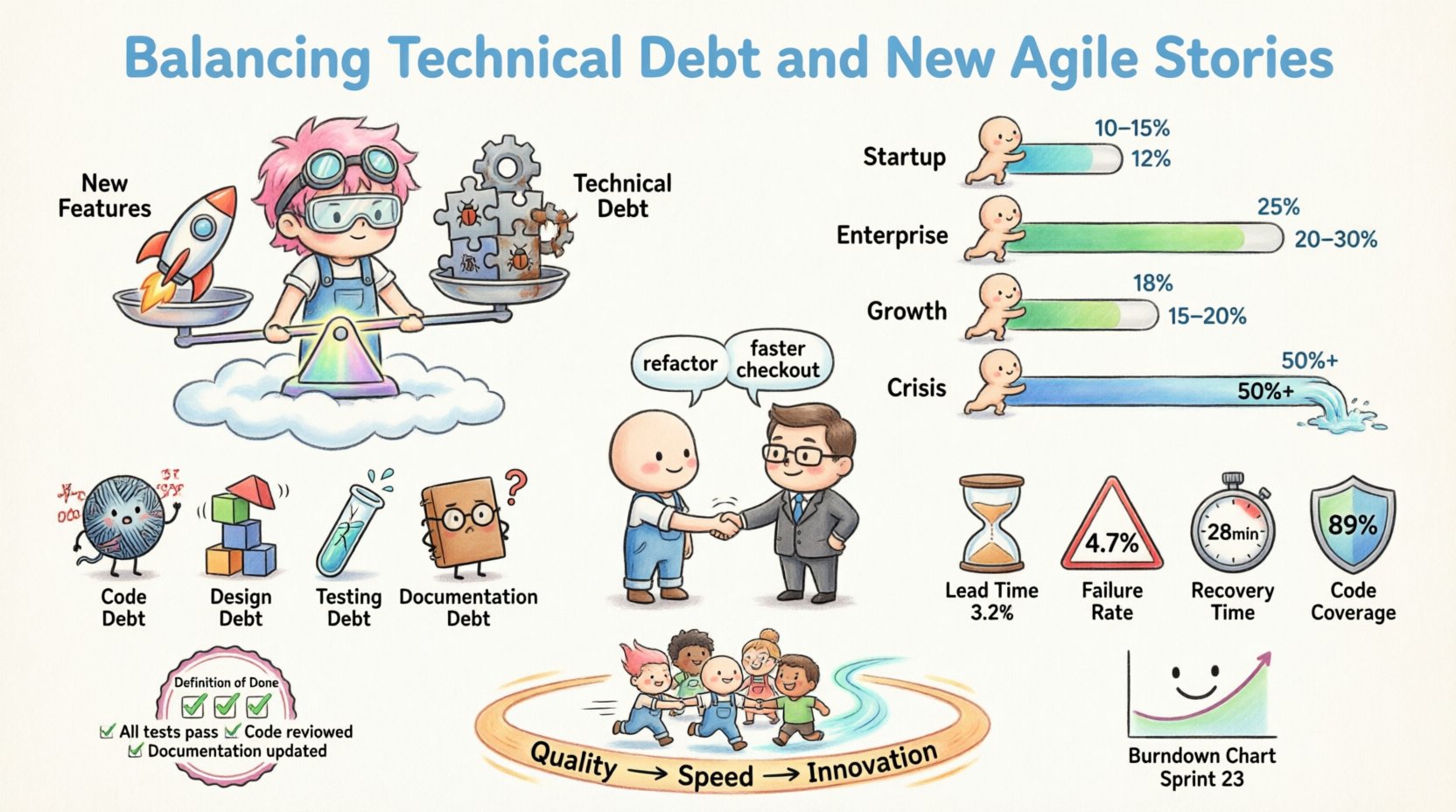
In modern software development, a constant tension exists between delivering new functionality and maintaining the health of the codebase. This dynamic is often framed as a battle between business value and engineering sustainability. For teams practicing agile methodologies, the challenge is not merely choosing one over the other, but integrating both seamlessly. The goal is to move forward with speed while ensuring the foundation remains solid enough to support future growth.
When development teams ignore the underlying structure, they accumulate what is known as technical debt. This debt accrues interest in the form of slower velocity, increased bug rates, and higher cognitive load for developers. However, paying down this debt too aggressively can stall feature delivery and lose market momentum. The art lies in finding the equilibrium where innovation thrives without compromising stability.
Understanding Technical Debt in an Agile Context 🧾
Technical debt is not a monolithic concept. It encompasses various layers of the software lifecycle. Recognizing these layers is the first step toward managing them effectively.
- Code Debt: This includes complex logic, lack of comments, duplication, or poor naming conventions that make future changes difficult.
- Design Debt: Architectural decisions made for speed that restrict scalability or flexibility in the long run.
- Testing Debt: Insufficient automated tests or reliance on manual verification processes that introduce risk.
- Documentation Debt: Outdated guides or missing information that hinders onboarding and knowledge transfer.
In an agile environment, work is broken down into small, manageable units. Each unit is intended to deliver value. When technical debt is ignored, it acts as a hidden tax on every subsequent story. Over time, the time required to implement a new feature increases exponentially if the underlying architecture is neglected. This phenomenon is often referred to as the cost of delay.
Consider a scenario where a team builds a feature rapidly without writing tests. The next developer must manually verify the functionality before adding new features. This slows down the entire team. Conversely, if the team stops all feature work to rewrite the entire codebase, the business loses revenue during that period. The balance is critical.
The User Story Perspective: Feature vs. Foundation 🚀
Agile frameworks rely heavily on user stories to communicate requirements. A standard user story follows the format: “As a [role], I want [feature], so that [benefit].” However, this format often excludes the non-functional requirements necessary for long-term health.
To address this, teams must expand the scope of user stories. Technical debt should not be an invisible burden; it must be visible in the backlog. There are several ways to integrate debt reduction into the story flow:
- Explicit Refactoring Stories: Create specific tickets dedicated to improving code quality without changing external behavior.
- Embedded Debt: Include technical improvements as part of the acceptance criteria for feature stories.
- Architecture Runway: Dedicate specific iterations to building capabilities that enable future features.
When embedding debt into feature stories, the team acknowledges that the work is not complete until the code is maintainable. This shifts the mindset from “getting it done” to “getting it done right.” It ensures that every story contributes to the overall health of the system.
Strategic Allocation: How Much to Pay? 📊
Deciding how much capacity to allocate to debt reduction is a strategic decision. There is no universal percentage that applies to every team. The ratio depends on the maturity of the product, the complexity of the domain, and the stability of the infrastructure.
Some teams adopt a heuristic, such as dedicating 20% of sprint capacity to debt. Others use a more dynamic approach, adjusting based on metrics like defect density or lead time. Below is a framework to help teams decide their allocation strategy.
| Scenario | Recommended Allocation | Rationale |
|---|---|---|
| Early Stage Startup | 10-15% | Speed is critical. Focus on validation and learning. |
| Stable Enterprise Product | 20-30% | Reliability is paramount. High risk of outage. |
| High Growth Phase | 15-20% | Need to scale infrastructure while maintaining velocity. |
| Crisis / High Debt | 50%+ | Velocity is stalled. Must stabilize before moving forward. |
It is important to note that these numbers are starting points. Teams should review their allocation regularly. If velocity begins to drop, the allocation might need to increase. If the product is stable and innovation is high, the allocation might decrease.
Measuring the Balance: Metrics That Matter 📉
You cannot manage what you do not measure. Relying on gut feeling is insufficient for technical decisions. Teams should track specific indicators that reflect the state of the codebase and the flow of value.
- Lead Time for Changes: How long does it take from code commit to deployment? Increasing lead time often signals growing complexity.
- Change Failure Rate: How often do deployments cause failures? High rates suggest insufficient testing or unstable architecture.
- Mean Time to Recovery: How quickly can the team fix a production issue? Slow recovery indicates fragile systems.
- Code Coverage: While not a perfect metric, it indicates the safety net available for refactoring.
- Sprint Burndown: Does the team consistently finish stories? Persistent unfinished work often signals estimation errors or hidden complexity.
Tracking these metrics allows the team to make data-driven decisions. For instance, if lead time increases by 20% over three sprints, it is a signal that technical debt is impacting delivery. The team can then adjust the sprint plan to address the root cause.
Communication with Stakeholders 🤝
One of the biggest challenges is explaining the value of technical work to non-technical stakeholders. Features are tangible; debt reduction is abstract. Stakeholders often see debt reduction as “no work” or “wasted time.” To overcome this, teams must translate technical health into business language.
Instead of saying “We need to refactor the database,” say “We need to improve the database to ensure the checkout process remains fast during high traffic.” This connects the technical task to a business outcome.
Key communication strategies include:
- Visualizing the Cost: Show graphs where velocity declines over time if debt is ignored. The visual impact is often more convincing than verbal explanations.
- Linking to Risk: Explain that ignoring debt increases the risk of outages, which directly impacts revenue and reputation.
- Showing Efficiency: Demonstrate how refactoring reduces the time needed for future features.
- Transparency: Keep the backlog visible. When stakeholders see technical items alongside features, they understand the dual nature of the work.
Common Pitfalls to Avoid 🕳️
Even with the best intentions, teams can fall into traps that worsen the balance. Being aware of these pitfalls helps in avoiding them.
- Perfectionism: Trying to write perfect code for every story leads to paralysis. Aim for “good enough” that can be improved later.
- Hidden Debt: Not logging technical work in the backlog creates an illusion of productivity. Stakeholders believe work is being done, but the backlog does not reflect reality.
- Ignoring the Definition of Done: If the Definition of Done does not include testing or documentation, debt will accumulate automatically.
- One-Size-Fits-All: Applying the same debt strategy to all projects. Some projects require higher stability, while others require higher speed.
Another common mistake is treating debt reduction as a separate phase. If the team stops feature work for a month to fix everything, they lose momentum. Debt reduction should be continuous, integrated into the daily flow of work.
Embedding Debt in Stories: Practical Examples 🧩
Let us look at how to write user stories that account for technical debt. This ensures that every ticket contributes to both functionality and health.
Example 1: Adding a Feature with Refactoring
Instead of a simple story: “Add search functionality to the dashboard.” A balanced story might be: “Add search functionality to the dashboard. Refactor the existing search service to support pagination.”
This approach ensures that the new feature does not exacerbate the existing limitations of the search service.
Example 2: Improving Performance
Story: “Optimize the report generation process to run under 5 seconds.” Acceptance Criteria:
- Query execution time is under 2 seconds.
- Logs are added to track slow queries.
- Unit tests cover the new logic.
By including performance as an acceptance criterion, the team avoids creating a new debt point.
The Role of the Definition of Done 🛑
The Definition of Done (DoD) is a checklist that a user story must meet before it is considered complete. This is a powerful tool for controlling debt. If the DoD includes requirements for code review, automated testing, and documentation, then debt cannot slip through the cracks.
Teams should review their DoD regularly. As the system grows, the requirements for quality may change. For example, a DoD might evolve to include security scanning or accessibility checks as regulations change.
When a story does not meet the DoD, it cannot be released. This forces the team to address technical issues before moving forward. It prevents the accumulation of “almost done” work that never gets finished.
Sustainable Pace and Team Morale 🏃♂️
Technical debt is not just a code problem; it is a human problem. When developers are forced to work in a broken system, morale drops. They feel frustrated by constant firefighting and lack of progress.
Investing in debt reduction improves the work environment. When the system is stable, developers can focus on solving business problems rather than fighting the code. This leads to higher retention and better engagement.
Leaders must prioritize sustainable pace. If the team is constantly working overtime to compensate for poor architecture, burnout is inevitable. A balanced approach respects the team’s capacity and acknowledges that quality takes time.
Long-term Sustainability Strategy 🌱
Managing technical debt is a marathon, not a sprint. It requires a long-term strategy that evolves with the product. Teams should establish a culture where quality is everyone’s responsibility, not just the senior engineers.
- Regular Audits: Schedule periodic reviews of the codebase to identify new debt.
- Knowledge Sharing: Encourage pair programming and code reviews to spread understanding of the system.
- Continuous Learning: Allocate time for the team to learn new tools and patterns that can reduce future debt.
- Feedback Loops: Use retrospectives to discuss what is working and what is not regarding debt management.
By treating technical debt as a first-class citizen in the backlog, teams can ensure that their software remains adaptable and resilient. The balance between new stories and debt reduction is not static. It requires constant attention, communication, and adjustment. When done correctly, it creates a flywheel where quality enables speed, and speed enables innovation.
Final Thoughts on Integration 💡
The journey to balance technical debt and feature delivery is ongoing. There is no final destination where the problem is solved once and for all. Instead, it is a continuous process of alignment.
Teams that succeed are those that view technical health as a competitive advantage. They understand that a slow system is a business risk. They also understand that a stalled system is a revenue risk.
By embedding these practices into the daily workflow, teams can build software that stands the test of time. The focus remains on delivering value, but the foundation is strengthened with every story completed.