
In the landscape of modern product development, a persistent tension exists between what a company needs to survive and what a user needs to thrive. This friction is not merely an administrative hurdle; it is a fundamental design challenge that defines the quality of the final output. When business objectives clash with user requirements, the result is often a product that feels disjointed, confusing, or simply unnecessary. Achieving harmony between these two forces requires deliberate strategy, clear communication, and a framework that values both revenue and experience equally.
This guide explores how to navigate the complex intersection of commercial viability and human-centric design. We will examine the underlying drivers of conflict, establish methods for alignment, and discuss how to measure success without compromising either side. By understanding the mechanics of this balance, teams can build products that are profitable without being exploitative.
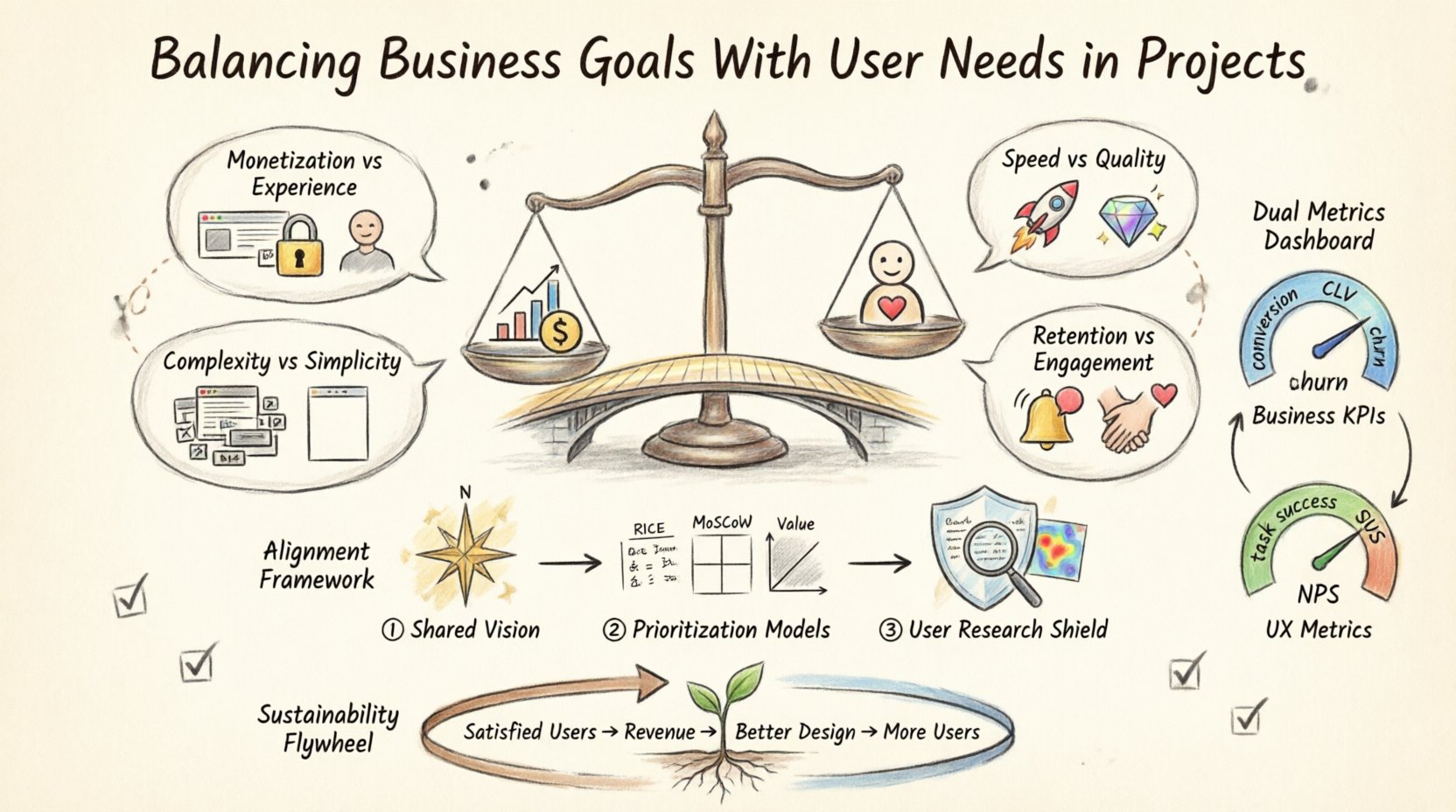
Understanding the Core Tension 💼 vs 🧑💻
To solve a problem, one must first define its nature. In UX design projects, the “business goal” is typically quantifiable: increased conversion rates, reduced churn, higher average order value, or cost reduction in support tickets. These are the metrics that justify the investment in the product. Conversely, “user needs” are often qualitative: ease of use, emotional satisfaction, accessibility, time saved, or trust in the platform.
When these priorities diverge, friction occurs. Consider a scenario where a marketing team wants to place a prominent upsell banner on the checkout page. From a revenue perspective, this is a logical step to boost average order value. However, from a user perspective, this interruption breaks the flow of completing a purchase, potentially causing anxiety or confusion. The user wants to finish the transaction quickly; the business wants to extract more value during that transaction.
Here are the common areas where this conflict manifests:
- Monetization vs. Experience: Introducing ads, paywalls, or data collection practices that feel intrusive to the user.
- Speed vs. Quality: The business pushes for a rapid launch to capture market share, while the user needs a polished, bug-free interface.
- Complexity vs. Simplicity: Business stakeholders may want to pack in features to differentiate the product, leading to interface clutter that overwhelms the user.
- Retention vs. Engagement: Strategies to keep users coming back might rely on notifications or gamification that feel manipulative rather than helpful.
Recognizing these friction points early allows the design team to anticipate objections and propose solutions that satisfy both parties before development begins.
Defining Success on Both Sides 📊
Alignment starts with shared language. Often, conflicts arise because business and design teams are measuring different things. If the business team measures “traffic” and the design team measures “task completion rate,” they are speaking different languages. To balance goals, you must map business outcomes to user outcomes.
Consider the following matrix of aligned metrics:
| Business Goal | Primary Metric | Corresponding User Need | Design Strategy |
|---|---|---|---|
| Reduce Support Costs | Number of Tickets | Find answers quickly | Improve Self-Service Knowledge Base |
| Increase Sign-ups | Conversion Rate | Understand value proposition | Clarify Onboarding Flow |
| Boost Retention | Monthly Active Users | Consistent reliability | Ensure Performance & Stability |
| Drive Upsells | Revenue Per User | Discover relevant features | Contextual Recommendations |
When you present this table to stakeholders, you demonstrate that improving the user experience is not an expense but a direct driver of the business metric. For instance, a user who can find answers quickly (User Need) generates fewer support tickets (Business Goal). This reframes the design work as a revenue protection strategy rather than just aesthetics.
Strategic Alignment Framework 🗺️
Once the metrics are aligned, the next step is operationalizing the balance. This requires a structured approach to decision-making that does not default to the loudest voice in the room. Instead, decisions should be made based on data and user evidence.
1. Establish a Shared Vision
Before a single wireframe is drawn, the team must agree on the product vision. This document should explicitly state how serving the user supports the business model. It acts as a north star for prioritization. If a feature request comes in that boosts revenue but degrades the experience, the vision document provides the criteria to evaluate it.
2. Prioritization Models
Use frameworks that account for both value dimensions. Common models include:
- RICE Scoring: Reach, Impact, Confidence, and Effort. You can weight “Impact” to include both business revenue and user satisfaction scores.
- MoSCoW Method: Must have, Should have, Could have, Won’t have. Use this to explicitly mark features that are business-critical versus user-critical.
- Value vs. Complexity Matrix: Plot features on a graph. High value, low complexity features are immediate wins. High value, high complexity features require careful resource allocation.
3. User Research as a Negotiation Tool
Data removes emotion from the negotiation. When a stakeholder insists on a feature, present user research that contradicts it. For example, if analytics show that 40% of users abandon a form at a specific field, but the business wants to add a new mandatory field there, the data acts as a shield. It shows that the change directly harms the business goal of conversion.
Research methods that bridge this gap include:
- A/B Testing: Test the business proposal against a control. Let the user behavior decide.
- Usability Testing: Observe users attempting tasks. Note where they struggle due to business-driven constraints.
- Surveys: Ask users about their satisfaction and their willingness to pay or share data.
Communication Strategies 🗣️
Even with data and frameworks, human dynamics play a significant role. Stakeholders often fear that prioritizing users means losing control or revenue. Designers and product managers must act as translators, converting user feedback into business language.
Speak the Language of Risk
Business leaders understand risk. When proposing a change that favors the user, frame it as risk mitigation. For example, “Ignoring accessibility guidelines exposes us to legal liability and limits our market share to 15% of the population. Fixing this reduces legal risk and expands the addressable market.”
Transparency in Trade-offs
Never hide the trade-offs. If a decision must be made to favor a business goal temporarily, admit it. Explain the “why” and the “how long.” Users are generally forgiving if they understand the context. Hiding a change behind a dark pattern erodes trust permanently.
Effective communication involves:
- Regular Syncs: Weekly meetings between design, product, and business leads.
- Visual Reports: Dashboards that show both traffic and engagement metrics side-by-side.
- Storytelling: Use user personas and journey maps to remind the team who they are building for.
Metrics That Matter 📏
How do you know if the balance is working? You need a dashboard that tracks dual success. Relying solely on financial KPIs is dangerous, as it may lead to short-term gains at the expense of long-term brand health. Relying solely on satisfaction scores can lead to a product that is loved but unprofitable.
Business Metrics to Monitor
- Conversion Rate: Percentage of users completing a desired action.
- Customer Lifetime Value (CLV): Total revenue expected from a single customer.
- Churn Rate: Percentage of users who stop using the service.
- Cost of Acquisition: How much it costs to gain a new user.
User Experience Metrics to Monitor
- Task Success Rate: Can users complete the task without help?
- Time on Task: How long does it take to finish the action?
- System Usability Scale (SUS): A standard measure of perceived usability.
- Net Promoter Score (NPS): Likelihood of users recommending the product.
When you track these together, you might notice correlations. For example, a drop in task success rate might predict a rise in churn rate three months later. This predictive power is the strongest argument for maintaining the balance.
Common Pitfalls ⚠️
Even with the best intentions, teams often stumble. Identifying these traps helps avoid them.
The “Feature Factory” Trap
This occurs when the business demands a continuous stream of new features to show activity. Without user validation, these features become bloat. The product becomes heavy, slow, and difficult to navigate. The solution is to enforce a “kill list” where old features are removed if they are not used, keeping the interface clean.
The “Design-Only” Trap
Conversely, design teams sometimes reject business constraints entirely, creating beautiful products that cannot be monetized or scaled. This leads to products that are unsustainable. Designers must understand the technical and financial constraints to propose feasible solutions.
Ignoring the Edge Cases
Business goals often focus on the “happy path”—the ideal scenario where everything goes right. User needs often exist in the edge cases—where things go wrong. Prioritizing the happy path might satisfy the business initially but frustrate users when they encounter problems. Always test the failure states.
Short-Termism
Pushing for immediate revenue often sacrifices long-term trust. Aggressive pop-ups, hidden fees, or forced upgrades can boost revenue for a quarter but destroy brand reputation. The strategy must prioritize sustainable growth over quarterly spikes.
Long-term Sustainability 🌱
The ultimate goal of balancing these goals is sustainability. A product that satisfies the user builds loyalty. A product that satisfies the business builds capacity. Together, they create a flywheel effect where satisfied users drive revenue, which funds better design, which attracts more users.
To maintain this over time:
- Iterate Continuously: Do not treat design as a phase. It is an ongoing process of refinement.
- Empower Cross-Functional Teams: Break down silos between engineering, design, and marketing.
- Invest in Training: Ensure stakeholders understand UX principles so they do not micromanage design decisions.
- Celebrate Wins: Acknowledge when a design decision improved both metrics. This reinforces the behavior.
By treating the user and the business as partners rather than adversaries, projects move forward with clarity. The path is not always easy, and compromises will be necessary. However, when the compromise is transparent and backed by evidence, the resulting product is robust, viable, and human.
Implementing the Balance in Agile Environments 🚀
In Agile workflows, speed is often the priority. This can exacerbate the tension between business speed and user quality. Here are specific tactics for Agile contexts:
- Definition of Done: Include UX validation in the Definition of Done. A feature is not “done” until it passes a usability check.
- Sprint Planning: Reserve capacity in every sprint for technical debt and UX refinements, not just new features.
- Backlog Grooming: Review the backlog with both business and user perspectives. If a story is too complex, break it down to ensure it remains usable.
- Retrospectives: Discuss where the balance slipped. Was a feature shipped too fast? Was a bug ignored for too long?
Final Thoughts on Strategic Harmony
The relationship between business goals and user needs is dynamic, not static. Markets change, user behaviors evolve, and company strategies shift. The ability to balance these forces is not a one-time task but a continuous discipline. It requires empathy for the customer and pragmatism for the company.
When executed well, this balance creates a competitive advantage. Competitors may offer lower prices or more features, but they cannot replicate the trust built through a thoughtful, user-respecting experience. By anchoring business decisions in user reality, organizations build products that last. This approach ensures that growth is not accidental but intentional, driven by a deep understanding of human behavior and market mechanics.