Strategic planning relies on accurate data. Yet, human judgment is rarely neutral. When conducting a SWOT analysis, the Weaknesses quadrant often becomes a minefield of self-deception. Leaders frequently underestimate internal vulnerabilities or rationalize them away. This guide details how to navigate cognitive bias to ensure your business weaknesses are identified with clarity and honesty.
The goal is not to find fault, but to uncover truth. Without this, resources are misallocated, and threats go unmitigated. We will explore the psychological mechanisms that distort internal audits and provide actionable steps to maintain objectivity.
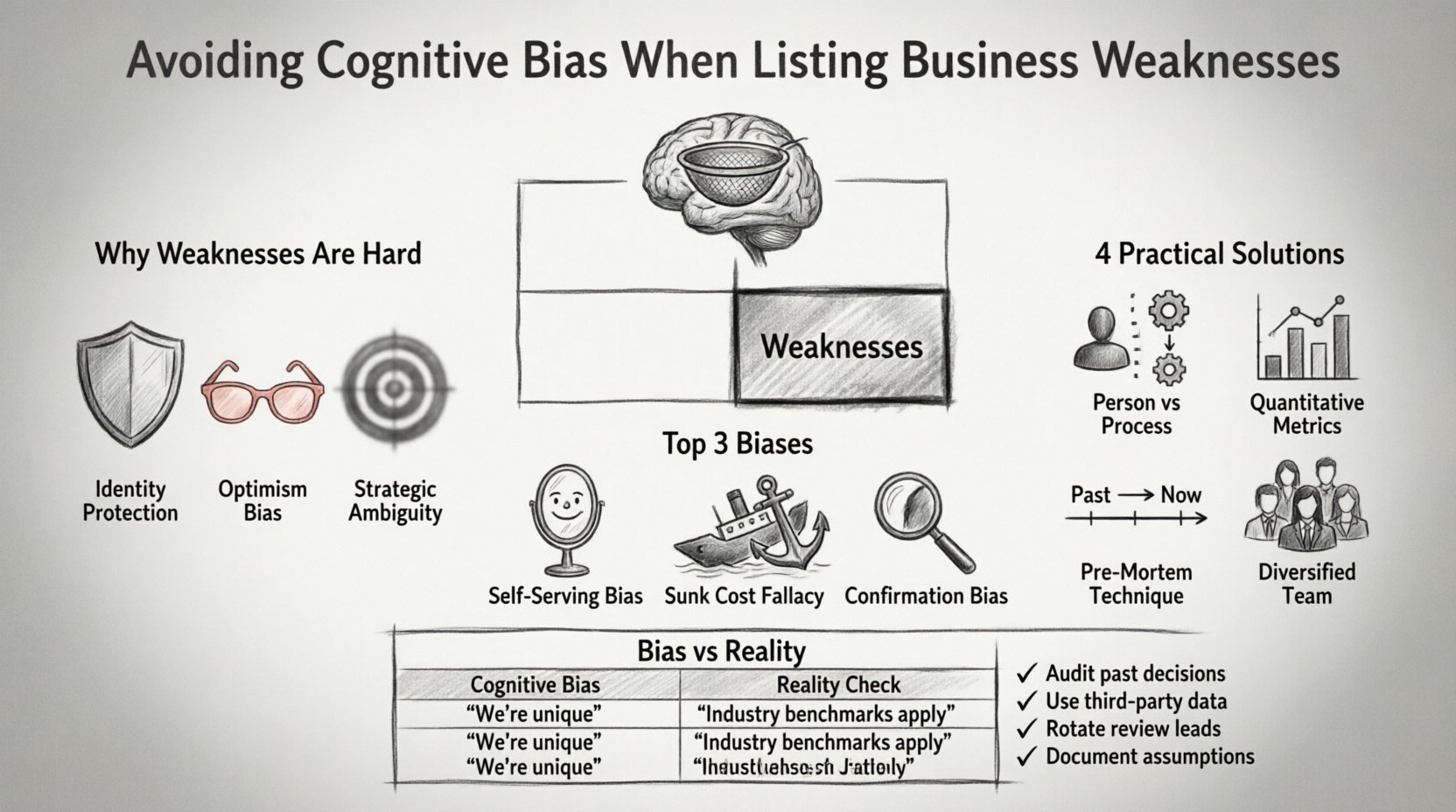
📉 Why Weaknesses Are the Hardest Part of SWOT
Strengths are often celebrated. Opportunities are exciting. Threats are external and can be blamed on market conditions. Weaknesses, however, are internal. They reflect decisions made, resources wasted, or capabilities lacking. Acknowledging a weakness feels like admitting failure. This emotional weight drives bias.
- Identity Protection: Leaders often tie their self-worth to company success. A weakness feels like a personal flaw.
- Optimism Bias: The natural tendency to believe we are less likely to experience negative outcomes than others.
- Strategic Ambiguity: Vague definitions of success make it easy to hide behind generalities instead of specific metrics.
When listing weaknesses, the mind seeks comfort. It filters out data that contradicts a positive self-image. This leads to a SWOT analysis that looks good on paper but fails in execution.
🧠 Understanding Cognitive Bias in Strategic Planning
Cognitive bias is a systematic pattern of deviation from norm or rationality in judgment. In a business context, these biases operate below the level of conscious awareness. They affect how information is processed, stored, and retrieved.
In the context of a SWOT analysis, bias acts as a filter. It lets positive internal factors pass while blocking negative ones. It is not malicious; it is biological. The brain prefers energy conservation and pattern recognition over raw accuracy.
The Mechanism of Distortion
When evaluating internal capabilities, the brain relies on heuristics (mental shortcuts). These shortcuts are efficient but prone to error.
- Affinity Processing: We give more weight to information that confirms our existing beliefs.
- Recency Effect: We prioritize recent events over historical data, potentially missing long-term structural issues.
- Emotional Tagging: Positive emotions associated with a project can mask its inherent risks.
Recognizing these mechanisms is the first step toward neutralizing them. You cannot eliminate bias entirely, but you can build systems to reduce its impact.
🔍 Top Biases Distorting Your Internal Audit
Certain biases appear more frequently during the identification of business weaknesses. Understanding the specific manifestations allows for targeted countermeasures.
1. Self-Serving Bias
This is the tendency to attribute positive outcomes to internal factors and negative outcomes to external factors. In a SWOT context, this means a leader might attribute a missed target to market conditions (Threat) rather than poor planning (Weakness).
- Example: A marketing campaign fails due to poor timing. The team cites algorithm changes (External Threat) rather than a lack of audience research (Internal Weakness).
- Impact: Repeated failures are not corrected because the root cause is never addressed.
2. Sunk Cost Fallacy
This occurs when you continue a behavior or endeavor as a result of previously invested resources (time, money, effort), even if the current costs outweigh the benefits.
- Example: A legacy software system is inefficient. However, because millions were spent on it, the team refuses to acknowledge it as a critical weakness requiring replacement.
- Impact: Innovation is stifled by the weight of past decisions.
3. Confirmation Bias
This is the tendency to search for, interpret, favor, and recall information in a way that confirms one’s preexisting beliefs.
- Example: If a CEO believes their culture is strong, they will only gather feedback that supports this view, ignoring survey results showing low morale.
- Impact: Blind spots remain invisible because contradictory evidence is dismissed.
📊 Bias Manifestation vs. Reality
| Bias Type | Perception (Biased) | Reality (Objective) |
|---|---|---|
| Sunk Cost | “We have invested too much to stop.” | “The ROI is negative; the asset is a liability.” |
| Optimism Bias | “We will fix this before it matters.” | “The issue will compound if left unaddressed.” |
| Self-Serving | “The market is just too tough.” | “Our agility is lower than the competition.” |
| Availability Heuristic | “We haven’t had a breach, so security is fine.” | “Lack of recent incidents does not equal robust security.” |
This table illustrates the gap between feeling and fact. Bridging this gap requires deliberate intervention.
🛠️ Practical Steps for Objective Evaluation
To list weaknesses accurately, you must introduce friction into the decision-making process. Friction slows down the intuitive, biased response and allows for analytical processing.
1. Separate the Person from the Process
Create a culture where identifying a weakness is seen as an act of professional integrity, not personal failure. This requires psychological safety.
- Normalize Failure: Discuss past mistakes as learning data points, not reasons for punishment.
- Anonymous Input: Allow team members to submit weaknesses without attribution to prevent fear of retribution.
- Focus on Systems: Frame weaknesses as process gaps rather than individual incompetence.
2. Use Quantitative Metrics
Subjective adjectives like “weak” or “poor” are easily defended. Data is harder to ignore.
- Turnover Rates: Instead of “good culture,” look at retention data.
- Customer Churn: Instead of “happy clients,” analyze cancellation reasons.
- Production Downtime: Instead of “efficient operations,” review downtime logs.
When a metric shows a negative trend, the weakness is no longer an opinion; it is a fact.
3. Implement the “Pre-Mortem” Technique
A pre-mortem assumes the project has already failed and asks the team to determine why. This flips the script from optimism to realistic risk assessment.
- Step One: Imagine it is one year from now and the strategy failed.
- Step Two: Ask the team to write down the reasons for failure.
- Step Three: Categorize these reasons into internal weaknesses.
This technique bypasses the fear of predicting failure because it is framed as a hypothetical exercise.
4. Diversify the Review Team
Homogeneous groups reinforce existing biases. Including people from different departments or external consultants introduces new perspectives.
- Cross-Functional Teams: Include finance, sales, and operations to see the full picture.
- External Auditors: Third parties have no emotional attachment to the company’s history.
- Customer Feedback: Direct feedback often highlights weaknesses internal teams overlook.
👥 Leveraging External Perspectives
Internal teams are often too close to the data. External perspectives provide the necessary distance to spot what is obvious to others but invisible to the company.
The Blind Spot Analysis
Conduct an exercise where you ask external partners or clients to rate your weaknesses. This forces the organization to see itself through the eyes of the market.
- Request Honest Feedback: Explicitly state you want to know where you are failing.
- Competitor Benchmarking: Compare your processes against industry standards.
- Third-Party Reviews: Utilize audit reports or industry analyses.
This approach shifts the focus from internal defense to external validation.
📊 Data-Driven Verification Methods
Emotions drive bias; data drives truth. Establishing a baseline of verified information makes it difficult to rationalize away weaknesses.
1. Audit Logs and Historical Data
Review past performance reports. Look for patterns of underperformance that were ignored in the moment.
- Quarterly Reviews: Analyze missed targets from the last 24 months.
- Project Post-Mortems: Review why previous initiatives failed.
- Financial Statements: Look for recurring cost overruns.
2. Real-Time Monitoring
Establish dashboards that track key performance indicators (KPIs) in real-time. This prevents the “it was fine until now” fallacy.
- Alert Systems: Set thresholds that trigger warnings when performance dips.
- Regular Check-ins: Schedule monthly reviews to assess current status against goals.
- Trend Analysis: Look for downward trajectories before they become critical.
⚠️ Consequences of Ignoring Bias
Failing to identify true weaknesses has tangible, negative outcomes. The cost of inaccuracy is high.
- Resource Misallocation: Money and time are spent fixing problems that do not exist while real issues are neglected.
- Strategic Fragility: The organization appears strong on paper but collapses under pressure due to hidden structural flaws.
- Loss of Trust: Stakeholders lose confidence when predictions fail repeatedly due to ignored internal factors.
- Missed Opportunities: Weaknesses often limit the ability to capitalize on Opportunities. You cannot seize an opportunity if a weakness blocks the path.
🏗️ Creating a Bias-Resistant Culture
One-off analysis is not enough. The organization must build a culture that continuously challenges assumptions.
1. Institutionalize Skepticism
Encourage healthy debate. Make it a requirement to challenge the prevailing opinion during planning sessions.
- Devil’s Advocate: Assign a team member to argue against the proposed strategy.
- Red Teaming: Simulate competitor attacks or market shifts to test internal resilience.
- Open Door Policy: Ensure employees can report issues without fear.
2. Regular Calibration
Periodically review your SWOT analyses against actual outcomes. Did the weaknesses you identified actually cause problems? Were there weaknesses you missed?
- Post-Implementation Review: After a quarter, compare the plan to the reality.
- Gap Analysis: Measure the difference between predicted and actual performance.
- Adjustment Protocols: Update the analysis based on new data.
✅ Checklist for Final Review
Before finalizing your SWOT analysis, run this checklist to ensure bias has been minimized.
- ☐ Have we used data to support every claim?
- ☐ Have we included voices from outside the immediate leadership team?
- ☐ Have we challenged our own assumptions about success?
- ☐ Have we considered the long-term impact of each weakness?
- ☐ Have we avoided blaming external factors for internal failures?
- ☐ Is the language specific and measurable rather than vague?
🛡️ The Cost of Subjectivity
Subjectivity is the enemy of strategy. A SWOT analysis that is influenced by cognitive bias is merely a reflection of the leader’s ego, not the business reality. The value of the exercise lies in the accuracy of the internal assessment.
By rigorously applying these methods, you transform the SWOT analysis from a ceremonial task into a strategic tool. You build a foundation that supports sustainable growth and resilience.
🔒 Summary of Best Practices
To maintain integrity in your strategic planning:
- Audit Regularly: Make bias checking a routine part of the planning cycle.
- Seek Disagreement: Value dissenting opinions that highlight potential weaknesses.
- Trust Data: Prioritize metrics over feelings or anecdotes.
- Stay Humble: Accept that no organization is immune to flaws.
Committing to this level of scrutiny is difficult. It requires courage to face uncomfortable truths. However, the alternative is operating on a foundation of illusion. By avoiding cognitive bias when listing business weaknesses, you ensure that your strategy is built on solid ground.