

Strategic planning often falls short not because the ideas are flawed, but because the connection between analysis and action is broken. Teams frequently conduct assessments, generate lists of factors, and then return to their daily workflows without translating those findings into concrete operational shifts. This disconnect creates a gap where potential becomes stagnation. To bridge this divide, organizations must move beyond simple data collection and integrate SWOT analysis directly into the strategic execution pipeline. This guide outlines the mechanics of aligning team strategy with core insights derived from Strengths, Weaknesses, Opportunities, and Threats.
Understanding the Anatomy of SWOT in a Team Context 🧩
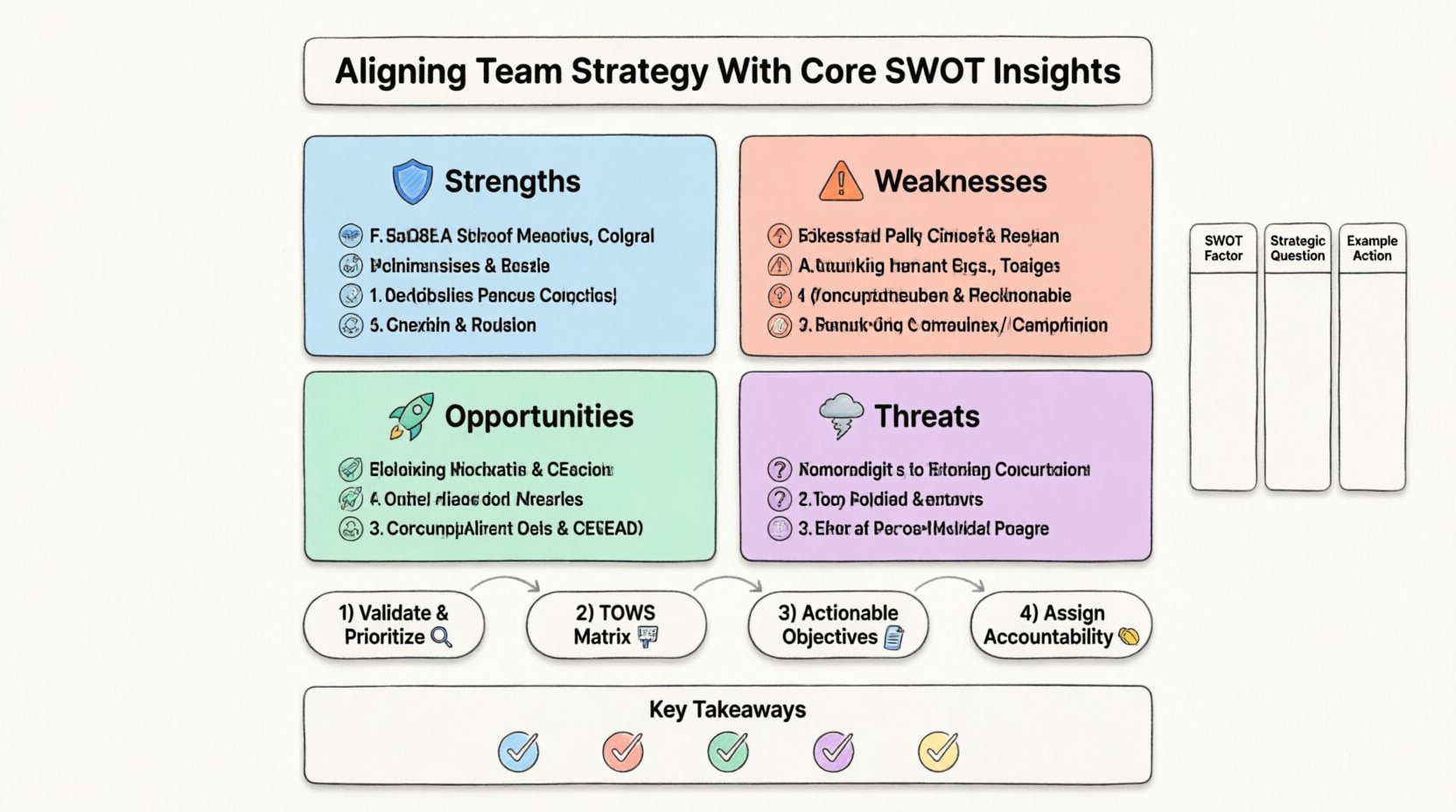
A SWOT analysis is more than a checklist; it is a diagnostic tool that reveals the internal and external forces shaping an organization’s trajectory. When applied to team strategy, it requires a nuanced view of how individual capabilities and market realities interact. It is not enough to list a strength or a threat; the team must understand the weight and implication of each factor.
Strengths: Internal Capabilities 🛡️
Strengths represent the attributes that place the team in a favorable position. These are resources under your direct control. In a strategic alignment context, these must be leveraged aggressively. Common internal strengths include:
- Specialized Expertise: Deep knowledge in a specific domain that competitors lack.
- Operational Efficiency: Streamlined processes that reduce waste and increase output speed.
- Brand Reputation: Trust built over time that lowers customer acquisition friction.
- Agile Culture: A workforce capable of adapting quickly to new information.
Identifying these is the first step. However, aligning them requires ensuring that every strategic objective explicitly utilizes one or more of these strengths. If a strategy does not capitalize on a known strength, it represents a wasted asset.
Weaknesses: Internal Limitations ⚠️
Weaknesses are characteristics that place the team at a disadvantage relative to others. These are also internal and controllable, though often harder to change. Honest assessment is required here. Common internal weaknesses include:
- Resource Constraints: Limited budget, manpower, or technology.
- Process Bottlenecks: Areas where work slows down due to outdated systems.
- Skill Gaps: Missing competencies needed for future growth.
- Communication Silos: Departments or teams operating without shared information.
Addressing weaknesses in strategy is about mitigation. The goal is not always to eliminate them immediately, but to ensure they do not derail the core mission. For example, if a skill gap exists, the strategy might involve hiring, training, or outsourcing specific tasks.
Opportunities: External Potential 🚀
Opportunities are external chances to improve performance or gain an advantage. These exist in the market environment and are often time-sensitive. Key external opportunities include:
- Market Expansion: Entering new geographic regions or demographic segments.
- Technological Shifts: Adopting new tools that enhance productivity.
- Competitor Instability: Rivals facing disruptions that create a vacuum.
- Regulatory Changes: New laws that favor your existing business model.
Strategy alignment here means prioritizing initiatives that capture these opportunities before they fade. A strategy that ignores a clear market shift is a strategy waiting to fail.
Threats: External Risks 🌪️
Threats are external elements that could cause trouble for the business. These are often harder to control and require defensive planning. Common external threats include:
- Economic Downturns: Reduced spending power among customers.
- New Competitors: Entrants with disruptive business models.
- Supply Chain Disruptions: Dependence on unstable vendors.
- Policy Shifts: Changes in compliance requirements that increase costs.
Strategic alignment for threats focuses on resilience. It involves building buffers and contingency plans so that when external pressures mount, the team can maintain stability.
The Gap Between Analysis and Execution 📉
Many teams complete a SWOT analysis and file the document away. This is a critical failure point. The analysis is merely the starting line. The real work begins when the insights are translated into actionable goals. The gap usually occurs for three reasons:
- Lack of Ownership: No one is assigned to act on specific findings.
- Resource Mismatch: The strategy demands more than the team possesses.
- Poor Communication: The team does not understand how the SWOT factors influence daily tasks.
To close this gap, leadership must ensure that every strategic pillar is traceable back to a specific SWOT insight. This creates a logical chain of reasoning that justifies why certain initiatives are funded and others are not.
Steps to Align Strategy with SWOT Insights 🎯
Aligning strategy requires a structured approach. It is not a one-time meeting but an iterative process. The following steps provide a framework for integrating these insights into the operational workflow.
1. Validate and Prioritize Findings 🔍
Not all insights carry equal weight. A minor weakness in a non-critical area is less important than a major threat to core revenue. Teams should rate each SWOT factor based on impact and urgency. This prioritization ensures that the strategy focuses on the most significant drivers of success.
2. Develop TOWS Strategies
Once factors are identified and prioritized, move to the TOWS matrix. This involves cross-referencing the internal and external factors to generate specific strategic options. This is where the real planning happens.
- SO Strategies: Use Strengths to maximize Opportunities.
- WO Strategies: Overcome Weaknesses by taking advantage of Opportunities.
- ST Strategies: Use Strengths to avoid Threats.
- WT Strategies: Minimize Weaknesses and avoid Threats.
3. Translate into Actionable Objectives 📝
Abstract insights must become concrete objectives. For instance, if a Strength is “fast development speed” and an Opportunity is “market demand for quick launches,” the objective becomes “Reduce launch cycle time by 20% in Q3.” This specificity allows the team to track progress.
4. Assign Accountability and Resources 🤝
Every objective needs an owner. Assigning responsibility ensures that the insights are not just theoretical. Resources must be allocated to match the priority of the strategy. If a weakness requires a new tool, the budget must reflect that need.
Mapping Insights to Strategic Actions 📋
Visualizing the relationship between insights and actions helps teams maintain focus. The table below illustrates how specific SWOT elements translate into strategic directives.
| SWOT Factor | Strategic Question | Example Action |
|---|---|---|
| Strength High Customer Retention |
How do we use this loyalty to grow? | Launch a referral program to incentivize current users. |
| Weakness Slow Customer Support Response |
How do we fix this to prevent churn? | Implement an automated ticketing system and hire two agents. |
| Opportunity New Competitor Entering Market |
How do we respond to their entry? | Highlight our unique value proposition in marketing campaigns. |
| Threat Rising Raw Material Costs |
How do we protect margins? | Negotiate long-term contracts with suppliers or adjust pricing. |
This mapping ensures that no insight is left without a corresponding plan. It forces the team to confront the implications of their data.
Common Pitfalls in Strategic Alignment 🛑
Even with a clear process, teams can stumble. Recognizing these pitfalls helps in avoiding them.
1. Analysis Paralysis
Teams sometimes spend too much time analyzing and not enough time acting. A perfect analysis is useless without execution. Set a deadline for the planning phase and move to implementation.
2. Confirmation Bias
It is easy to interpret SWOT data in a way that supports a preconceived notion. Leaders must challenge their own assumptions and encourage dissenting opinions during the assessment phase.
3. Static Planning
Markets change. A SWOT analysis done six months ago may be obsolete. Treat the analysis as a living document that is reviewed and updated regularly.
4. Ignoring Culture
You cannot impose a strategy on a team culture that resists it. If a strategy requires high agility but the culture values stability, the plan will fail. Alignment must include cultural readiness.
Measuring Success and Iteration 📈
How do you know the alignment is working? You need metrics that reflect the strategic goals derived from the SWOT. These should not be vanity metrics but indicators of progress on the specific objectives.
- Leading Indicators: Measures that predict future success, such as the number of new leads generated from a referral program.
- Lagging Indicators: Measures that show past performance, such as total revenue for the quarter.
Regular review cycles are essential. Monthly or quarterly check-ins allow the team to assess whether the actions taken are addressing the identified SWOT factors. If a weakness persists despite intervention, the strategy may need adjustment.
Building a Culture of Strategic Awareness 🧠
True alignment happens when every team member understands how their role contributes to the broader strategy. This requires transparent communication. Share the SWOT findings with the wider team, not just leadership.
When employees understand the why behind the what, engagement increases. They can see how their daily tasks mitigate threats or leverage strengths. This creates a self-correcting system where the team naturally steers towards strategic goals.
Key Takeaways for Leaders 👔
- Don’t stop at the list: Move quickly to the TOWS matrix.
- Assign ownership: Every insight needs an owner.
- Update regularly: Treat the analysis as dynamic.
- Communicate broadly: Ensure the whole team understands the context.
- Measure outcomes: Track progress against specific strategic objectives.
Final Thoughts on Execution 🏁
Aligning team strategy with core SWOT insights is a discipline that requires consistency and honesty. It is about making difficult decisions based on reality rather than hope. By rigorously applying these insights to operational planning, teams can navigate uncertainty with greater confidence. The goal is not to predict the future perfectly, but to build an organization robust enough to adapt when the future arrives.
Start by reviewing your current strategic documents. Trace every major initiative back to a specific strength, weakness, opportunity, or threat. If you cannot find that link, reconsider the initiative. This simple exercise ensures that resources are directed where they matter most. In the end, strategy is not about having the best plan; it is about having the best execution of a relevant plan.