
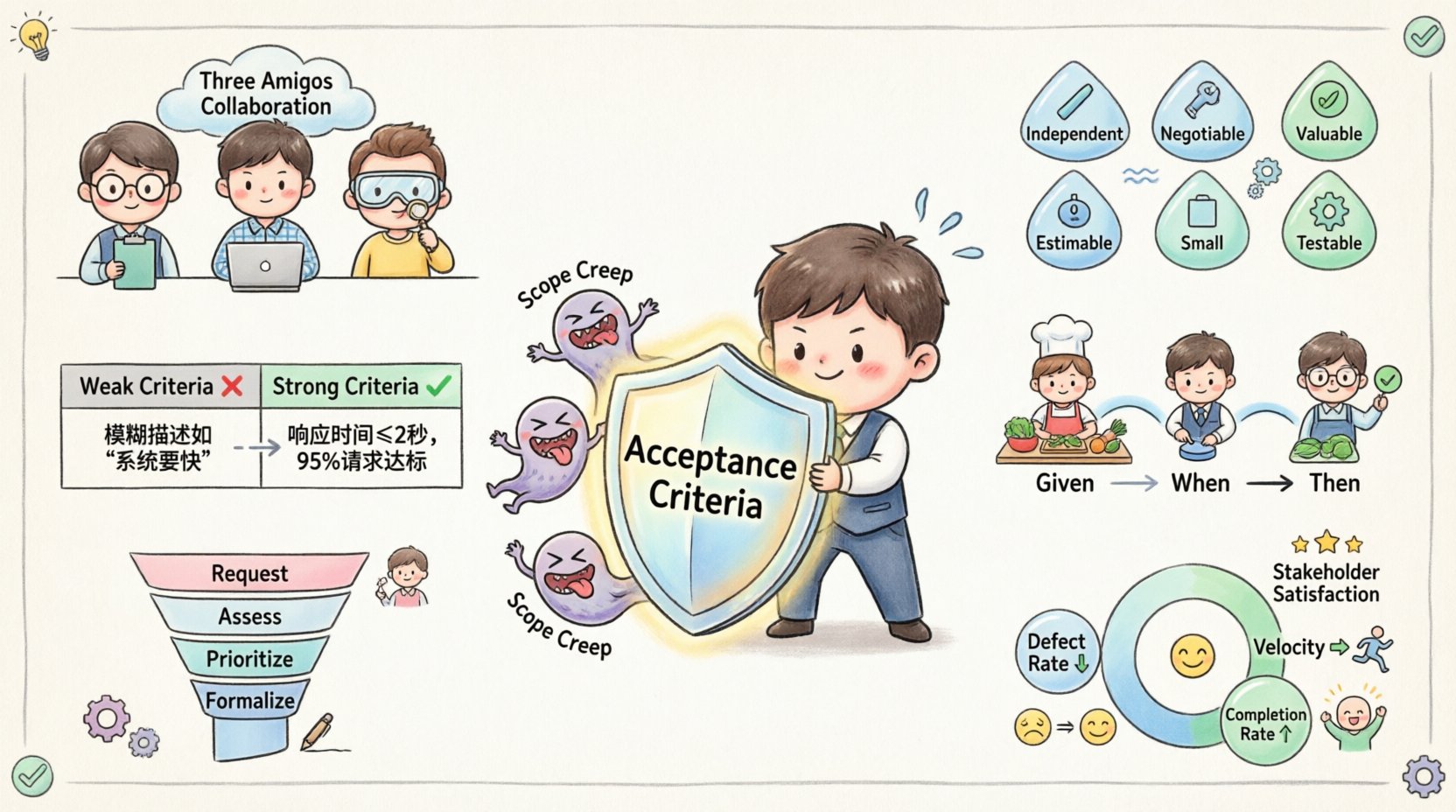
Scope creep is the silent killer of projects. It happens when requirements expand beyond the original plan without corresponding adjustments to time, budget, or resources. In the context of user stories, this often manifests as “just one more small feature” requests that accumulate over time. The defense against this phenomenon lies in the precision of acceptance criteria. These criteria are not merely testing checklists; they are the contract between stakeholders and the delivery team. When defined correctly, they create a boundary that protects the integrity of the deliverable while ensuring quality standards are met.
This article explores the mechanics of writing robust acceptance criteria. We will examine how to define clear boundaries, facilitate collaboration, and maintain focus throughout the development lifecycle. By understanding the relationship between user stories and acceptance criteria, teams can reduce ambiguity and deliver value predictably.
Understanding the Core Concepts 🧠
Before diving into the mechanics of prevention, it is necessary to define the terms clearly. A user story captures a requirement from the perspective of the user. It typically follows the format: “As a [role], I want [feature], so that [benefit].” However, a story alone is often too vague to be developed or tested effectively.
Acceptance criteria fill the gap. They are a set of statements that describe the conditions under which a user story is considered complete. These statements serve as the definition of done for that specific item. Without them, development relies on implicit understanding, which varies from person to person. Explicit criteria remove this variance.
Why Scope Creep Occurs
Scope creep does not happen by accident. It is usually the result of several underlying factors:
- Vague Requirements: When initial descriptions are open to interpretation, stakeholders assume features they did not explicitly discuss are included.
- Changing Priorities: Market conditions shift, leading to new requests that interrupt the original flow.
- Missing Boundaries: Without clear “in-scope” and “out-of-scope” definitions, everything feels like a potential addition.
- Communication Gaps: Misunderstandings between business stakeholders and technical teams create expectations that do not align with reality.
- Gold Plating: Developers adding extra features to impress, believing it adds value without stakeholder request.
Acceptance criteria act as the anchor. They force a conversation about what is actually required before work begins. This upfront investment saves significant time later when features need to be cut or reworked.
Characteristics of Effective Acceptance Criteria ✅
Not all criteria are created equal. To prevent scope creep, the criteria must be specific, measurable, and testable. Vague statements like “the system should be fast” are insufficient. They invite debate and subjective judgment.
The INVEST Model
While often applied to user stories, the INVEST principles guide the quality of criteria:
- Independent: Criteria should not rely on other stories being completed first.
- Negotiable: The details can be discussed, but the core value remains fixed.
- Valuable: The criteria must deliver value to the user or business.
- Estimable: The team must be able to size the work required to meet the criteria.
- Small: Large criteria should be broken down into smaller, manageable chunks.
- Testable: There must be a way to verify if the criteria are met.
Writing Clear Statements
Effective criteria use concrete language. They avoid adjectives that imply quality without defining it. Instead of “user-friendly,” use “the user can complete the form in under three clicks.” Instead of “robust security,” use “passwords must be encrypted using AES-256.”
Consider the following table comparing weak criteria against strong criteria. This distinction is vital for maintaining scope control.
| Aspect | Weak Criteria (Vulnerable to Creep) | Strong Criteria (Scope Controlled) |
|---|---|---|
| Specificity | “The dashboard should look good.” | “The dashboard displays four key metrics in a grid layout.” |
| Measurability | “The page should load quickly.” | “The page loads within 2 seconds on a 4G connection.” |
| Completeness | “Handle errors.” | “If the API fails, display a toast notification and retry button.” |
| Testability | “Ensure data is accurate.” | “Data must match the source database within 1% margin of error.” |
The Role of Collaboration in Definition 🤝
Writing acceptance criteria is not a solitary task performed by a single individual. It requires the involvement of the entire team. This collaborative approach ensures that technical constraints, business goals, and user needs are all represented.
The Three Amigos Technique
This practice involves three perspectives coming together to define the story:
- Business Analyst: Focuses on the user need and business value.
- Developer: Focuses on technical feasibility and implementation complexity.
- Tester: Focuses on edge cases, validation, and failure scenarios.
When these three review the acceptance criteria together, gaps are identified early. A developer might point out that a specific requirement requires a database change that impacts performance. A tester might identify that a success case was defined but no failure case was considered. This early alignment prevents scope creep by establishing boundaries before code is written.
Refinement Sessions
Refinement, or grooming, is the process of preparing user stories for future development. During these sessions, the team breaks down large stories and writes the initial acceptance criteria. This is not the time to finalize every detail, but it is the time to ensure the story is understood.
Criteria should evolve as understanding deepens. However, once a story moves to the active sprint, the criteria should be stable. Changing acceptance criteria mid-sprint is a primary driver of scope creep. If a change is necessary, it should be evaluated against the sprint goal and capacity.
Handling Change Requests Effectively 🔄
Change is inevitable. New information emerges, market conditions shift, and stakeholder needs evolve. The goal is not to prevent change entirely, but to manage it without derailing the project.
Change Control Process
When a new request arises during development, it should not be simply added to the current work. Instead, it should follow a change control process:
- Identify the Request: Clearly document what is being asked.
- Assess Impact: Determine how the request affects the current scope, timeline, and budget.
- Prioritize: Decide if the new request is more valuable than the current work.
- Formalize: If approved, update the backlog and adjust the plan.
Acceptance criteria play a role here. If a request falls outside the existing criteria, it is a new feature, not a bug fix. This distinction helps teams say “no” or “not now” with confidence. It shifts the conversation from “why can’t we do this?” to “where does this fit in the priority list?”
Testing and Verification Alignment 🧪
Acceptance criteria are the bridge between requirements and testing. Every criterion should map to a test case. If a criterion cannot be tested, it is not a valid criterion.
Behavior Driven Development (BDD)
Many teams use the Given-When-Then syntax to write criteria. This format promotes clarity and aligns with testing strategies.
- Given: The initial context or state.
- When: The action or event that occurs.
- Then: The expected outcome or result.
Example:
Given the user is on the checkout page,
When they click the submit button without entering a shipping address,
Then the system displays an error message highlighting the missing field.
This format ensures that the criteria are actionable. It also prevents scope creep by forcing the team to define exactly what “success” looks like. If the error message is different, the criterion is not met. There is no room for “it looks close enough.”
Common Pitfalls to Avoid ❌
Even with the best intentions, teams can write poor criteria. Recognizing these pitfalls helps in maintaining strict scope control.
- Implementation Details: Criteria should describe what the system does, not how it does it. Specifying database tables or API endpoints in criteria locks the team into a specific design that might need to change.
- Assumed Functionality: Do not assume the user knows the system. Explicitly state all interactions.
- Missing Edge Cases: Focus only on the happy path. Creep often hides in the exceptions. What happens if the network fails? What if the input is too long?
- Over-Engineering: Do not write criteria for features that are not needed now. Future-proofing is not the same as scope control.
- Ignoring Non-Functional Requirements: Performance, security, and accessibility must be included as criteria. They are often the first things cut when time is short.
Metrics for Success 📈
How do you know if your acceptance criteria are working? Track specific metrics to gauge effectiveness.
- Defect Rate: A lower defect rate in production suggests criteria were clear and comprehensive.
- Change Request Frequency: A decrease in mid-sprint changes indicates better initial planning.
- Story Completion Rate: Higher completion rates suggest that stories were well-defined before work began.
- Team Velocity: Consistent velocity implies that scope is stable and predictable.
Regularly reviewing these metrics helps the team adjust their approach. If defect rates rise, the team may need to spend more time refining criteria. If change requests increase, the team may need to enforce stricter change control.
Final Considerations for Long-Term Stability 🏁
Maintaining scope control is a continuous process. It requires discipline from stakeholders and the development team. The acceptance criteria document is a living artifact that should be referenced throughout the project.
When a story is completed, the criteria should be reviewed to ensure they matched the final output. If they did not, the discrepancy must be understood. Was the requirement unclear? Was the implementation wrong? This feedback loop improves the quality of future criteria.
Teams should also consider the definition of done. This is a broader set of criteria that applies to every story in the sprint. It includes code review, testing, documentation, and deployment readiness. Acceptance criteria are specific to the story; the definition of done ensures the quality of the entire release.
By investing time in writing precise acceptance criteria, teams protect their time and resources. They ensure that the work delivered matches the value promised. This alignment builds trust with stakeholders and creates a sustainable pace for development.
Scope creep is a natural risk in any project. However, it is not an inevitability. With clear boundaries, collaborative definition, and rigorous testing, teams can navigate changes without losing control. The acceptance criteria are the tool that makes this possible. They turn vague desires into concrete deliverables, ensuring that the project remains on track and on budget.