Customer journey mapping is more than just drawing a line from point A to point B. It is a strategic exercise that reveals the intricate web of interactions a user has with your organization. By visualizing the end-to-end experience, teams can identify friction, uncover opportunities, and align around a shared vision of customer success. This process requires discipline, empathy, and data. It demands that we step out of our internal biases and view the product or service through the eyes of the person using it.
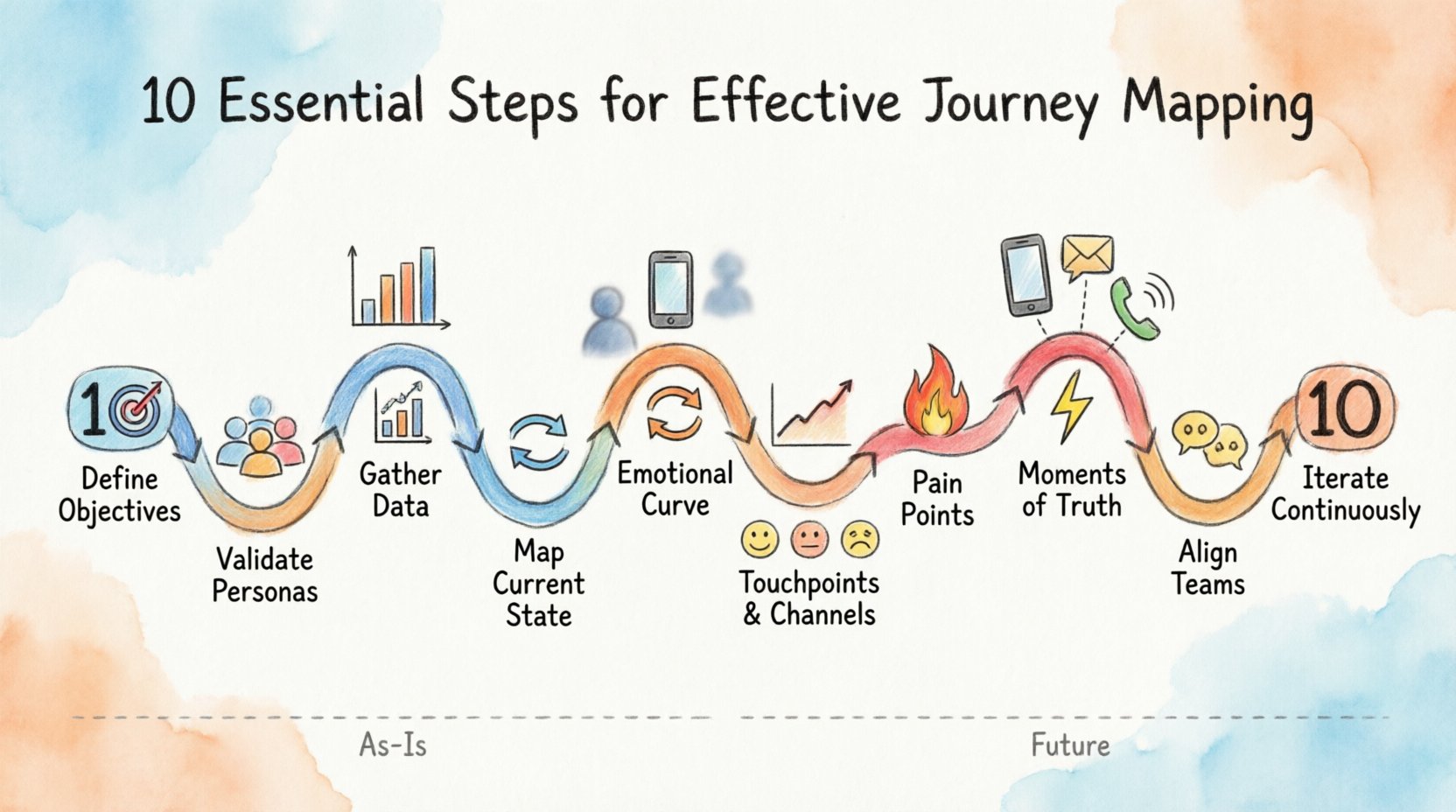
Without a clear map, teams often optimize for efficiency rather than experience. They might streamline a backend process that confuses a user. They might launch a feature that solves a problem nobody actually has. Journey mapping bridges this gap. It ensures that every decision is grounded in the reality of the user’s life. Below, we outline the ten essential steps to create a robust, actionable, and insightful journey map.
1. Define Clear Objectives 🎯
Before sketching a single touchpoint, you must establish what this map is meant to achieve. A journey map is not a one-size-fits-all document. It is a tool designed to solve specific problems or answer specific questions. Is the goal to reduce churn? Is it to improve onboarding? Is it to optimize the support experience? Without a defined scope, the project can become bloated and lose focus.
- Scope the specific journey: Are you looking at the entire lifecycle or just a single transaction?
- Identify the stakeholders: Who needs to see this map? Who needs to act on it?
- Set success criteria: How will you know the mapping exercise was valuable?
When objectives are vague, the resulting map often becomes a decorative artifact that gathers dust. Clear goals ensure that the output drives tangible business decisions and resource allocation.
2. Identify and Validate Personas 👥
A journey map is meaningless without a defined user. You cannot map a journey for “everyone.” You must define who is taking the journey. This requires creating detailed personas based on research, not assumptions. A persona represents a segment of your audience with shared characteristics, goals, and behaviors.
- Use real data: Base personas on interview transcripts, survey results, and behavioral analytics.
- Avoid stereotypes: Ensure your personas reflect the complexity of real human beings.
- Multiple journeys: Different personas may have vastly different experiences with the same product.
If you map a journey for a persona that does not accurately represent your user base, your insights will be flawed. Validation is key. Share these personas with customer-facing teams to ensure they resonate with daily interactions.
3. Gather Qualitative and Quantitative Data 📊
Data drives the accuracy of your map. Relying solely on intuition leads to gaps. You need a mix of hard numbers and soft stories. Quantitative data shows you what is happening, while qualitative data explains why it is happening.
Quantitative Sources:
- Web analytics (bounce rates, time on page)
- Transaction logs
- Support ticket volumes
Qualitative Sources:
- Customer interviews
- Usability testing sessions
- Feedback forms and open-ended surveys
Combining these data sets provides a holistic view. For instance, analytics might show a drop-off at a specific step, but interviews might reveal that users are confused by the language used on that screen.
4. Map the Current State (As-Is) 🔄
Start by documenting the journey exactly as it exists today. This is the “As-Is” state. It is crucial not to edit or improve anything at this stage. You must capture the reality, including the broken parts. This honest assessment prevents the common mistake of mapping the ideal journey rather than the actual one.
- Chronological order: List steps in the order they occur.
- Include off-channel touchpoints: Real life happens outside your app or website. Consider phone calls, emails, or in-person meetings.
- Document emotions: Note how the user feels at each stage (frustrated, relieved, anxious).
This baseline serves as your reference point. You cannot measure improvement if you do not know the starting position.
5. Identify All Touchpoints and Channels 📱
A journey is composed of numerous touchpoints across various channels. Users rarely interact with a single platform. They might see an ad on social media, research on a blog, call support, and finally purchase via a web form. Each of these interactions is a touchpoint that contributes to the overall experience.
Ensure you capture:
- Digital: Mobile apps, websites, emails, chatbots.
- Physical: Retail stores, packaging, hardware devices.
- Human: Sales calls, support agents, account managers.
Mapping these channels helps identify fragmentation. Often, a customer feels a disconnect when moving from one channel to another. Your map should highlight where these handoffs occur and where they succeed or fail.
6. Visualize the Emotional Curve 📈
A line on a map is not enough. The emotional journey is often more important than the functional journey. Users do not care about the process; they care about how the process makes them feel. Plotting the emotional curve helps teams empathize with the user’s highs and lows.
- Highs: Moments of delight, ease, or success.
- Lows: Moments of frustration, confusion, or delay.
- Valleys: The deepest points of frustration require immediate attention.
This visualization often sparks empathy in stakeholders who are removed from the day-to-day user interactions. Seeing a steep drop in satisfaction can be a powerful motivator for change.
7. Pinpoint Pain Points and Friction 🔥
Once the map is drawn, analyze it for friction. Friction is anything that slows the user down or causes them to abandon the process. These are the barriers between the user and their goal. Identifying them is the primary value of the mapping exercise.
Common friction points include:
- Complicated forms with too many fields
- Unclear navigation or terminology
- Long wait times for support
- Inconsistent information across channels
- Lack of transparency regarding pricing or status
For each pain point, ask “why” repeatedly. Is it a technical limitation? A process gap? A lack of training? Understanding the root cause ensures you fix the right problem.
8. Highlight Moments of Truth ⚡
Not all interactions are equal. Some moments define the relationship between the customer and the brand. These are “Moments of Truth.” A positive moment can build loyalty, while a negative one can destroy it. Identify the critical interactions that carry the most weight.
Examples include:
- The first login experience
- The moment a product is delivered
- The resolution of a billing error
- The first time a new feature is used
Focus your resources on optimizing these high-impact moments. Improving a minor step may save time, but optimizing a Moment of Truth can change the trajectory of the customer relationship.
9. Align Stakeholders and Cross-Functional Teams 🤝
A journey map is rarely the work of a single department. It involves marketing, sales, product, support, and engineering. Siloed work leads to disjointed experiences. The mapping process should be a collaborative workshop where representatives from all teams contribute.
- Invite diverse perspectives: Support sees different issues than Product does.
- Build shared ownership: When teams help build the map, they are more likely to act on it.
- Document decisions: Record agreements on how to address identified gaps.
This alignment prevents the “throw it over the wall” mentality. It ensures that everyone understands their role in the customer experience.
10. Iterate and Monitor Continuously 🔄
A journey map is a living document, not a static poster. Customer behaviors, market conditions, and internal processes change. The map created today may be obsolete in six months. Establish a routine for reviewing and updating the map.
- Set review cycles: Schedule quarterly or biannual reviews.
- Track changes: Log updates when features are launched or processes change.
- Measure impact: Did the changes made based on the map improve the metrics?
Continuous iteration ensures the map remains relevant and useful. It transforms the map from a one-time project into an ongoing strategic asset.
Common Pitfalls in Journey Mapping ⚠️
Even with a solid process, teams often stumble into common traps. Understanding these pitfalls helps you avoid them and maintain the integrity of your mapping efforts.
| Pitfall | Consequence | Corrective Action |
|---|---|---|
| Mapping for the internal team | Focuses on backend processes rather than user needs. | Center every step on the persona’s goal. |
| Ignoring the “off-screen” experience | Misses critical context like unboxing or support calls. | Include all physical and human touchpoints. |
| Assuming one journey fits all | Overlooks segment-specific behaviors and needs. | Create separate maps for key personas. |
| Creating a map and filing it away | No action is taken to improve the experience. | Link map insights directly to product roadmaps. |
| Using outdated data | Maps reflect past behaviors, not current reality. | Validate data sources regularly. |
Measuring Success and Impact 📏
How do you know if your journey mapping is working? You need to tie the insights back to business metrics. The map should inform the metrics you track. Common metrics include:
- Net Promoter Score (NPS): Measures overall loyalty and satisfaction.
- Customer Effort Score (CES): Measures how easy it is for users to complete tasks.
- Churn Rate: Tracks how many customers leave the service.
- Conversion Rate: Measures the effectiveness of specific touchpoints.
- Support Ticket Volume: Indicates where confusion or failure occurs.
By monitoring these metrics alongside the journey map, you can validate whether the identified improvements are delivering value. If a pain point was addressed but the metric did not move, the root cause analysis may need to be revisited.
Integrating Mapping into Operations 🏗️
For journey mapping to have a lasting impact, it must be integrated into daily operations. It should influence design sprints, product backlogs, and marketing campaigns. When a new feature is proposed, ask: “How does this fit into the current journey map? Does it reduce friction or add it?”
This integration ensures that the customer experience is not an afterthought. It becomes a core component of decision-making. Teams stop asking “Can we build this?” and start asking “Should we build this, and how will it affect the user?”.
The Human Element in Design 🧠
Technology changes, but human psychology remains relatively constant. People seek clarity, efficiency, and respect. A journey map reminds us that behind every data point is a person with a life, a job, and a set of expectations. It grounds the work in empathy.
When teams are immersed in the map, they become more attentive to the human impact of their work. They start to notice the small details that matter—the tone of an email, the speed of a loading screen, the clarity of a notification. These details compound over time to define the brand perception.
Final Thoughts on Execution 🚀
Executing a journey mapping initiative requires patience and commitment. It is not a quick fix. It is a discipline that builds organizational empathy. By following these ten steps, you create a foundation for a customer-centric culture. You move from guessing what users want to knowing what they need.
The journey map is a compass. It does not drive the car, but it ensures you are heading in the right direction. Use it to navigate complex challenges and align your team around a shared vision of quality and service. When the map is accurate, the actions taken are effective, and the customer experience improves measurably.